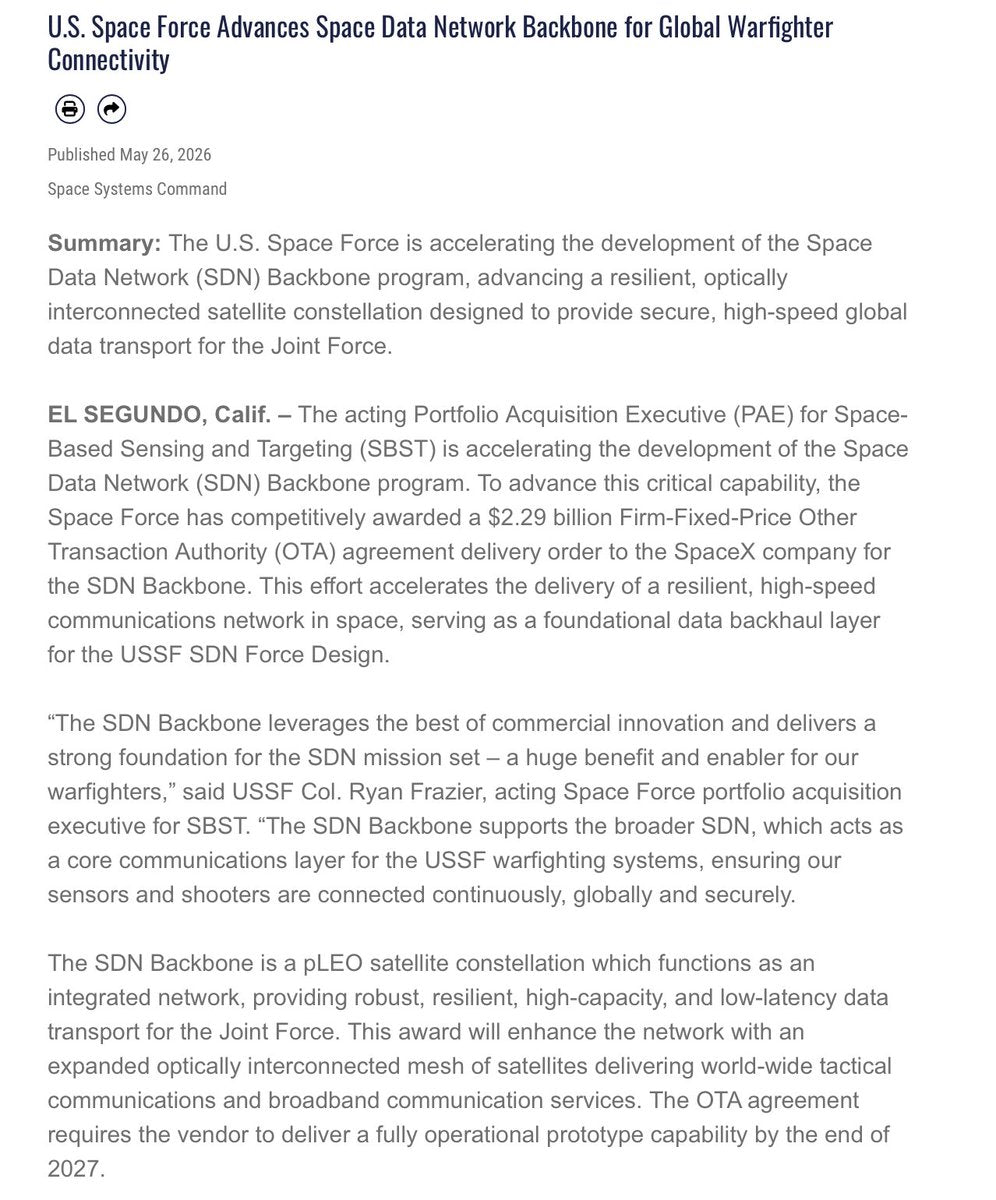
The U.S. Space Force has awarded SpaceX a $2.29 billion contract to build what the Pentagon is calling the Space Data Network (SDN) Backbone — a next-generation military satellite communications system built on the Starshield platform. The award, confirmed on May 26, 2026, represents one of the largest single defense contracts SpaceX has secured to date and signals a major expansion of low Earth orbit infrastructure for U.S. military operations.

What the SDN Backbone Actually Is
The contract is structured as a Firm-Fixed-Price Other Transaction Authority (OTA) agreement — a procurement mechanism the Pentagon increasingly uses to move faster than traditional acquisition channels allow. The SDN Backbone is designed as a proliferated low Earth orbit (pLEO) satellite constellation, meaning it won't rely on a handful of high-value satellites but rather a dense mesh of interconnected nodes that are individually cheaper and collectively harder to degrade or destroy.
According to the Space Force, the network will deliver robust, resilient, high-capacity, and low-latency data transport for the Joint Force. The architecture features an optically interconnected mesh — satellites communicating via laser links rather than radio frequency alone — enabling worldwide tactical communications and broadband services without the vulnerabilities of ground-based relay infrastructure.
The SDN Backbone won't operate in isolation. It's designed to work alongside the Space Development Agency's existing Transport Layer, forming what the Pentagon describes as a unified, open architecture for critical Department of Defense data transport. In practice, that means Starshield becomes the backbone through which the SDA's constellation routes its most sensitive traffic.
Timeline and Deliverables
| Milestone | Detail |
|---|---|
| Contract Value | $2.29 billion (Firm-Fixed-Price OTA) |
| Contract Type | Other Transaction Authority delivery order |
| Orbit | Proliferated Low Earth Orbit (pLEO) |
| Prototype Deadline | Fully operational prototype by end of 2027 |
| Integration Partner | Space Development Agency Transport Layer |
SpaceX is required to deliver a fully operational prototype capability by the end of 2027 — an aggressive timeline that would be difficult for most aerospace primes to meet but fits comfortably within SpaceX's demonstrated cadence of satellite manufacturing and launch. The company has already placed thousands of Starlink satellites in LEO and maintains its own launch infrastructure, giving it a structural advantage over competitors who would need to contract launches separately.
Why Starshield, and Why Now
Starshield is SpaceX's government-focused satellite platform, distinct from the commercial Starlink service in its security architecture and intended customer base. While Starlink provides broadband to consumers and businesses, Starshield is purpose-built for classified government and military applications — including end-to-end encryption, hardened ground terminals, and the ability to host government-owned payloads directly on the satellites.
The timing of this award reflects a broader Pentagon shift toward commercial space infrastructure as a force multiplier. Traditional geostationary military satellites are expensive, slow to build, and represent high-value targets. A pLEO mesh like the SDN Backbone is inherently more survivable — losing a few nodes doesn't degrade the network the way a single GEO satellite failure would. For the Space Force, which was stood up specifically to address growing threats in the space domain, that resilience is the point.
The $2.29 billion figure also reflects the scale of what's being built. This isn't a study contract or a technology demonstration — it's a delivery order for operational military infrastructure, with a fixed price that puts execution risk squarely on SpaceX rather than the government.
Whether the 2027 prototype deadline holds will be the first real test of this contract's ambitions. SpaceX has rarely missed a launch cadence target, but integrating a classified military communications layer into an existing constellation at this scale is a different kind of challenge than adding more Starlink satellites to an already-proven stack. The Space Force is betting $2.29 billion that SpaceX can pull it off on schedule. For more on SpaceX's expanding role in government programs, see our SpaceX coverage.

Sarah focuses on Tesla Energy, SpaceX missions, and the broader Musk AI portfolio. Former data analyst in clean energy. Based in San Francisco.
Sources verified at publish time. Spotted an inaccuracy? Email editorial@basenor.com.