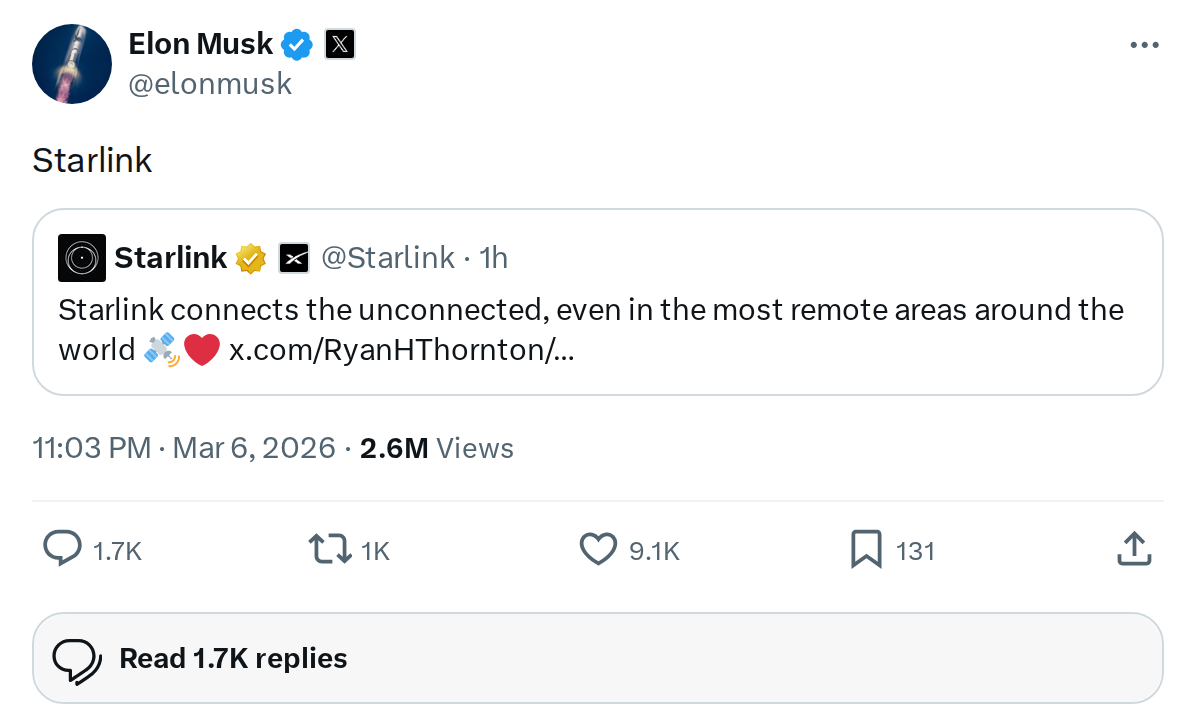
The News: Elon Musk posted a direct link to Starlink, drawing attention to a wave of major updates across the satellite internet service — including a brand rebrand, next-gen satellites, new aviation pricing, and a residential promo deal.
Why It Matters: Starlink is expanding aggressively in 2026, and whether you use it at home, in the air, or rely on it via your carrier, something in this update likely affects you.
Source: @elonmusk on X

📊 Key Figures
| Metric | Value | Context |
|---|---|---|
| Active Starlink Mobile users | ~10M/month | Projected 25M+ by end of 2026 |
| Direct-to-cell satellites in orbit | 650 | V2 constellation targets ~1,200 |
| Total Starlink satellites in orbit | ~10,000 | 83 launched in last 5 days alone |
| V2 satellite link performance gain | 20× | vs. first-gen satellites |
| V2 user download speed | Up to 150 Mb/s | 100× data density improvement |
| V2 launch target | Mid-2027 | Via Starship; 1,200 sats in 6 months |
| Residential promo price | $39/mo | 100 Mbps plan, valid through Mar 31 |
| Aviation 300MPH plan | $250/mo | New; 20 GB data cap |
What's Actually Changing at Starlink Right Now
Direct to Cell Is Now Starlink Mobile
SpaceX has officially rebranded its direct-to-phone satellite service as Starlink Mobile. This isn't just a name change — it signals a commercial maturity push. The service currently reaches roughly 10 million active users per month through partner carriers, and SpaceX is targeting more than 25 million by the end of 2026, according to verified reports.
The rebrand aligns with how SpaceX is positioning the product: not as a replacement for your carrier's network, but as a seamless coverage layer that kicks in when you're out of range of any cell tower. Think of it as a global safety net built into your existing phone plan — no new hardware required.
V2 Satellites Are a Generational Leap — Coming Mid-2027
The next-generation Starlink Mobile (V2) system is confirmed for a mid-2027 debut. These satellites will be launched via Starship, with SpaceX aiming to deploy approximately 1,200 of them within just six months to achieve global continuous coverage.
The performance numbers are significant. According to technical specifications, V2 satellites will deliver:
- 20× greater link performance than first-generation satellites
- User speeds of up to 150 Mb/s
- 100× the data density of current satellites
- A phased-array antenna 5× larger and 4× the bandwidth per beam
For context: the current constellation is approaching 10,000 total satellites. SpaceX launched 54 on March 1 and another 29 on March 4 — the pace of deployment is relentless.
Aviation Pricing Gets Restructured
If you use Starlink on a private or commercial aircraft, the pricing model has changed. The Roam and Priority plans are now capped at a maximum supported in-motion speed of 100 mph (87 knots) — meaning they're no longer suitable for most aviation use cases.
Two new aviation-specific plans replace them:
- Aviation 300MPH — $250/month, 20 GB data cap
- Aviation 450MPH — $1,000/month, 20 GB data cap
Both plans are designed for aircraft operating at higher speeds where the standard Roam plan's speed ceiling is a technical limitation. If you're a pilot or operate in aviation, this is an immediate action item — check your current plan against the new speed caps before your next flight.
$39/Month Residential Deal — Expires March 31
There's a time-sensitive offer on the table for residential customers. Starlink is offering its 100 Mbps broadband plan for $39/month for six months — down from the standard $50/month. That's an $11 monthly discount, or $66 in total savings over the promotional period.
The offer expires March 31, 2026. If you've been on the fence about Starlink for home use, this is the lowest entry price currently available.
Deutsche Telekom Partnership Extends Starlink Mobile to Europe
Deutsche Telekom has signed on to bring Starlink Mobile service to 10 European countries, with launch expected in 2028 using V2 next-generation technology. This is the first major European carrier partnership of this scale and signals that Starlink Mobile is moving from a US-centric product to a genuinely global one.
🔭 The BASENOR Take
| Timeline | Residential promo ends Mar 31, 2026 · V2 satellites mid-2027 · Deutsche Telekom launch 2028 |
| Impact Level | 🟠 High — affects residential users, aviation customers, and mobile subscribers globally |
| Confidence | 🟢 High — figures sourced from verified industry reports and official announcements |
📰 Deep Dive
Elon Musk's single-word post — "Starlink" — with a link is a deliberate signal. When the CEO of SpaceX drops a pointed reference to his satellite internet business, it's worth paying attention to what's actually happening across the product. And right now, a lot is happening simultaneously.
The rebranding from "Direct to Cell" to "Starlink Mobile" is strategically important. The old name described a technology. The new name describes a product category. That shift matters for carrier partnerships — it's much easier to sell "Starlink Mobile" to a Deutsche Telekom or a T-Mobile than to explain what "direct-to-cell" means to consumers. The 25 million active user projection for end of 2026 — up from 10 million today — is aggressive, but the carrier partnership model means SpaceX doesn't need to acquire those users individually. They come bundled through existing carrier relationships.
The V2 satellite architecture is where the real long-term story lives. A 20× improvement in link performance isn't incremental — it's the kind of leap that makes entirely new use cases viable. At 150 Mb/s per user and 100× data density, V2 transforms Starlink Mobile from a "better than nothing" fallback into a genuinely competitive data connection. The Starship dependency is the key variable: if Starship achieves the launch cadence needed to put 1,200 satellites in orbit within six months of mid-2027, SpaceX will have built global continuous satellite mobile coverage faster than any competitor could realistically respond to. For more on SpaceX's broader trajectory, see our SpaceX coverage.
The aviation pricing restructure is the most immediate practical change for a specific user segment. Capping Roam and Priority plans at 87 knots effectively forces any serious aviation user into the new dedicated plans. At $250–$1,000/month, these aren't consumer products — they're professional tools priced accordingly. The 20 GB data cap on both tiers is worth watching; for long-haul commercial operations, that ceiling could become a friction point. The residential $39 promo, meanwhile, is the kind of offer that converts fence-sitters. Six months at a meaningful discount, no long-term commitment implied — it's a customer acquisition play ahead of what will likely be a busy 2026 for Starlink's residential business.