📌 UPDATE — July 15, 2026
Dutch semiconductor equipment giant ASML has confirmed that its 2027–2028 capacity expansion plans are explicitly factoring in anticipated demand from Tesla's Terafab facility in Texas. This marks the first time a major upstream equipment supplier has publicly acknowledged Terafab as a named demand driver in its forward planning — a significant signal that the project's production timeline is being taken seriously at the supply-chain level. ASML's lithography machines are critical to advanced chip manufacturing, meaning their capacity commitments suggest Terafab is targeting cutting-edge process nodes. The disclosure adds meaningful third-party validation to Tesla's ambitions to produce its own AI chips at scale.

📌 UPDATE — July 15, 2026
Terafab's scale is now rippling through global chip supply chains. ASML — the world's leading semiconductor equipment manufacturer — confirmed today that its capacity expansion plans for 2027 and 2028 are being shaped in part by anticipated demand from Elon Musk's Terafab facility in Texas. This is a significant signal: ASML doesn't expand capacity speculatively, meaning Terafab's procurement timelines are serious enough to move one of the most constrained suppliers in the entire chip industry. The disclosure came during ASML's capacity briefing and was first flagged by @SawyerMerritt.

📌 UPDATE — July 10, 2026
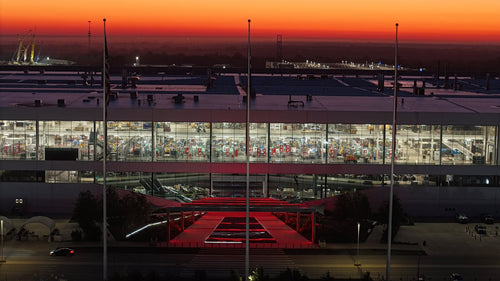
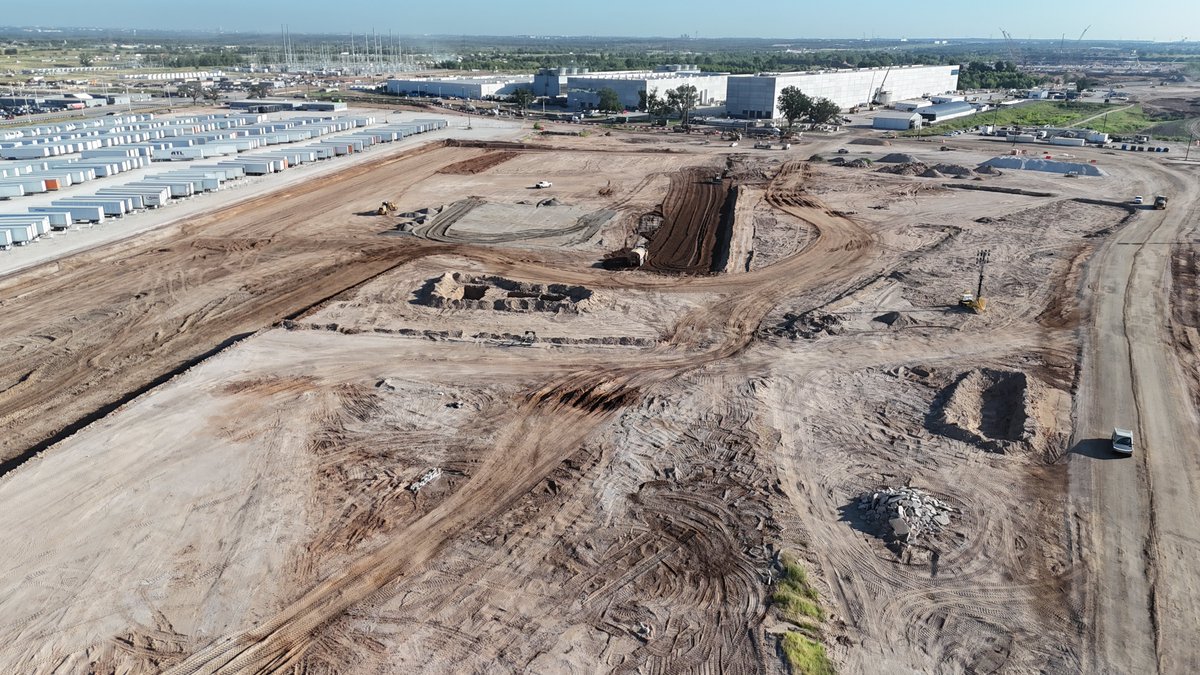
Fresh drone footage from Giga Texas (July 10) confirms construction is actively accelerating on two distinct sites simultaneously: the east-side Advanced Chip Fab and a northern Optimus factory site — both progressing even on a non-production day. Drone operator Joe Tegtmeyer also spotted additional clearing, excavation, and workshop setup activity in the far northeast corner of the battery cathode plant, signaling that expansion is spreading across multiple zones of the Austin campus at once. This is the first visual confirmation that the Optimus factory footprint is being established as a separate, named construction zone alongside Terafab. 🔍

Ground grading and foundation excavation are now visibly underway at Giga Texas for Terafab — the joint chip fabrication facility being built by Tesla, SpaceX, and xAI. Drone footage captured this week offers what may be the first real sense of the building's footprint, and the scale is significant. Here's what we know about the project so far.

1. The Official Name Is Terafab — and It Involves Three Companies
This isn't just a Tesla project. Terafab is a joint venture between Tesla, SpaceX, and xAI, following SpaceX's acquisition of xAI in an all-stock deal. Elon Musk officially launched the project on March 21, 2026. The consolidation of three of Musk's most chip-hungry enterprises under one fabrication roof is the core strategic logic here — each company is competing for semiconductor supply that the broader market simply cannot deliver fast enough.
2. The Location Is Giga Texas North Campus — With a Second Site Planned
The facility currently breaking ground sits on the North Campus of Giga Texas in Austin, Texas, adjacent to the new Optimus humanoid robot factory site. That's not the only location in play: a larger, more extensive Terafab installation is also proposed for Grimes County, Texas, near the Gibbons Creek Reservoir. A public hearing for a property tax abatement agreement related to that Grimes County site was scheduled for June 3, 2026, suggesting both sites are advancing in parallel.
3. The Investment Numbers Are Staggering
The initial cost estimate for Terafab sits at $20–25 billion. SpaceX has indicated plans to initially spend $55 billion on the project, with a potential ceiling of $119 billion if all additional phases are constructed. Tesla's CFO has acknowledged that the full Terafab cost is not yet incorporated into Tesla's already-record capital expenditure plan for 2026 — meaning the financial commitment could grow considerably from what's currently priced into Tesla's balance sheet.
4. The Target Technology Is 2-Nanometer Chips at Massive Scale
Terafab is designed to produce semiconductors using 2-nanometer process technology — among the most advanced nodes in production anywhere in the world. The production targets are equally ambitious: an initial output of 100,000 wafer starts per month, scaling to 1 million wafer starts per month at full capacity. That translates to between 100 and 200 billion custom AI and memory chips annually, and a stated goal of generating 1 terawatt of computing power per year.
5. The Chips Power Tesla's Most Critical Programs
For Tesla owners, the downstream impact is direct. Terafab chips are intended to power Full Self-Driving (FSD), the Cybercab robotaxi program, and Optimus humanoid robots. On the SpaceX side, the same facility will supply chips for orbital compute systems and AI data centers in space. Musk has been explicit about why in-house fabrication is necessary: current semiconductor manufacturers cannot expand fast enough to meet the combined demand across these programs, and existing global chip output represents only a fraction of what is required.
6. Terafab Will Actually Be Two Separate Fabs
One detail worth noting: Musk has clarified that Terafab will technically be two fabs, not one. One will focus on chips for cars and humanoid robots; the other will supply artificial intelligence centers in space. That distinction matters for understanding the construction timeline — what's taking shape at Giga Texas North Campus is one half of a larger, two-facility architecture. The adjacent Optimus factory is targeting high-volume output starting in Summer 2027, which gives a rough reference point for when the broader North Campus buildout needs to be operational.
Construction progress is still in early stages — ground grading and foundation prep are the beginning of a multi-year build — but the pace of activity visible from drone footage suggests the project is moving with urgency. For Tesla owners watching FSD and Cybercab timelines, Terafab's construction schedule is now one of the most consequential infrastructure stories to follow.
🚕 Following the Robotaxi rollout? See every operating city, launch date and announced market in our Tesla Robotaxi Tracker.
Related Gear
Gear up your Tesla with tested, custom-fit BASENOR accessories — shop Tesla accessories →
🤖 Tracking Tesla's humanoid robot? See every Optimus production milestone and appearance in our Tesla Optimus Tracker.
Sources & reporting notes
The links below identify the material source records used for this report.
- @JoeTegtmeyer on X (2026-07-10T16:09:07.000Z) — Direct source
- @JoeTegtmeyer on X (2026-07-10T21:32:47.000Z) — Direct source
- @JoeTegtmeyer on X (2026-07-10T21:32:56.000Z) — Direct source
- @SawyerMerritt on X (2026-07-15T14:40:56.000Z) — Direct source
- @TeslaNewswire on X (2026-07-15T16:12:42.000Z) — Direct source
Source links are preserved as published or accessed. See our editorial standards and corrections policy.
The BASENOR Editorial Desk covers Tesla, SpaceX, and related technology, curating reporting from primary sources — official accounts, regulatory filings, and software release data. Every article passes source-record and fact-checking review before publication. About the newsroom.
This report was curated by the BASENOR Editorial Desk from the sources listed above. Read our editorial standards or email editorial@basenor.com to report an error.