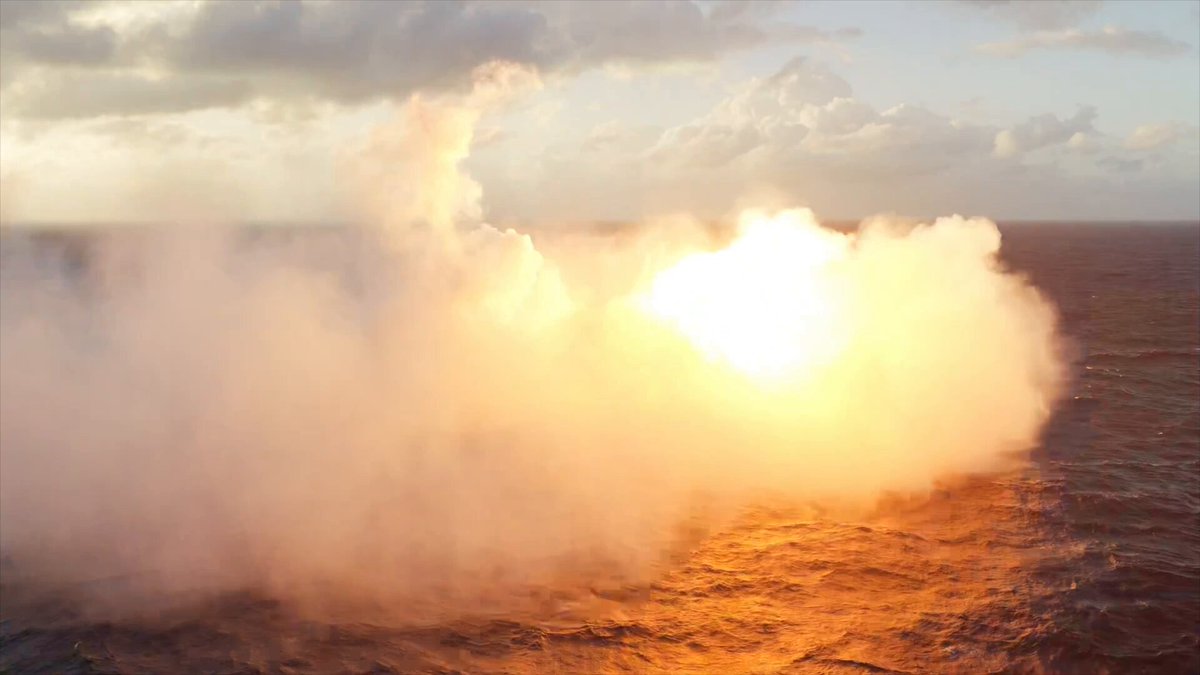
After Starship's latest ocean landing, a piece of debris — specifically a COPV, or Composite Overwrapped Pressure Vessel — broke free and slammed directly into one of SpaceX's Starlink-equipped camera buoys. The buoy kept transmitting video without interruption. It's the kind of moment that gets a laugh on social media, but it also quietly reveals something meaningful about how SpaceX has engineered its ground support infrastructure.

1. What a COPV actually is — and why it hits hard
A Composite Overwrapped Pressure Vessel is a high-pressure tank used on Starship to store gases like gaseous nitrogen. The vessels are built from carbon fiber wound around a metal liner, making them both lightweight and extremely strong. When Starship's structure breaks apart on ocean impact, these tanks can be ejected at significant velocity. A COPV striking a floating buoy isn't a gentle nudge — it's a dense, pressurized projectile launched by an exploding rocket. The fact that the buoy survived the hit with its connection intact is the story here.
2. The buoys are purpose-built for exactly this environment
According to background research, SpaceX's ocean buoys are described as compact, water-resistant units featuring gyroscopically stabilized cameras paired with standard Starlink Mini terminals. They're deployed in the Indian Ocean landing zone ahead of each mission to provide close-up live footage of Starship's terminal descent and splashdown. These aren't consumer-grade setups bolted to a float — they're engineered to survive the chaotic conditions of a rocket splashdown, including wave action, steam plumes, and apparently, flying debris.
3. Starlink Mini is doing the heavy lifting out there
The terminal keeping that video stream alive is a Starlink Mini — the compact, portable form factor SpaceX developed for mobility use cases. Sitting on a buoy in the middle of the Indian Ocean, miles from any infrastructure, it maintained a stable enough uplink to stream high-definition video through a direct impact event. That's a real-world stress test that no lab simulation replicates. For anyone evaluating Starlink's reliability in remote or harsh deployments, this is a data point worth noting.
4. This footage is operationally valuable, not just a spectacle
SpaceX engineers review every frame of splashdown footage to understand how Starship behaves in its final seconds — the landing burn profile, structural behavior on water contact, and the post-impact breakup sequence. The COPV strike on the buoy is itself useful data: it shows where pressure vessel components are being ejected, at what trajectory, and with what force. Continuous video through that event means the engineering team didn't lose coverage at a critical moment. The buoy's resilience directly serves the mission analysis.
5. It reflects a broader SpaceX philosophy about redundancy
SpaceX has consistently over-engineered its support infrastructure relative to what a single mission technically requires. Deploying multiple buoys, using gyro-stabilized cameras, and running Starlink terminals that can absorb physical punishment all reflect a design philosophy where losing a data stream is treated as an unacceptable failure mode. The Starship program moves fast precisely because SpaceX captures detailed data from every test — and that data pipeline has to be robust enough to survive the test itself. A buoy that keeps streaming after taking a COPV to the hull is that philosophy made visible.
Whether this specific buoy will be recovered and reused isn't confirmed, but the video it captured almost certainly will be. SpaceX's SpaceX coverage from this mission continues to offer a window into how the company thinks about operational reliability at every layer of a launch — not just the rocket itself.
🚀 Following the Starship program? See every test flight, official outcome and the next launch window in our SpaceX Starship Tracker.
Sources & reporting notes
The links below identify the material source records used for this report.
- @SawyerMerritt on X (2026-07-10T17:24:27.000Z) — Direct source
Source links are preserved as published or accessed. See our editorial standards and corrections policy.
The BASENOR Editorial Desk covers Tesla, SpaceX, and related technology, curating reporting from primary sources — official accounts, regulatory filings, and software release data. Every article passes source-record and fact-checking review before publication. About the newsroom.
This report was curated by the BASENOR Editorial Desk from the sources listed above. Read our editorial standards or email editorial@basenor.com to report an error.