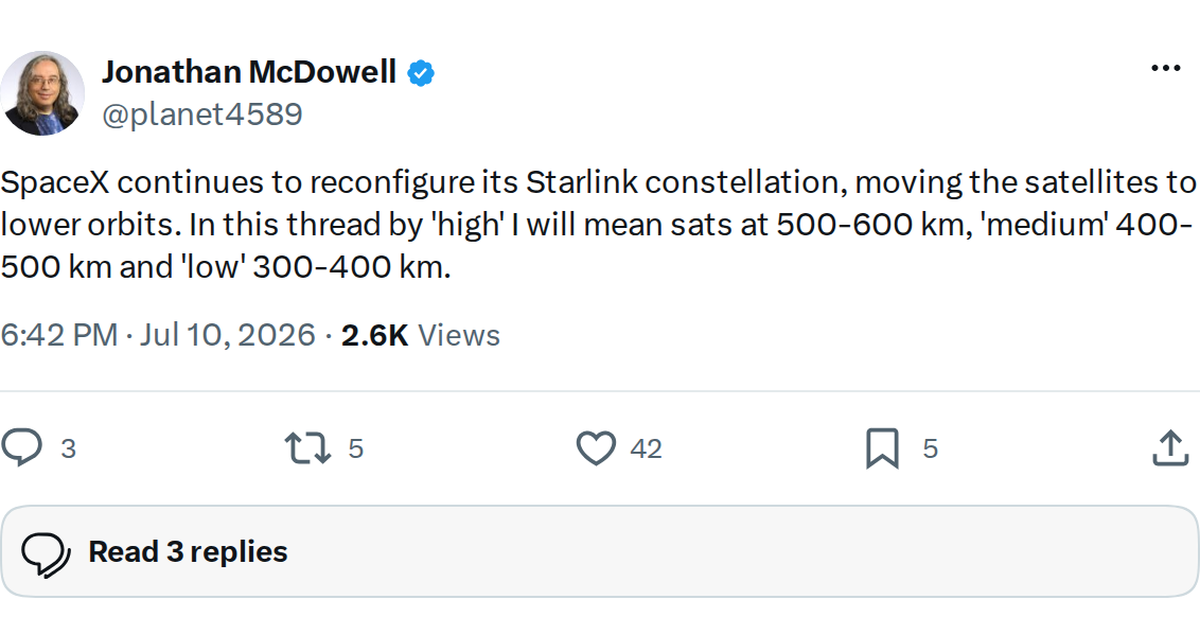
SpaceX is in the middle of a large-scale reshuffling of its Starlink constellation, systematically lowering thousands of satellites from higher orbits (500–600 km) to medium orbits (400–500 km). Orbital analyst Jonathan McDowell — one of the most respected independent trackers of spacecraft activity — broke down the current state of the reconfiguration in a detailed thread on July 10. The numbers reveal a project that is well underway on some fronts and barely started on others.

1. The Scale: ~4,400 Satellites Being Relocated
According to McDowell's data, roughly 4,400 Starlink satellites currently in orbit were originally launched to the high shells (500–600 km). SpaceX began this reconfiguration on January 1, 2026, with a target of completing the process over the course of the year. Of those 4,400 satellites, approximately 2,000 have already been successfully moved down to medium shells (400–500 km), while another 1,000 are actively descending right now. That means SpaceX has already repositioned nearly half the targeted fleet, with roughly a quarter still in transit.

2. The 43-Degree Shell Is Nearly Done
Progress is not uniform across inclination shells. The 43-degree inclination group is the furthest along — of the satellites originally in the high shell at this inclination, 1,260 have already relocated to medium orbit, 15 are currently on the way down, and just 4 remain in the high shell. That is effectively complete. This shell covers mid-latitude coverage zones and its early completion suggests SpaceX prioritized it, possibly due to traffic density or coverage demand in those regions.

3. The 53-Degree Shell Is Mid-Process
The 53-degree inclination group — the largest high-shell population — is roughly halfway through. McDowell's count shows 580 satellites still sitting in the high shell, 578 already relocated to medium orbit, and 771 actively descending. That 771-in-transit figure is the largest active descent batch of any inclination group, suggesting this shell is currently the most active phase of the operation. The 53-degree shell provides coverage across much of the Northern Hemisphere, including Europe and North America.

4. The 97-Degree and 70-Degree Shells Tell Two Different Stories
The polar-orbit 97-degree shell (sun-synchronous) is partway through: 157 remain high, 275 have moved to medium, and 28 are descending. Then there is the 70-degree shell — 700 satellites still sitting in the high shell with zero relocations recorded yet. McDowell's data makes no mention of any descents started for this group, making it the last major shell yet to begin the process. Given the pace on other shells, the 70-degree group is likely the final phase of the 2026 reconfiguration plan.

5. Direct-To-Cell Satellites Are Untouched — and Why That Matters
The low shells (300–400 km) are occupied exclusively by Starlink's Direct-To-Cell satellites: 312 at 53-degree inclination and 328 at 43-degree inclination. These are not part of the reconfiguration. According to background research, operating below 500 km reduces the aggregate collision risk with space debris significantly, and satellites at these altitudes deorbit far faster if they fail — cutting ballistic decay time by over 80% compared to higher shells. The Direct-To-Cell sats were already in low orbit by design; the broader reconfiguration is bringing the rest of the constellation in line with the same safety logic.

With the 43-degree shell essentially wrapped up and the 53-degree shell's 771 in-transit satellites actively descending, the bulk of this reconfiguration is moving at pace. The 70-degree shell — 700 satellites with no relocations started — remains the clearest indicator of how much work is still ahead before SpaceX can call the 2026 reshuffle complete.
Sources & reporting notes
The links below identify the material source records used for this report.
- @planet4589 on X (2026-07-10T18:44:03.000Z) — Direct source
- @planet4589 on X (2026-07-10T18:43:40.000Z) — Direct source
- @planet4589 on X (2026-07-10T18:43:25.000Z) — Direct source
- @planet4589 on X (2026-07-10T18:43:16.000Z) — Direct source
- @planet4589 on X (2026-07-10T18:43:06.000Z) — Direct source
- @planet4589 on X (2026-07-10T18:42:54.000Z) — Direct source
- @planet4589 on X (2026-07-10T18:42:43.000Z) — Direct source
Source links are preserved as published or accessed. See our editorial standards and corrections policy.
The BASENOR Editorial Desk covers Tesla, SpaceX, and related technology, curating reporting from primary sources — official accounts, regulatory filings, and software release data. Every article passes source-record and fact-checking review before publication. About the newsroom.
This report was curated by the BASENOR Editorial Desk from the sources listed above. Read our editorial standards or email editorial@basenor.com to report an error.