📌 UPDATE — March 13, 2026
New market share data reveals Tesla claimed 3rd place in China's NEV segment for February 2026, capturing 8.2% of the NEV market — a significant position behind only BYD, which dominated with a 19.1% share. In the broader overall passenger car retail market, Geely led with 14.1%, while BYD ranked second at 8.6%, highlighting how Tesla's strength is concentrated specifically within the NEV segment rather than the total auto market.

| Brand | NEV Market Share | Overall Passenger Car Share |
|---|---|---|
| BYD | 19.1% 🥇 | 8.6% 🥈 |
| Geely | — | 14.1% 🥇 |
| Tesla | 8.2% 🥉 | — |
📌 UPDATE — March 12, 2026
New data from CnEVPost reveals that Tesla's February China rebound was even more significant than headline sales figures suggest. Tesla's retail BEV market share climbed to its highest level since April 2024, underscoring that the 91% YoY sales surge wasn't just a volume story — it translated into genuine market share recovery amid broader segment weakness. The milestone marks nearly a two-year high for Tesla's competitive positioning in China's fiercely contested battery-electric vehicle market, suggesting the brand's appeal remains resilient despite intensifying local competition from BYD and other domestic rivals.
📌 UPDATE — March 12, 2026
Beyond the raw sales volume, Tesla's February performance in China has now been confirmed to represent its highest BEV market share since April 2024 — a nearly two-year high. This is particularly notable given that the broader Chinese EV market experienced weakness during the same period, meaning Tesla gained share against the tide rather than simply riding a rising market. The data reinforces that Tesla's February surge was a genuine competitive win, not just a seasonal rebound. Analysts will be watching whether Tesla can sustain this elevated market share position heading into the traditionally stronger Q2 months.

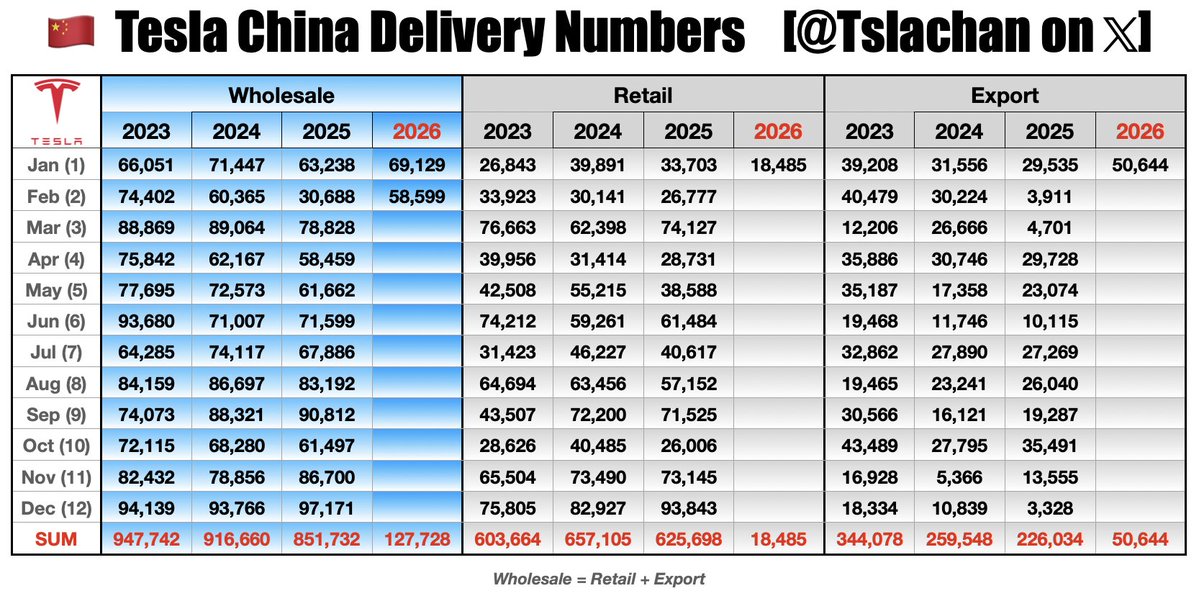
The News: China-made Tesla sales rose 91% year-over-year in February 2026, with 58,600 units shipped from the Shanghai Gigafactory — while BYD reported a 41.1% YoY decline over the same period.
Why It Matters: This is Tesla's fourth consecutive month of YoY sales growth in China, and the export surge — up fivefold — signals Shanghai is increasingly feeding global demand, not just the domestic market.
Source: @ray4tesla on X

📊 Key Figures
🇨🇳 China Market Data — February 2026
| Metric | Value | YoY Change |
|---|---|---|
| Tesla China-Made Sales (Wholesale) | 58,600 units | +91% |
| Tesla China-Made Sales (MoM) | vs. January 2026 | −15.2% |
| Tesla Shanghai Exports | ~20,000 units | +400% (5×) |
| BYD Total Vehicle Sales | 190,190 units | −41.1% |
| BYD BEV Sales | 79,539 units | −36% |
| BYD PHEV Sales | 108,243 units | −44% |
| BYD Exports | 100,600 units | +50.1% |
🔭 The BASENOR Take
📰 Deep Dive
The 91% year-over-year headline is real — but context matters. February 2025 was an unusually weak baseline for Tesla China. The Shanghai factory was partially shut down for Model Y production upgrades during the Lunar New Year period, which compressed last year's numbers significantly. That base effect is doing a lot of the heavy lifting in this comparison. Still, 58,600 wholesale units in a shortened February is a genuinely solid result, and the fourth consecutive month of YoY growth signals that the refreshed Model Y (Juniper) is holding its momentum in the world's most competitive EV market.
The export story is arguably more significant than the domestic sales figure. Roughly 20,000 of those 58,600 units were shipped out of China — a fivefold increase year-over-year. That tells you two things: global demand for Shanghai-built Teslas is accelerating, and the Gigafactory is running at a throughput that comfortably supports both the domestic market and international orders simultaneously. For owners in Europe and Asia-Pacific, where Shanghai-built Model 3 and Model Y are common, this is a positive supply signal.
BYD's February decline — 41.1% overall, with BEVs specifically down 36% — deserves careful reading too. The Chinese New Year holiday window (February 15–23 this year) hit BYD harder than Tesla partly because of how each company structures its sales channel and inventory pipeline. BYD also faced a reduction in state EV purchase incentives that disproportionately affected its higher-volume, lower-margin PHEV lineup. Notably, BYD's exports held up extremely well at over 100,000 units, up 50% YoY — so the domestic softness isn't a sign of a company in crisis, just one navigating a seasonally difficult month.
For Tesla investors and owners watching the China story: the competitive dynamic in February looks favorable for Tesla, but a single month — especially one with a distorted base — shouldn't be read as a trend reversal. The March figures, which will reflect a full working month without holiday disruption on either side, will be far more telling about where the Shanghai-versus-Shenzhen rivalry actually stands in 2026.

David covers the EV industry, regulatory developments, and accessory ecosystem. 15+ years writing about consumer tech. Based in London.
Sources verified at publish time. Spotted an inaccuracy? Email editorial@basenor.com.