📌 UPDATE — March 10, 2026
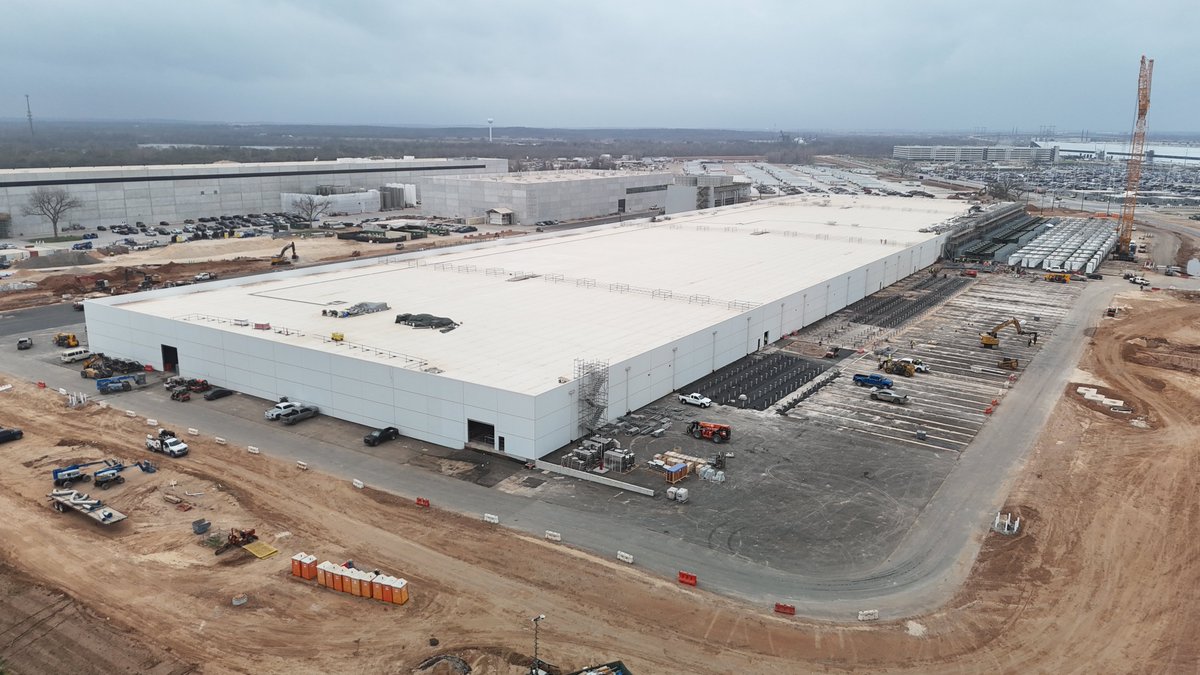
Fresh on-the-ground reporting from Joe Tegtmeyer confirms Cortex 2 at Giga Texas is making rapid progress toward its April initial operation target, as previously confirmed by Elon Musk. The build-out strategy is phased: Tesla is prioritizing completion of Part 1 of the Megapack integration and cooling infrastructure — augmented with temporary chillers — alongside installation of half of the planned computer cabinetry before going live. This staged approach suggests Tesla is optimizing for the earliest possible power-on date rather than waiting for full buildout, a move consistent with its aggressive AI compute expansion timeline.

📸 Via @JoeTegtmeyer — March 10, 2026
📌 UPDATE — March 7, 2026
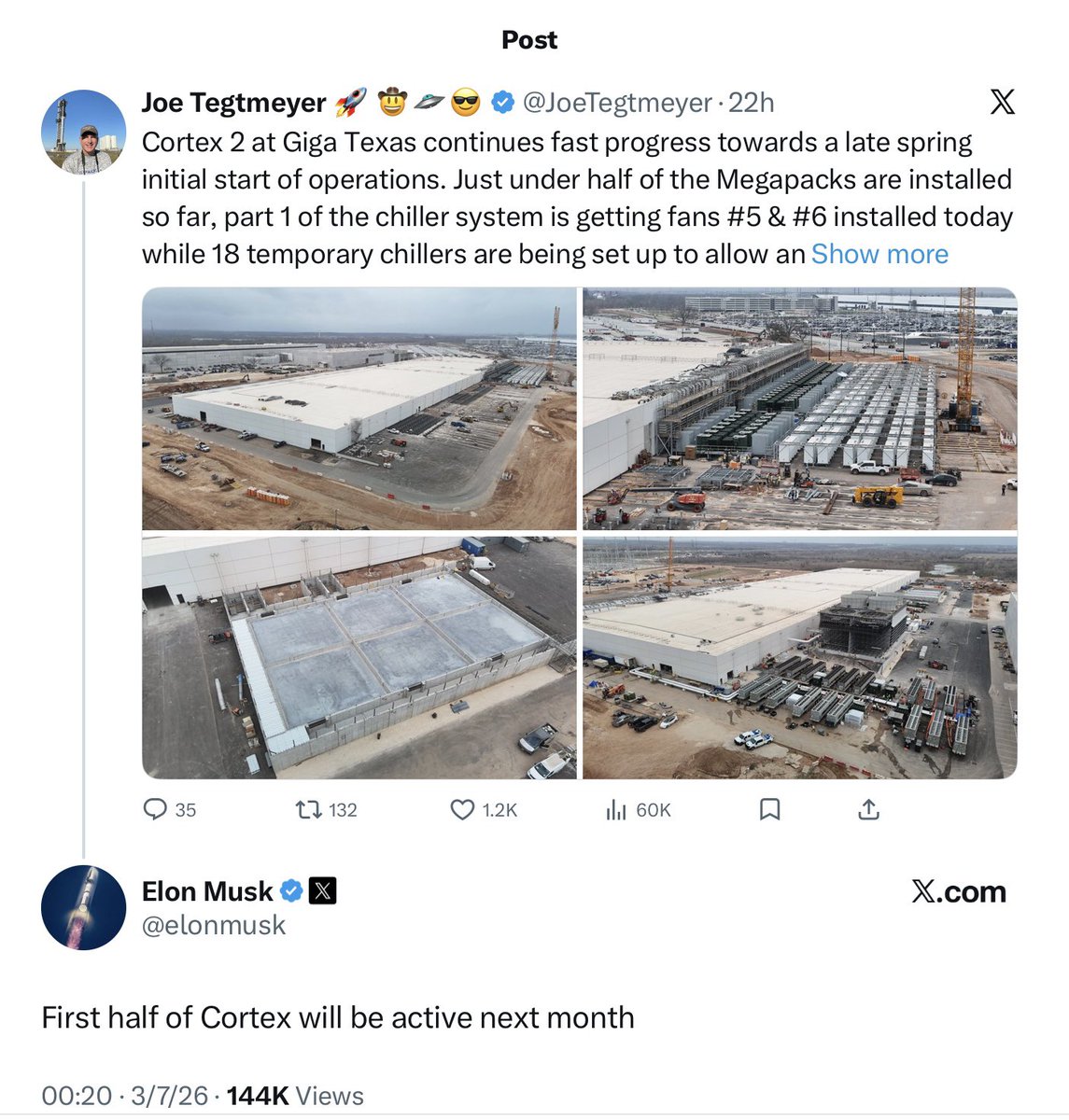
Elon Musk has now personally confirmed the timelines and progress of Cortex 2 at Giga Texas, lending official weight to the April activation window reported earlier. Tesla watcher @JoeTegtmeyer noted widespread construction activity across the Giga Texas site, describing 2026 as a major "stepping stone" into Tesla's autonomous and physical AI future. The on-the-ground activity suggests the Cortex 2 buildout is proceeding on or ahead of schedule, with multiple simultaneous workstreams visible across the campus.
@JoeTegtmeyer · Mar 7, 2026
"Looks like @elonmusk confirms the timelines and progress of Cortex 2! A lot more ahead underway at Giga Texas all over the site and 2026 is shaping up to be a big stepping stone into an autonomous & physical AI future for @Tesla"
The News: Tesla's Cortex 2.0 supercomputer — its second AI training cluster, located at GigaTexas — will activate its first 250MW phase in April 2026, with the full 500MW capacity expected online by mid-2026.
Why It Matters: Cortex 2.0 is the engine that will train Tesla's Optimus robot and accelerate FSD development. More compute means faster iteration on both fronts — directly impacting when owners see meaningful Optimus and autonomy milestones.
Source: @SawyerMerritt on X

What Is Cortex 2.0 — And Why Does It Exist?
Tesla's original Cortex supercomputer cluster was built to train FSD. Cortex 2.0 is the next-generation evolution, purpose-built at Gigafactory Texas with a dramatically larger power footprint. At 500MW total capacity, it dwarfs most AI training facilities in the world.
According to Elon Musk's own statements, the GigaTexas compute cluster is built around approximately 100,000 Nvidia H100/H200 GPUs, paired with massive video storage infrastructure for training both FSD and Optimus. That GPU count alone puts it in the same league as the largest AI clusters operated by any company on the planet.
The primary focus for Cortex 2.0, per multiple sources, is Optimus — Tesla's humanoid robot currently in limited production. Training a robot to perform real-world physical tasks requires an enormous amount of compute: video data, simulation runs, reinforcement learning loops. The April activation of the first 250MW phase means that training pipeline is about to get a massive injection of horsepower.

📊 Key Figures
| Metric | Value | Context |
|---|---|---|
| Phase 1 Power | 250 MW | Active April 2026 |
| Total Capacity | 500 MW | Full build-out mid-2026 |
| GPU Count | ~100,000 | Nvidia H100/H200 (per Musk) |
| Location | GigaTexas | North side of complex |
| Permit Approved | 200 MW | December 2025 |

🔭 The BASENOR Take
Timeline: Phase 1 active April 2026 → Full 500MW by mid-2026
Impact Level: 🔴 High — directly accelerates Optimus and FSD training timelines
Confidence: Medium-High — reported by @SawyerMerritt, corroborated by construction progress and permit data; exact activation dates are not yet officially confirmed by Tesla
The April activation of Cortex 2.0's first phase is a significant infrastructure milestone — not just for Tesla, but for the broader AI race. Here's the strategic read:
For Optimus: Tesla has been clear that compute is the bottleneck for robot training. Cortex 2.0 at full capacity is designed to run the kind of large-scale simulation and video-based learning that turns a robot prototype into a deployable product. The faster this cluster comes online, the faster Tesla can iterate on Optimus capabilities — and the faster it can scale production beyond the current limited runs. Every month of additional compute translates directly into robot dexterity, task completion rates, and real-world reliability.
For FSD: While Optimus is the primary stated focus, Cortex 2.0 will also feed the FSD training pipeline. More compute means Tesla can process more edge-case video data, run more neural net training iterations, and push toward higher autonomy levels faster. Owners waiting on FSD improvements have a direct stake in this infrastructure coming online on schedule.
The power numbers matter: 500MW is not a rounding error. For reference, a typical large data center runs 20-100MW. Tesla is building something in a completely different class — one that signals the company views AI compute as a core competitive moat, not just a supporting function. The decision to co-locate this at GigaTexas rather than a standalone facility also speaks to Tesla's vertical integration philosophy: manufacturing, energy, and AI training all under one roof.
Watch the mid-2026 date: The second 250MW phase coming online by mid-2026 will be the real inflection point. That's when the full training throughput becomes available — and when the downstream effects on Optimus capabilities and FSD performance should start becoming visible in product updates. For our FSD coverage, this is a key upstream variable to track.
📰 Deep Dive
What makes Cortex 2.0 structurally different from Tesla's original Cortex cluster isn't just scale — it's the deliberate pivot toward robotics training. The original Cortex was conceived primarily as a video-ingestion and neural net training machine for FSD, processing dashcam footage from Tesla's fleet at scale. Cortex 2.0 expands that mandate significantly, adding the simulation-heavy workloads that humanoid robot training demands. These are fundamentally different compute profiles, and building a single facility capable of handling both is an engineering statement in itself.
The infrastructure buildout has been visible from the air for months. Drone operators and Tesla watchers have documented Megapack installations on the north side of GigaTexas — the battery storage necessary to provide the power stability a 500MW compute cluster requires. Chiller systems and high-density electrical infrastructure have also been photographed in various stages of completion. The fact that a 200MW permit was approved in December 2025 and the first phase is now reported for April activation suggests the construction timeline has stayed largely on track.
One detail worth watching: the gap between the approved permit capacity (200MW) and the reported total build-out (500MW) suggests additional permitting and infrastructure work is still in progress for the second phase. The mid-2026 target for full 500MW operation is credible given the construction pace, but it carries the usual caveats around permitting, grid interconnection, and hardware delivery timelines. Tesla has not made an official public announcement confirming these specific dates.
For Tesla owners, the practical takeaway is this: the AI infrastructure that will define how good Optimus and FSD become over the next two to three years is being switched on in the next few weeks. Cortex 2.0 isn't a product you'll interact with directly — but its output will show up in every software update, every Optimus demo, and every FSD capability milestone that follows.
🤖 Tracking Tesla's humanoid robot? See every Optimus production milestone and appearance in our Tesla Optimus Tracker.
Related Gear
Gear up your Tesla with tested, custom-fit BASENOR accessories — shop Tesla accessories →
Sources & reporting notes
The links below identify the material source records used for this report.
- @SawyerMerritt on X (2026-03-07T07:26:31.000Z) — Direct source
- @wholemars on X (2026-03-07T07:35:52.000Z) — Direct source
- @TeslaNewswire on X (2026-03-07T07:46:05.000Z) — Direct source
- @JoeTegtmeyer on X (2026-03-07T13:45:10.000Z) — Direct source
- @JoeTegtmeyer on X (2026-03-10T14:00:17.000Z) — Direct source
Source links are preserved as published or accessed. See our editorial standards and corrections policy.
The BASENOR Editorial Desk covers Tesla, SpaceX, and related technology, curating reporting from primary sources — official accounts, regulatory filings, and software release data. Every article passes source-record and fact-checking review before publication. About the newsroom.
This report was curated by the BASENOR Editorial Desk from the sources listed above. Read our editorial standards or email editorial@basenor.com to report an error.