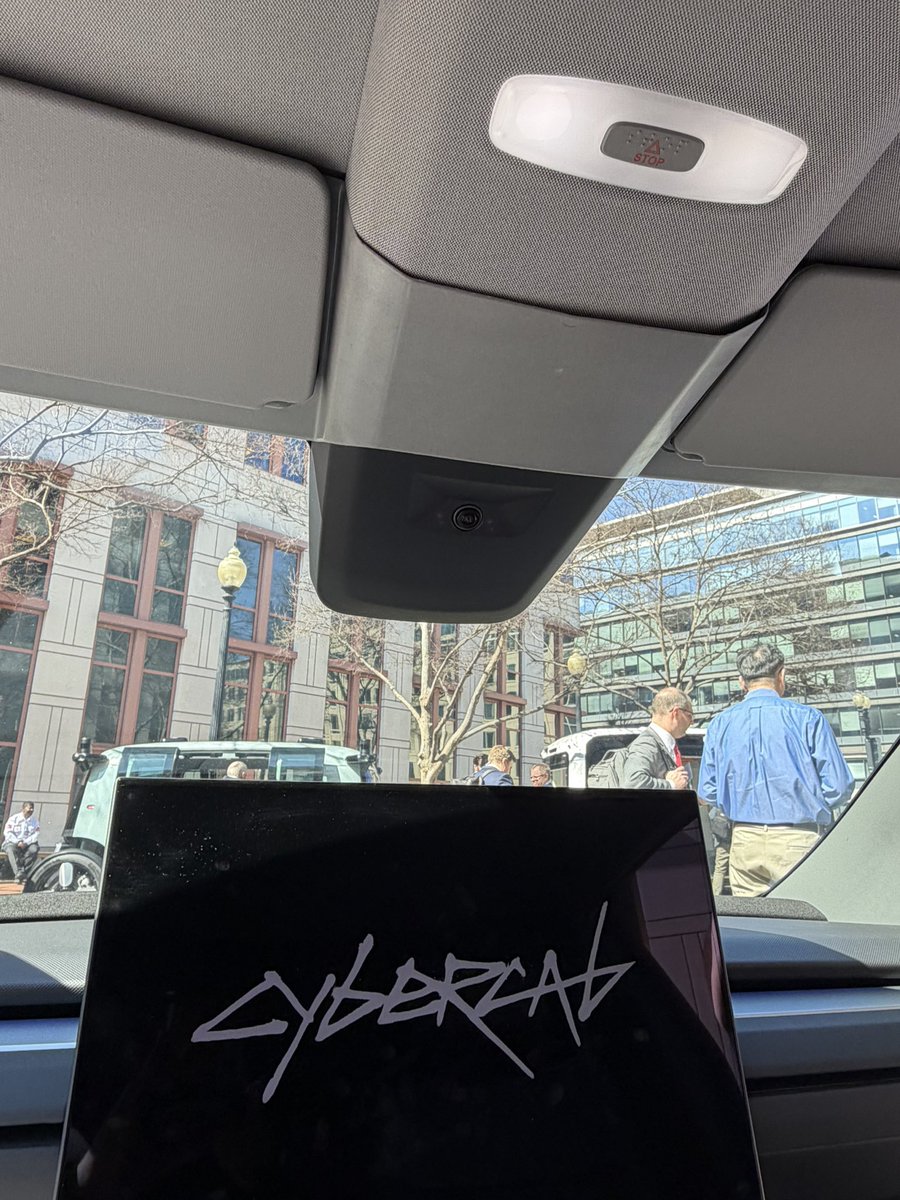
The News: The Tesla Cybercab includes an emergency stop button on the overhead panel — and it features Braille lettering for accessibility.
Why It Matters: This small detail reveals a lot: Tesla is building its robotaxi with blind and visually impaired passengers in mind from day one, a meaningful signal for the future of autonomous transport.
Source: @TeslaNewswire on X
Tesla Cybercab Emergency Stop Button Features Braille — A Closer Look at What It Does
With the first Tesla Cybercab unit rolling off the Gigafactory Texas line on March 9, 2026, new interior details are emerging fast. One of the most quietly significant: an emergency stop button mounted on the overhead panel, visible in close-up photos shared today — and it's not just functional. It's engraved with Braille.

What the Emergency Stop Button Actually Does
Based on the photos and what we know about the Cybercab's safety architecture, the overhead button is designed to do three things when pressed:
- Trigger a safe pullover: The vehicle autonomously navigates to the side of the road and stops — consistent with the emergency pullover logic Tesla has already built into the Cybercab's autonomous driving system.
- Activate hazard lights: Standard safety protocol, signaling to other road users that the vehicle is stopping.
- Give passengers physical control: In a car with no steering wheel and no pedals, this button is the primary mechanical override available to anyone inside.
That last point is worth sitting with. The Cybercab is designed to be fully autonomous — there's no driver seat, no wheel to grab. For a passenger who feels unsafe, disoriented, or simply needs to stop immediately, this button is the only direct intervention available. It's not a convenience feature. It's a lifeline.

The Braille Detail: Small Feature, Large Statement
The Braille lettering on the button is the detail that deserves more attention than it's getting. In a vehicle with no human driver, a visually impaired passenger needs to be able to locate and activate an emergency stop without sighted assistance. The Braille labeling means they can find it by touch alone.
This isn't a regulatory checkbox — at least not yet. ADA requirements for autonomous vehicles are still being defined, and there's no existing federal mandate specifically requiring Braille on robotaxi emergency controls. Tesla appears to be getting ahead of that curve voluntarily.
It also reflects something broader about how Tesla is thinking about the Cybercab's passenger base. A traditional ride-hailing car has a human driver who can assist a visually impaired passenger. The Cybercab has no one. If Tesla wants to serve the full spectrum of riders — including the estimated 7.6 million Americans with visual disabilities — accessibility features like this aren't optional. They're foundational.
📊 Key Figures
| Detail | What We Know |
|---|---|
| Button Location | Overhead panel (confirmed via photos) |
| Primary Function | Triggers autonomous safe pullover + hazard lights |
| Accessibility Feature | Braille lettering (visible in close-up photos) |
| First Unit Produced | March 9, 2026 — Gigafactory Texas |
| Mass Production Target | April 2026 |
| Starting Price | Under $30,000 (Tesla's stated target) |
🔭 The BASENOR Take
Timeline: First unit off the line March 9 → interior details surfacing March 10 → mass production targeted April 2026
Impact Level: Medium-High — signals Tesla's accessibility strategy for the robotaxi era
Confidence: High — photos show the button clearly; Braille detail visible in close-up
The emergency stop button is one of those details that seems minor until you think about it from first principles. Tesla is building a vehicle with no human operator. Every safety function that a driver currently handles — pulling over in an emergency, communicating distress, assisting a passenger in need — has to be replaced by either software or hardware that passengers can use themselves.
The overhead button is the hardware answer to that problem. And the Braille lettering is Tesla acknowledging that "passengers" isn't a monolithic category. It includes people who are elderly, anxious, non-English speaking, or visually impaired. Building for the edge cases from the start, rather than retrofitting later, is exactly the right approach — and it's what will ultimately determine whether regulators and the public trust autonomous vehicles with vulnerable populations.
There's also a regulatory dimension here. Tesla's Cybercab is going to face intense scrutiny from the NHTSA, state DMVs, and accessibility advocates as it scales. Having documented, photographable accessibility features like Braille emergency controls gives Tesla a concrete answer when those questions come. It's good engineering and good politics simultaneously.
Mass production is targeted for April 2026. Between now and then, expect more interior details to surface. The emergency stop button won't be the last thoughtful design choice we find in this vehicle.
🚕 Following the Robotaxi rollout? See every operating city, launch date and announced market in our Tesla Robotaxi Tracker.
Related Gear
Gear up your Tesla with tested, custom-fit BASENOR accessories — shop Tesla accessories →
Sources & reporting notes
The links below identify the material source records used for this report.
- @TeslaNewswire on X (2026-03-10T21:03:59.000Z) — Direct source
- @TeslaNewswire on X (2026-03-10T21:44:07.000Z) — Direct source
Source links are preserved as published or accessed. See our editorial standards and corrections policy.
The BASENOR Editorial Desk covers Tesla, SpaceX, and related technology, curating reporting from primary sources — official accounts, regulatory filings, and software release data. Every article passes source-record and fact-checking review before publication. About the newsroom.
This report was curated by the BASENOR Editorial Desk from the sources listed above. Read our editorial standards or email editorial@basenor.com to report an error.