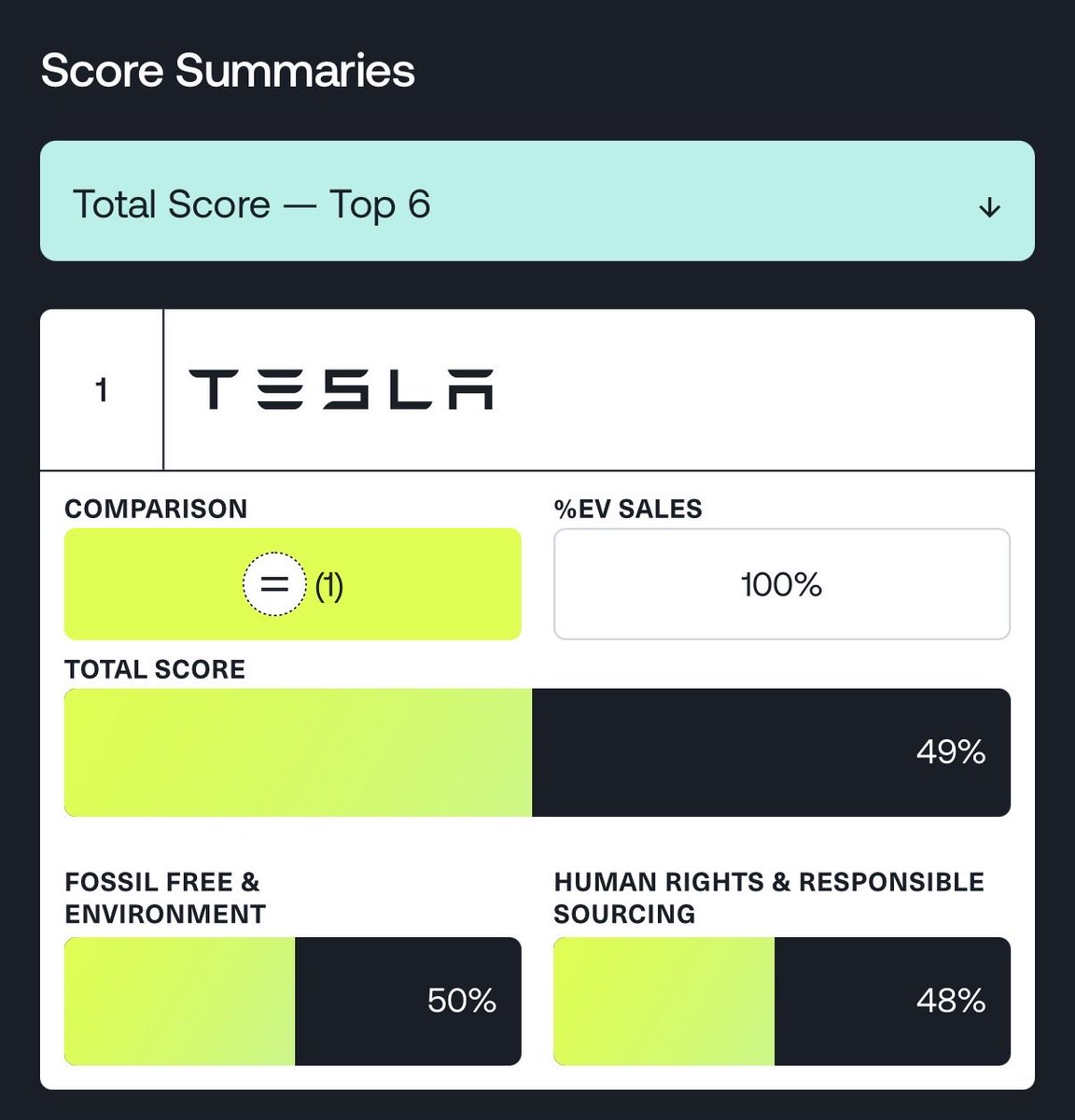
The News: Tesla has been ranked #1 among 18 global automakers for supply chain sustainability by Lead the Charge — for the second consecutive year.
Why It Matters: For Tesla owners, this reinforces that the car in your driveway is backed by one of the most rigorously scrutinized and transparently reported supply chains in the automotive industry.
Source: @TeslaNewswire on X
Tesla Ranks #1 in Supply Chain Sustainability for the Second Consecutive Year
For the second year running, Tesla has claimed the top spot on the 2026 Lead the Charge Auto Supply Chain Leaderboard — the most comprehensive independent ranking of automotive supply chain sustainability in the world. Published on March 2, 2026, by a coalition that includes Transport & Environment and the Sierra Club, the report evaluated 18 major global automakers across more than 80 indicators and 1,584 individual data points.

📊 Key Figures
| Automaker | 2026 Score | Rank |
|---|---|---|
| Tesla 🥇 | 49% | #1 |
| Ford | 45% | #2 |
| Volvo | 44% | #3 |
| Mercedes-Benz | 41% | #4 |
| Volkswagen | 39% | #5 |
Source: 2026 Lead the Charge Auto Supply Chain Leaderboard, published March 2, 2026. 18 automakers evaluated.
What the Score Actually Measures
A 49% score might not sound like a perfect grade — and that's the point. The Lead the Charge methodology is deliberately rigorous. The 80+ indicators span the full upstream supply chain: carbon emissions from procuring steel, aluminum, batteries, and critical minerals; workers' rights at mining operations; and responsible sourcing practices across the entire bill of materials. No automaker is close to 100%, but Tesla leads the pack by a widening margin.
Tesla's overall score improved by 6 percentage points year-over-year, stretching its lead over second-place Ford to nearly 5 percentage points. That gap is growing — not shrinking.
The Battery Category Breakthrough
The most significant single achievement in this year's report is Tesla's performance in the battery supply chain category. Tesla not only reclaimed the top spot in batteries but improved its score by a remarkable 20 percentage points — becoming the first automaker ever to exceed 50% in that category.
Critically, Tesla is also now the first automaker to fully meet the battery emissions disclosure indicator. This was achieved by publicly disclosing the individual emissions contributions of cell production and key materials — lithium, nickel, cobalt, and graphite — to its overall battery supply chain footprint. That level of granularity is unprecedented in the industry and sets a new transparency benchmark that other manufacturers will be measured against.
Low-Carbon Aluminum: A New Supply Chain Commitment
The report also flagged a new off-take agreement Tesla has secured for low-carbon aluminum in North America. The agreement covers aluminum with an emission intensity below 2 kg of CO₂e per kg of aluminum, achieved through the use of post-consumer recycled scrap. For context, conventional primary aluminum production typically emits 10–20 kg of CO₂e per kg — making this a meaningful reduction in the emissions footprint of every vehicle body Tesla produces.
🔭 The BASENOR Take
Timeline: Second consecutive #1 ranking — 2025 and 2026
Impact Level: Medium-High — reinforces brand value and long-term regulatory positioning
Confidence: High — sourced from independent coalition report with verified methodology
What to Watch: Whether Tesla can push past 50% overall in 2027, and whether other automakers close the gap in the battery category
There's a narrative that often gets lost in the day-to-day Tesla news cycle: the company's supply chain story is genuinely differentiated, not just in marketing language but in independently verified data. The Lead the Charge coalition — which includes organizations like the Sierra Club that have historically been critical of the automotive industry — is not a friendly audience. Earning the top spot twice in a row from this group carries real credibility.
For Tesla owners, this matters beyond brand pride. Supply chain sustainability is increasingly tied to regulatory compliance in the EU and increasingly in the US. Automakers with opaque or high-emission supply chains face growing tariff exposure, regulatory friction, and reputational risk. Tesla's lead here is a structural advantage, not just a trophy.
The battery transparency milestone is particularly worth watching. As battery passport requirements roll out in Europe — mandating detailed lifecycle emissions data for EV batteries sold in the EU — Tesla is already operating above the disclosure threshold that competitors are still working toward. That's not a coincidence; it's preparation.
📰 Deep Dive
The 2026 Lead the Charge leaderboard is a useful reality check on the broader EV industry's sustainability claims. Even the top-ranked automaker — Tesla at 49% — is barely halfway to full compliance across all indicators. The report's authors are explicit that no company has solved the supply chain challenge; they're measuring progress and transparency, not perfection. Tesla's advantage is that it's moving faster and disclosing more than anyone else in the field.
The 20-point improvement in the battery category deserves particular attention. Battery supply chains are the most complex and ethically fraught part of EV manufacturing — involving cobalt from the Democratic Republic of Congo, lithium from South America's salt flats, and nickel from operations with varying environmental standards. The fact that Tesla can now itemize the emissions contribution of each of those materials — and publish that data — suggests a level of supply chain visibility that most automakers simply don't have yet.
The low-carbon aluminum agreement is a quieter but strategically important move. Aluminum is the second-largest material input by weight in most Tesla vehicles. Locking in a supply of recycled, low-emission aluminum at scale is the kind of upstream decision that compounds over time — both in terms of lifecycle emissions and in terms of future regulatory compliance costs that competitors will face as carbon border adjustment mechanisms expand.
The gap between Tesla and the rest of the field is widening, not narrowing. That's the headline buried inside a report full of percentages and indicators. For an industry that has spent years arguing that legacy automakers are 'catching up' on sustainability, the 2026 data tells a different story.
Related Gear
Gear up your Tesla with tested, custom-fit BASENOR accessories — shop Tesla accessories →
Sources & reporting notes
The links below identify the material source records used for this report.
- @TeslaNewswire on X (2026-03-10T20:31:41.000Z) — Direct source
Source links are preserved as published or accessed. See our editorial standards and corrections policy.
The BASENOR Editorial Desk covers Tesla, SpaceX, and related technology, curating reporting from primary sources — official accounts, regulatory filings, and software release data. Every article passes source-record and fact-checking review before publication. About the newsroom.
This report was curated by the BASENOR Editorial Desk from the sources listed above. Read our editorial standards or email editorial@basenor.com to report an error.