📌 UPDATE — March 25, 2026
Cybercab activity at Giga Texas has surged dramatically, with Tesla observer Joe Tegtmeyer spotting over 35 units across the facility on March 25 — including 12 in the outbound lot parked alongside Model Ys for scale comparison, 11 at the factory exit point, and roughly a dozen more in and around the crash testing facility. Several units were also observed actively driving around the campus. The sheer volume of units — spanning production staging, active driving tests, and crash safety validation simultaneously — signals Tesla is pushing hard toward a launch-ready state. With April now just days away, this multi-front testing blitz strongly suggests the anticipated Robotaxi launch event is imminent.

📸 @JoeTegtmeyer via X — March 25, 2026
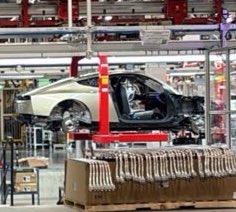
The News: Tesla Cybercabs in production have been photographed with a steering wheel installed, raising questions about whether the first robotaxis off the line will include manual controls.
Why It Matters: Tesla has consistently stated the production Cybercab will ship without a steering wheel or pedals — so these sightings suggest either a testing-phase workaround or a potential phased approach to full autonomy.
Source: @TeslaNewswire on X
Tesla Cybercab Production Units Spotted With Manual Controls
Images circulating on social media show what appear to be Tesla Cybercabs on or near a production line — and they have a steering wheel. That's a notable detail for a vehicle Tesla has repeatedly said will launch without one.
The sighting, shared by The Tesla Newswire, immediately sparked debate: Are these dedicated testing and validation units, or is Tesla hedging its bets on full autonomy by equipping early Cybercabs with driver controls?

Context: What We Already Know About the Cybercab
To understand why this matters, here's what Tesla has confirmed about the production Cybercab:
- The first production Cybercab — without a steering wheel or pedals — rolled off the Gigafactory Texas assembly line in February 2026.
- Mass production is scheduled to begin in April 2026.
- It's a two-door, two-seat battery-electric vehicle with a 35 kWh battery and an estimated range of approximately 200 miles.
- The vehicle features a 21-inch center display (the largest Tesla has put in a production vehicle), inductive charging capability, and a target price below $30,000.
- CEO Elon Musk has consistently stated the Cybercab is optimized for full autonomy and will not include manual controls in its production form.
So if the production intent is a steeringless robotaxi, what are these steering-wheel-equipped units doing on what appears to be a production line?
The Most Likely Explanation: Engineering and Validation Fleet
Based on verified reporting, Cybercab prototypes used for testing have consistently included a steering wheel and pedals. These units serve a critical purpose — they allow human engineers to intervene during real-world validation drives, which is both a practical necessity and a regulatory requirement during the testing phase.
Previous sightings of Cybercab test mules have confirmed the existence of a "remote controlled fleet" — engineering prototypes that look production-ready but are equipped with manual controls specifically for validation and safety testing. The units in these latest images are very likely part of that same program.
The Regulatory Wild Card
There's a less-discussed dimension to this story that's worth understanding. As of late 2025, Tesla had not yet applied for the necessary regulatory exemption from NHTSA that would allow it to sell vehicles without basic driver controls (steering wheel, pedals, mirrors) on public roads at scale.
Current federal safety standards still require these controls. Tesla is reportedly seeking exemptions, but approval isn't guaranteed — and the timeline is uncertain. This creates a scenario where Tesla might need steering-wheel-equipped Cybercabs as a contingency, at least for initial deployments or certain jurisdictions.
It's an important nuance: even if the design intent is fully autonomous, the regulatory reality may require a phased approach.
🔭 The BASENOR Take
| Timeline | Mass production on track for April 2026 |
| Impact Level | Medium — Likely testing units, but regulatory uncertainty persists |
| Confidence | High that these are validation/test units; Moderate that production Cybercabs ship without steering wheel on schedule |
Our read: These are almost certainly testing and validation units — not a signal that Tesla is backing away from its steeringless vision. The February 2026 production unit was explicitly confirmed without manual controls, and nothing from Tesla's public communications suggests a design reversal.
However, the regulatory picture is the real story beneath the surface. Tesla needs NHTSA to grant exemptions from decades-old safety standards that assume a human driver. Until that exemption is secured, there's a legitimate question about whether the first Cybercabs deployed commercially in the U.S. will need some form of manual override capability — even if Tesla's engineering doesn't require one.
For current Tesla owners watching the FSD and robotaxi roadmap, this is a reminder that the technological challenge and the regulatory challenge are two separate hurdles. Tesla appears to be clearing the first. The second is still in play.
📰 Deep Dive
The Cybercab has been Tesla's most ambitious product bet since the original Roadster — a vehicle designed from the ground up without the assumption that a human will ever need to drive it. That philosophy cascades through every design decision: no steering column means a different dashboard architecture, different airbag configurations, different crash structures, and a fundamentally different relationship between occupant and machine.
Seeing steering wheels in test units doesn't undermine that vision — it reinforces how seriously Tesla is taking the validation process. Every autonomous vehicle company, from Waymo to Cruise, has used manually-controlled prototypes extensively before removing the human from the loop. The difference is that Tesla is building the Cybercab on a dedicated platform rather than retrofitting an existing car, which means the steering-wheel versions are purpose-built test rigs, not future products.
The April 2026 mass production target remains the date to watch. If Cybercabs start rolling off the line next month at volume, the conversation shifts from "will they build it" to "where can it legally operate" — and that's where the real battle for Tesla's robotaxi future will be fought, in regulatory offices rather than on factory floors.
What we're watching next: any NHTSA filing from Tesla requesting the steering-wheel exemption, and the first confirmed Cybercab deployment market. Austin, Texas remains the most likely candidate given Gigafactory proximity and relatively favorable state regulations.
🚕 Following the Robotaxi rollout? See every operating city, launch date and announced market in our Tesla Robotaxi Tracker.
Related Gear
Gear up your Tesla with tested, custom-fit BASENOR accessories — shop Tesla accessories →
Sources & reporting notes
The links below identify the material source records used for this report.
- @TeslaNewswire on X (2026-03-20T20:36:17.000Z) — Direct source
- @JoeTegtmeyer on X (2026-03-25T15:52:48.000Z) — Direct source
- @JoeTegtmeyer on X (2026-03-25T15:52:46.000Z) — Direct source
- @JoeTegtmeyer on X (2026-03-25T15:52:42.000Z) — Direct source
- @JoeTegtmeyer on X (2026-03-25T15:52:40.000Z) — Direct source
- @JoeTegtmeyer on X (2026-03-25T15:52:36.000Z) — Direct source
Source links are preserved as published or accessed. See our editorial standards and corrections policy.
The BASENOR Editorial Desk covers Tesla, SpaceX, and related technology, curating reporting from primary sources — official accounts, regulatory filings, and software release data. Every article passes source-record and fact-checking review before publication. About the newsroom.
This report was curated by the BASENOR Editorial Desk from the sources listed above. Read our editorial standards or email editorial@basenor.com to report an error.