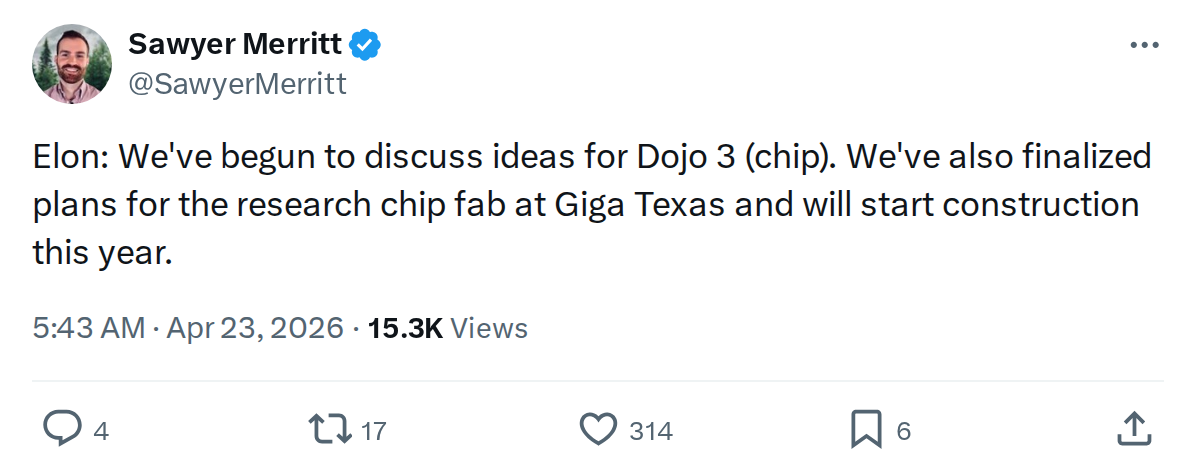
The News: Elon Musk confirmed Tesla has begun discussions on the Dojo 3 chip and finalized plans for a research chip fabrication facility at Gigafactory Texas, with construction starting in 2026.
Why It Matters: Dojo 3 is designed to be Tesla's first fully in-house supercomputer — no external GPUs — and is targeted at space-based AI computing. This signals Tesla's long-term ambition to own its entire AI hardware stack, which ultimately powers FSD, Optimus, and the Cybercab.
Source: @SawyerMerritt on X
Tesla Begins Dojo 3 Chip Discussions — and Is Building Its Own Chip Fab at Giga Texas
Tesla's AI hardware roadmap just got a major new chapter. Elon Musk confirmed this week that Tesla has begun early discussions on the Dojo 3 chip — the next generation of its custom AI training silicon — while simultaneously announcing that plans for a research chip fabrication facility at Gigafactory Texas have been finalized, with construction set to begin this year.
For Tesla owners, this isn't abstract semiconductor news. Every improvement in Tesla's AI training infrastructure — from FSD decision-making to Optimus dexterity to Cybercab autonomy — flows directly from the compute power these chips enable. Dojo 3 is the hardware that trains the software that drives your car.

📊 Key Figures
| Metric | Value | Context |
|---|---|---|
| AI5 Compute Gain vs HW4 | 40× | Processing power increase |
| AI5 Memory Gain vs HW4 | 9× | Memory bandwidth increase |
| AI5 Chip Samples | Late 2026 | Expected availability |
| AI5 High-Volume Production | Mid-2027 | Mass manufacturing target |
| AI6 Performance vs AI5 | ~2× | Expected compute gain |
| Samsung D3 Process Node | 2 nm | Texas facility, training chips |
Where Dojo 3 Fits in Tesla's Chip Roadmap
To understand why Dojo 3 matters, you need to see the full picture of Tesla's AI silicon strategy — which has been moving faster than most people realize.
Tesla paused Dojo development in mid-2025 to concentrate resources on the AI5 chip — its next-generation inference chip destined for Cybercab, Optimus, and Tesla data centers. According to verified reporting, Musk restarted Dojo 3 discussions in January 2026 once the AI5 design reached a stable state. The sequencing is deliberate: nail the inference chip first, then build the training supercomputer around the chips that follow.
Dojo 3 is planned to use AI7 chips — two generations beyond AI5 — and is specifically targeted at space-based AI computing, a use case that demands extreme power efficiency and radiation tolerance. This is a fundamentally different design brief than a ground-based data center, and it explains why Tesla needs its own fab research capability rather than relying entirely on TSMC or Samsung for every process decision.
The Giga Texas Chip Fab: Why This Is a Bigger Deal Than It Sounds
The announcement that Tesla has finalized plans for a research chip fab at Giga Texas — with construction beginning this year — deserves its own spotlight. This isn't a production fab; it's a research and development facility. But that distinction is exactly what makes it strategically significant.
Most chip companies, even large ones, rely entirely on third-party foundries (TSMC, Samsung, Intel Foundry) for all fabrication. A dedicated research fab gives Tesla the ability to experiment with novel packaging, interconnects, and process nodes on its own timeline — without waiting in line behind Apple, Nvidia, or Qualcomm for foundry capacity.
According to background research, Intel's EMIB (Embedded Multi-die Interconnect Bridge) technology is already slated to handle assembly and testing of Dojo modules. Samsung's Texas facility will produce D3 training chips on a 2 nm process. Tesla's own research fab adds a third leg to this manufacturing strategy — one Tesla controls entirely.
The chip roadmap beyond AI5 is structured around roughly nine-month development cycles, with AI6 expected to deliver approximately double the performance of AI5, and AI7 following after that. Dojo 3, built on AI7, is therefore still several years from deployment — but the discussions starting now will shape what Tesla's AI infrastructure looks like in the 2028–2030 window.
🔭 The BASENOR Take
Timeline: Dojo 3 chip discussions just beginning (April 2026) → AI5 samples late 2026 → AI5 high-volume production mid-2027 → AI6 ~9 months after AI5 → AI7 ~9 months after AI6 → Dojo 3 deployment estimated 2028–2029
Impact Level: 🔴 High — long-term implications for FSD capability ceiling, Cybercab economics, and Optimus scalability
Confidence: High — confirmed directly by Elon Musk, corroborated by multiple verified sources
The pattern here is clear and worth naming explicitly: Tesla is executing a vertical integration play in AI hardware that mirrors what it did with battery cells and vehicle manufacturing. Own the design. Own the fab research. Own the training infrastructure. Every layer Tesla controls is a layer where a competitor cannot catch up simply by writing a check to a supplier.
For owners, the near-term relevance is AI5 — not Dojo 3. AI5 is what powers Cybercab's autonomy and what will eventually make its way into Tesla's data center training clusters. Dojo 3 is the training supercomputer that will teach the AI systems running on AI7-equipped vehicles years from now. It's a long game, but the moves being made today are the ones that determine whether Tesla's FSD lead in 2029 is measured in months or years.
Tesla is also actively recruiting engineers for the Dojo team — a reliable signal that this is a fully resourced program, not a skunkworks side project. The research fab at Giga Texas breaking ground this year means there will be tangible, observable progress on this roadmap before 2026 is out. Watch for hiring announcements and construction updates as the next concrete milestones.

Sarah focuses on Tesla Energy, SpaceX missions, and the broader Musk AI portfolio. Former data analyst in clean energy. Based in San Francisco.
Sources verified at publish time. Spotted an inaccuracy? Email editorial@basenor.com.