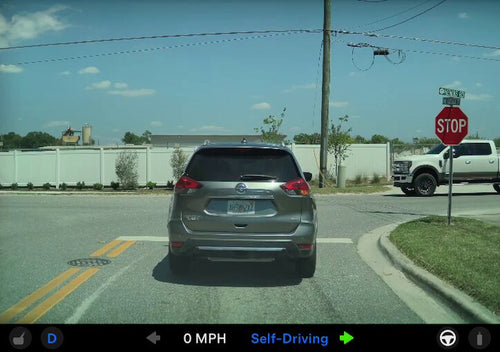
The News: Prominent Tesla community account @wholemars is signaling imminent movement on Tesla's Full Self-Driving rollout in China with a pointed two-word tease.
Why It Matters: China is Tesla's second-largest market. A meaningful FSD expansion there would be a commercial and regulatory milestone with global implications for every Tesla owner watching autonomous driving progress.
Source: @wholemars on X

Two words. Eleven thousand views in under an hour. When Whole Mars Catalog posts "FSD China 👀" at midnight, the Tesla community pays attention — and for good reason. The hint lands at a moment when FSD's regulatory journey in China has been one of the most-watched storylines in the EV world.
Where FSD in China Actually Stands Right Now
Let's be precise, because this story has a lot of noise around it. Tesla does not yet have full regulatory approval for FSD in China. What it does have is meaningful and growing: since February 2025, Tesla has been rolling out what it calls "Intelligent Assisted Driving" — an advanced Level 2 system for urban roads — to Chinese owners. Drivers must remain attentive and in control, but the feature set is substantively more capable than basic Autopilot.
The path to that point wasn't simple. Tesla partnered with Baidu in April 2024 for lane-level mapping and navigation — a critical infrastructure requirement under Chinese regulations — and secured partial clearance on data security and privacy requirements. Tesla also established a local FSD training center in China to adapt the system to domestic driving conditions, a non-trivial undertaking given how different urban driving patterns are in Chinese cities compared to the US.
📊 FSD China: Key Facts
| Current Feature Status | "Intelligent Assisted Driving" (Level 2) live since Feb 2025 |
| Hardware Requirement | Hardware 4.0 |
| Software Version | FSD V13.2.6 |
| Purchase Price (China) | RMB 64,000 (~$8,990) |
| Free Trial Period | March 17 – April 16, 2026 (now ended) |
| Full Regulatory Approval | Pending — no confirmed date |
| Global FSD Driving Data | 12 billion km (7.5 billion miles) as of Feb 2026 |
The Regulatory Saga: What Happened to Musk's February Deadline?
Elon Musk had publicly expected Tesla to receive full FSD regulatory approval in China around February or March 2026. That timeline didn't hold. In January 2026, Chinese state media — citing a government source — stated that Musk's February claim was "not true." Tesla China Vice President Grace Tao confirmed in February 2026 that no specific launch date had been set.
That context makes the @wholemars signal on April 20 worth watching closely. The free trial period for FSD V13.2.6 (which required Hardware 4.0) ended on April 16 — just four days before this tweet. A hint dropping immediately after the trial window closes could suggest Tesla is preparing the next phase: a broader commercial rollout, a new trial, or a regulatory announcement. None of that is confirmed. But the timing is not random.
🔭 The BASENOR Take
Timeline: Signal posted April 20, 2026 — 4 days after the China FSD free trial ended
Impact Level: 🔴 High — China is Tesla's second-largest market; FSD expansion there directly affects sales momentum and the global autonomous driving narrative
Confidence: 🟡 Medium — @wholemars has a strong track record of early signals, but this is a two-word tease, not an official announcement. Regulatory approval in China moves on Beijing's timeline, not Tesla's.
Here's what makes this moment genuinely significant beyond the tweet itself: China's regulatory posture toward FSD has been the single biggest external constraint on Tesla's autonomous driving business outside the US. Full approval — or even a meaningfully expanded Level 2+ rollout — would do several things at once.
First, it would unlock a major revenue stream. At RMB 64,000 (~$8,990) per vehicle, FSD attach rates in China have room to grow substantially if the product earns trust through expanded availability. Unlike the US market, where Tesla ended the one-time purchase option on February 14, 2026, Chinese buyers can still purchase FSD outright — no subscription model has launched there yet.
Second, it feeds Tesla's data flywheel. With over 12 billion kilometers of global FSD driving data accumulated as of February 2026, adding dense Chinese urban driving data would accelerate training on some of the world's most complex traffic environments — a capability gap that matters for every market Tesla operates in.
Third, it changes the competitive story in China. Tesla's local rivals — including BYD and a wave of domestic smart-EV startups — have been aggressive on advanced driver assistance features. A credible FSD expansion gives Tesla a differentiated answer in a market where software capability increasingly drives purchase decisions.
The infrastructure is in place: the Baidu mapping partnership, the local training center, the Hardware 4.0 vehicles already on Chinese roads. What's been missing is the regulatory green light for the full product. Whether @wholemars is signaling that light is about to turn — or simply that something notable is in motion — is the question every Tesla watcher in China is now asking. For our FSD coverage, this is a story we'll be tracking closely as details emerge.