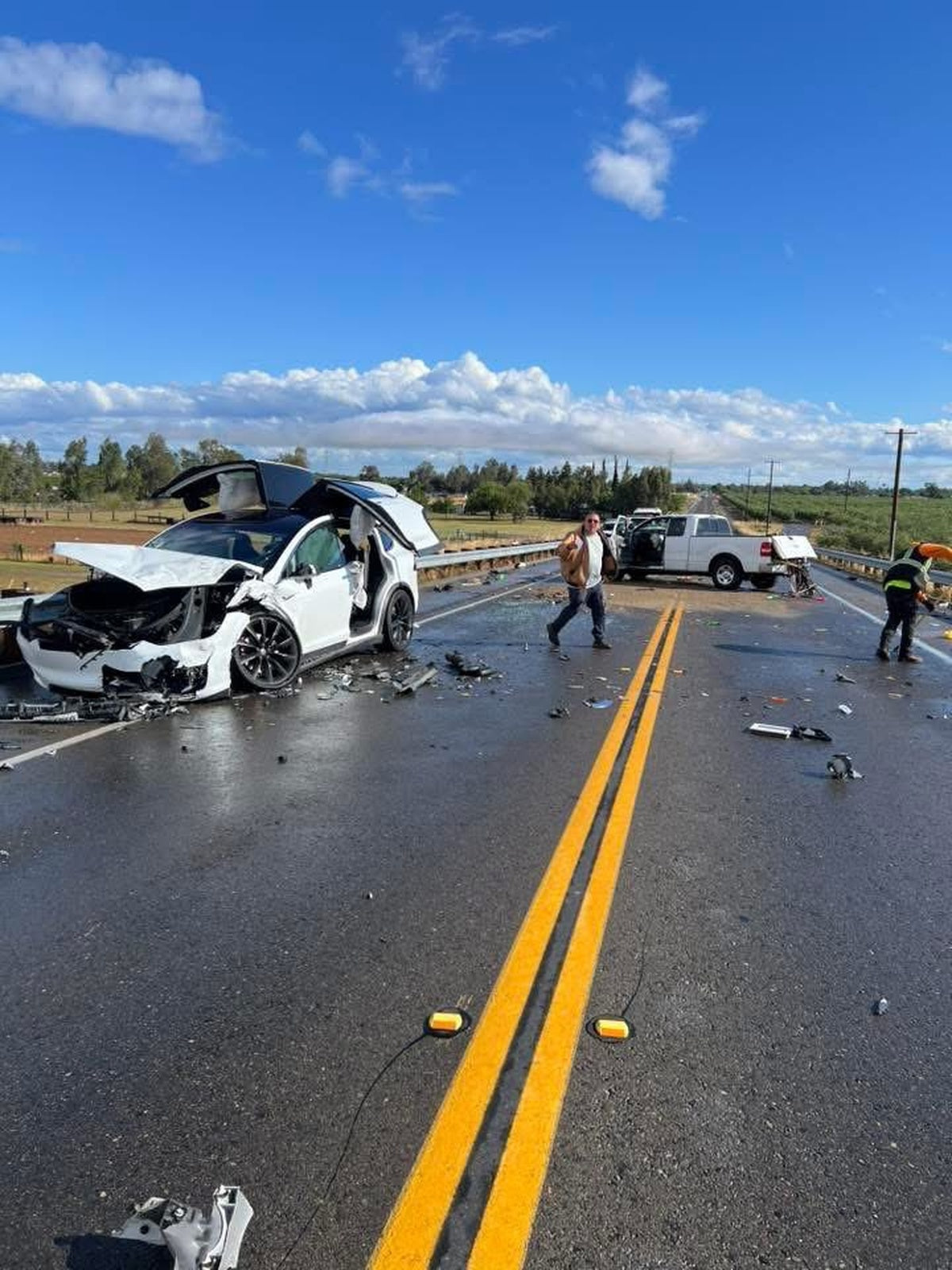
The News: A Tesla Model X driver survived a severe head-on collision with a drunk driver, walking away with only swelling, bruising, and a fractured sternum — while the other driver was ejected and hospitalized in the ICU.
Why It Matters: Real-world crashes continue to validate Tesla's safety architecture, reinforcing why the Model X holds a 5-star NHTSA rating in every tested category.
Source: @TeslaNewswire on X
Tesla Model X Survives Head-On Collision With Drunk Driver — Driver Walks Away
Another real-world crash has put Tesla's safety engineering in the spotlight. A Tesla Model X driver was struck head-on by a drunk driver and survived with what amounts to survivable injuries — swelling, bruising, and a fractured sternum. The other driver, who was ejected from his vehicle, is now in the ICU at a trauma center.
This is not a controlled lab test. It's a head-on collision — statistically among the most lethal crash types on public roads — and the Model X absorbed it well enough for the driver to walk away.

📊 Key Figures
| Metric | Model X Driver | Drunk Driver |
|---|---|---|
| Outcome | Walked away | Ejected from vehicle |
| Injuries | Swelling, bruising, fractured sternum | Critical — ICU at trauma center |
| Vehicle Status | Model X (intact enough for occupant survival) | Ejection indicates severe structural failure |
| NHTSA Overall Rating | 5-Star (every category) | — |
What the Model X Is Built to Do in a Crash
The Model X's survival performance in this incident isn't luck — it's the product of deliberate engineering choices that Tesla has been refining for over a decade.
The vehicle's all-electric architecture plays a central role. Without a traditional combustion engine filling the front crumple zone, Tesla engineers designed a front structure that progressively absorbs and redirects crash energy away from the occupant cell. The battery pack, mounted flat beneath the floor, acts as a structural backbone — creating a rigid, low-center-of-gravity platform that resists both deformation and rollover.
According to NHTSA testing data, the Model X was the first SUV ever to achieve a 5-star rating in every single tested category and sub-category — frontal crash, side crash, and rollover. NHTSA data also indicates the Model X has the lowest probability of injury of any SUV it has ever tested, with an estimated 93% probability that occupants walk away from a serious crash without serious injury.
A fractured sternum — painful and serious, but survivable — is consistent with what happens when a properly restrained occupant decelerates rapidly inside a well-engineered safety cell. The airbags deploy, the seatbelt pre-tensioners fire, and the structure does its job. The driver walks away. In this case, that's exactly what happened.
The contrast with the other driver is stark. Ejection from a vehicle is one of the most dangerous outcomes in any crash — it indicates the occupant's restraint system or vehicle structure failed to contain them. That driver is now in a trauma ICU.
🔭 The BASENOR Take
Timeline: Crash occurred prior to April 25, 2026 — reported same day
Impact Level: 🟡 Medium — individual incident, but part of a consistent pattern
Confidence: High — sourced from direct crash reporting with photographic evidence
Stories like this one matter beyond the individual. They are data points in an ongoing real-world safety record that no lab test can fully replicate. Head-on collisions are high-energy events — the combined closing speeds of two vehicles can easily exceed 100 mph. The fact that a Model X driver sustained a fractured sternum and walked away, rather than being transported to a trauma center themselves, is a meaningful outcome.
Tesla's safety record in real-world crashes has been a consistent thread across multiple incidents and vehicle models. The architecture that makes this possible — the rigid battery floor, the engineered crumple zones, the absence of a heavy engine block in the primary impact path — is baked into every Tesla produced. It's not a feature you can add after the fact. It's the vehicle itself.
For current Model X owners, this incident is a reminder of what you're driving. For anyone considering a large family SUV, the safety data — both official ratings and real-world outcomes — deserves serious weight in the decision. The IIHS awarded the Model X its Top Safety Pick+ designation, and NHTSA's 5-star sweep across every category remains among the strongest results any SUV has ever posted.
The drunk driver who caused this crash is in critical condition. The Model X driver is recovering at home. That gap in outcomes tells the story more clearly than any test dummy ever could.
Related Gear
Gear up your Model S & X with tested, custom-fit BASENOR accessories — shop Model S & X accessories →
Sources & reporting notes
The links below identify the material source records used for this report.
- @TeslaNewswire on X (2026-04-25T19:39:21.000Z) — Direct source
Source links are preserved as published or accessed. See our editorial standards and corrections policy.
The BASENOR Editorial Desk covers Tesla, SpaceX, and related technology, curating reporting from primary sources — official accounts, regulatory filings, and software release data. Every article passes source-record and fact-checking review before publication. About the newsroom.
This report was curated by the BASENOR Editorial Desk from the sources listed above. Read our editorial standards or email editorial@basenor.com to report an error.