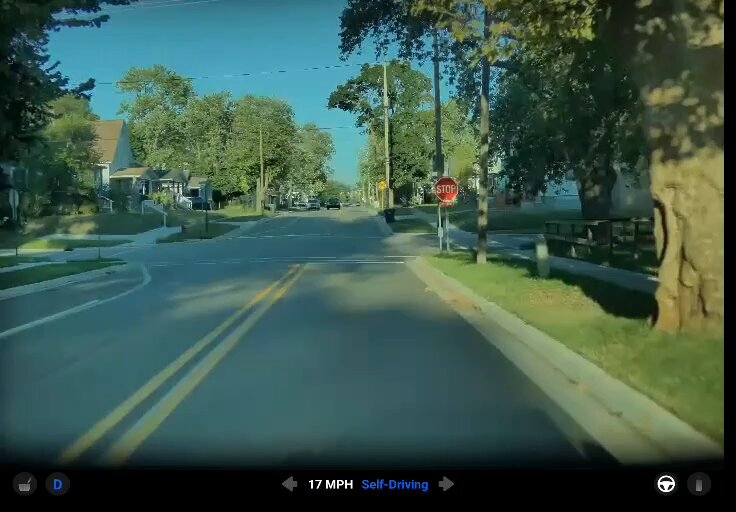
A video circulating on X this week captures a police officer doing a rolling stop at a stop sign — the same maneuver NHTSA forced Tesla to remove from Full Self-Driving back in 2022. The clip, shared by Tesla commentator Sawyer Merritt, cuts to the heart of a tension that FSD owners have quietly complained about for years: the software is held to a legal standard that human drivers — including the people who enforce those laws — routinely ignore.

1. Tesla actually built rolling stops into FSD — and it worked
In October 2020, Tesla shipped FSD Beta version 2020.40.4.10 with a deliberate rolling stop feature. Under tightly defined conditions — all-way stop intersection, speed below 5.6 mph, no detected pedestrians, cyclists, or moving vehicles, sufficient visibility, and surrounding road speed limits at or below 30 mph — FSD could ease through without a full halt. Tesla reported no crashes, injuries, or fatalities linked to the feature during its time in the field. It wasn't a bug. It was an intentional design choice that mirrored how most drivers actually behave.
2. NHTSA disagreed — and triggered a recall
After discussions with Tesla on January 10 and January 19, 2022, NHTSA determined that rolling stops increase collision risk and pushed for a fix. Tesla voluntarily issued recall NHTSA ID 22V-037, covering 53,822 vehicles in the US and Canada — certain Model S (2016–2022), Model X (2016–2022), Model 3 (2017–2022), and Model Y (2020–2022) vehicles running the affected firmware. The fix arrived as an OTA update beginning with firmware 2021.44.30.15 in early February 2022. No hardware, no service visit — just a software patch that removed the capability entirely.
3. Current FSD stops completely — sometimes twice
Post-recall, Tesla's FSD (Supervised) is designed to come to a full stop at stop signs and traffic lights. Owners have noted the system occasionally performs what they call a 'double stop' — halting at the sign line, then creeping forward to a better sightline and stopping again before proceeding. It's technically correct behavior, but it can feel stilted compared to how a confident human driver would handle the same intersection. That gap between legal compliance and natural driving feel is exactly what Merritt's video puts a spotlight on.
4. The enforcement irony is real — and documented
NHTSA's position is that rolling stops 'increase the risk of a collision.' That's the agency's official rationale for the recall. The video shared by Merritt shows a police officer — someone whose job includes issuing citations for this exact infraction — doing a rolling stop without apparent concern. This isn't an isolated observation. Traffic safety researchers have long noted that rolling stops are among the most universally practiced and least enforced moving violations on American roads. FSD is being held to the letter of a law that human enforcement treats as effectively optional.
5. The double standard has real consequences for FSD development
This isn't just an abstract fairness argument. When autonomous systems are required to behave more conservatively than surrounding traffic, they can become a friction point — hesitating in ways that feel unnatural to other drivers or, in some cases, creating minor flow disruptions at busy intersections. Regulators are beginning to grapple with this more broadly as autonomous vehicles move from test fleets to consumer products. The question of whether AV standards should reflect the law as written or driving behavior as practiced is one that NHTSA, state DMVs, and manufacturers will need to resolve as FSD and similar systems scale. For now, your Tesla stops. Everyone else might not.
Related Gear
Gear up your Tesla with tested, custom-fit BASENOR accessories — shop Tesla accessories →
Sources & reporting notes
The links below identify the material source records used for this report.
- @SawyerMerritt on X (2026-08-18T04:43:27.000Z) — Direct source
Source links are preserved as published or accessed. See our editorial standards and corrections policy.
The BASENOR Editorial Desk covers Tesla, SpaceX, and related technology, curating reporting from primary sources — official accounts, regulatory filings, and software release data. Every article passes source-record and fact-checking review before publication. About the newsroom.
This report was curated by the BASENOR Editorial Desk from the sources listed above. Read our editorial standards or email editorial@basenor.com to report an error.