Adam L. Wingfield has driven more than a million miles in commercial trucks. He's also the Editorial Director at FreightWaves — someone who thinks about the trucking industry for a living. So when he toured Tesla's newly inaugurated Semi factory in Sparks, Nevada, his reaction carried real weight: "This doesn't feel like trucking." That sentence, shared in a post-event interview, says more about where the industry stands than any analyst report.

Who is Adam Wingfield, and why does his opinion matter here?
Wingfield isn't a tech enthusiast who took a factory selfie. He's a million-mile commercial driver and Editorial Director at FreightWaves, one of the most closely followed freight and logistics publications in North America. His perspective bridges the operational reality of long-haul trucking with the analytical lens of an industry journalist. When someone with that background walks a factory floor and comes away genuinely impressed, it's not a PR moment — it's a data point.
What exactly did he see at the factory?
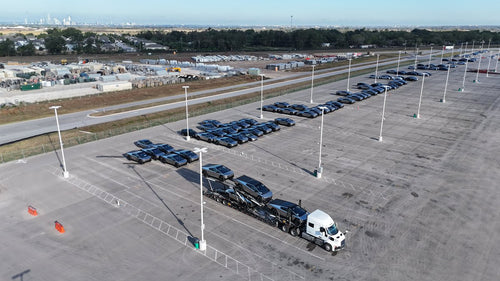
Wingfield toured Tesla's dedicated Semi production facility in Sparks, Nevada, which Tesla formally inaugurated on September 24, 2026. The plant is a 1.7 million square foot facility built adjacent to Gigafactory Nevada, designed for an annual capacity of up to 50,000 Semis — roughly 1,000 trucks per week at full run rate. According to reporting from FreightWaves and industry sources, the factory emphasizes vertical integration, with Tesla manufacturing its own 4680 battery cells on-site. The first truck from the new production line rolled off in April 2026, making the September launch event the formal transition to high-volume output.

What did he mean when he said it "doesn't feel like trucking"?
That line is the crux of his reaction. Traditional truck manufacturing — and the trucking industry broadly — has been slow to adopt new technology. Cab designs, drivetrain architecture, and factory processes at legacy OEMs have evolved incrementally over decades. What Wingfield encountered at the Tesla Semi facility was something structurally different: an automated, software-centric production environment that looked more like a consumer electronics plant than a conventional truck assembly line. The contrast, for someone who has spent a career in traditional freight, was stark enough to stop him mid-tour.
How slow has the traditional trucking industry actually been to adopt technology?
Wingfield's comment about slow adoption isn't hyperbole — it's a widely acknowledged reality within freight circles. Advanced driver-assistance systems, electronic logging devices, and telematics have taken years, sometimes decades, to achieve meaningful penetration in commercial fleets. Many Class 8 operators still run on procurement cycles and maintenance cultures built around diesel powertrains that haven't fundamentally changed since the 1980s. Tesla's approach — building the truck, the battery, the software stack, and now the factory from scratch — sidesteps that legacy entirely.

What does the factory's scale tell us about Tesla's ambitions in freight?
A 50,000-unit annual capacity target is a serious number for the Class 8 segment. For context, the entire U.S. Class 8 truck market typically sees around 250,000–300,000 new registrations per year. A facility designed to supply roughly 15–20% of that market — once at full capacity — signals that Tesla is not treating the Semi as a niche product or a halo vehicle. The vertical integration of 4680 battery production within the same campus also suggests Tesla is betting that controlling the energy storage supply chain is as critical in commercial trucking as it has been in passenger EVs.

The trucking industry's technology gap has been a known problem for years — but it's rarely been illustrated this vividly. A million-mile driver walking a factory floor and struggling to reconcile what he's seeing with his entire professional experience is a more honest assessment than any spec sheet. Whether legacy OEMs respond in time, or whether Tesla's Sparks facility becomes the template for what Class 8 manufacturing looks like in 2030, is the question the freight world is now quietly asking itself.
Related Gear
Gear up your Tesla with tested, custom-fit BASENOR accessories — shop Tesla accessories →
Sources & reporting notes
The links below identify the material source records used for this report.
- @SawyerMerritt on X (2026-10-06T03:58:55.000Z) — Direct source
Source links are preserved as published or accessed. See our editorial standards and corrections policy.
The BASENOR Editorial Desk covers Tesla, SpaceX, and related technology, curating reporting from primary sources — official accounts, regulatory filings, and software release data. Every article passes source-record and fact-checking review before publication. About the newsroom.
This report was curated by the BASENOR Editorial Desk from the sources listed above. Read our editorial standards or email editorial@basenor.com to report an error.