30-Second Brief
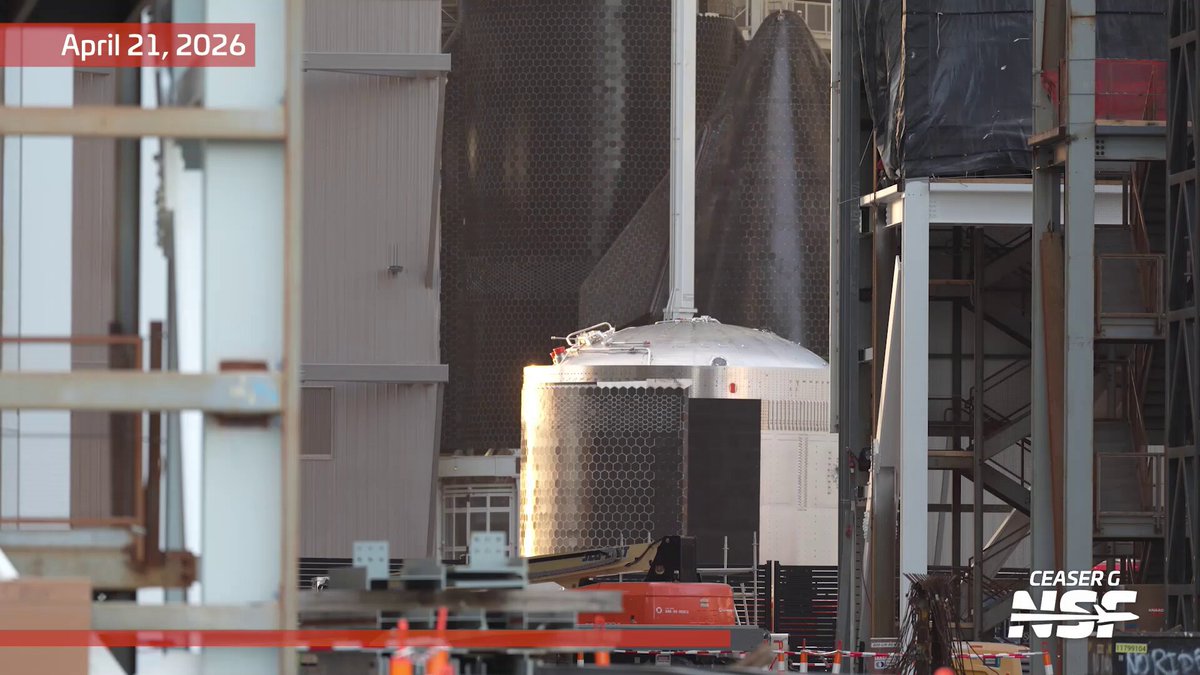
The News: NASASpaceflight reports SpaceX has Starship production running through at least Ship 48, with Ship 41 — designated for Flight 14 — already in stacking at Starbase.
Why It Matters: A packed vehicle pipeline, a second operational launch pad, and active KSC planning signal SpaceX is shifting Starship from test program to operational launch system — with direct implications for Tesla's satellite connectivity, Cybercab autonomy infrastructure, and NASA's lunar ambitions.
Source: @NASASpaceflight on X
Starship's Production Pipeline Is Stacking Up Fast — Ships 41 Through 48 Already in the Works
SpaceX's Starship program has crossed a threshold that would have seemed implausible even two years ago: vehicles are now being built faster than they can fly. NASASpaceflight confirmed late Friday that production is underway through at least Ship 48, while Ship 41 — the vehicle assigned to Flight 14 — is already being stacked at Starbase. That's not a test program anymore. That's a production line.

📊 Key Figures
| Metric | Value | Context |
|---|---|---|
| Highest ship in production | Ship 48 | Confirmed by NSF |
| Flight 14 vehicle | Ship 41 | Already stacking |
| Starfactory production rate | 1 stack / 14 days | Ship + booster |
| V3 payload to LEO | >100 tonnes | vs ~35t for V2 |
| Proposed KSC launch rate | Up to 44/year | FAA review underway |
| Pad 2 status | Operational | Doubles Starbase capacity |
From Test Flights to Flight Manifest: What's Actually Happening at Starbase
The jump from Ship 41 (Flight 14, currently stacking) to Ship 48 (in production) represents roughly seven vehicles in various stages of build simultaneously. That kind of overlap only makes sense if SpaceX is confident in the architecture — and the numbers back that up. According to reporting from space.com, SpaceX's Starfactory automated manufacturing facility at Starbase is now capable of producing one complete ship-and-booster stack every 14 days.
The vehicles coming off that line are meaningfully different from earlier Starships. The current Starship V3 architecture — which Ship 39 inaugurated as the first V3 ship — is approximately 10 meters taller than V2, carries over 100 tonnes to low Earth orbit (versus ~35 tonnes for V2), and runs on the new Raptor 3 engines, which are lighter, more powerful, and more reliable than their predecessors. Booster 19, the V3 Super Heavy, has already completed a full 33-engine static fire at Pad 2.
The next major milestone is Flight 12, which will be the first full V3 architecture flight and is tentatively scheduled for May 2026. An earlier April target slipped due to a prioritized block-wide software and hardware integration check — the kind of delay that signals SpaceX is treating these vehicles more like operational assets than expendable prototypes.
The KSC Angle: Why Barge Transport Matters
NASASpaceflight's mention of potential KSC launches via barge is the detail that deserves more attention. The FAA is nearing completion of its environmental review for Starship launches from Launch Complex 39A at Kennedy Space Center — the same pad that launched Apollo 11 and the Space Shuttle. SpaceX has proposed up to 44 Starship-Super Heavy launches per year from LC-39A, with Super Heavy boosters landing back at the pad or on a droneship, and Starship upper stages landing at LC-39A or in the ocean.
Transporting vehicles by barge from Starbase to KSC is a logistical bridge that lets SpaceX begin staging vehicles at LC-39A before the pad is fully certified for launches. An orbital launch mount matching Starbase's latest configuration was already transported to LC-39A in November 2025. The infrastructure is moving faster than the regulatory timeline — which is exactly how SpaceX prefers to operate.
🔭 The BASENOR Take
Timeline: Flight 12 targeting May 2026 → Flight 14 (Ship 41) likely Q3 2026 → KSC launches pending FAA approval
Impact Level: 🔴 High — This is the inflection point where Starship becomes a recurring launch system, not a development program
Confidence: High — NSF reporting is sourced directly from Starbase observations; production figures corroborated by multiple space journalists
The pipeline from Ship 41 to Ship 48 tells a story that's easy to miss in the headline numbers: SpaceX is building vehicles for missions that haven't been announced yet. That's the behavior of a company that has solved the hard engineering problems and is now optimizing for throughput. For context, the program's entire history through Flight 7 involved fewer unique vehicles than are currently in simultaneous production.
For Tesla owners specifically, the Starship cadence has downstream relevance. Starlink's next-generation satellite constellation — which powers the in-car connectivity that Tesla vehicles use for over-the-air updates, navigation data, and the Tesla app — depends on Starship's ability to deploy large batches of V3 satellites. A faster Starship launch rate means a denser, faster Starlink network. It also means SpaceX's orbital refueling demonstrations, tentatively targeted for mid-2026, move closer to reality — a prerequisite for the lunar and Mars missions that define SpaceX's long-term roadmap.
The second operational pad at Starbase, combined with the pending KSC approval, means SpaceX could theoretically be running three launch sites for Starship before the end of 2026. That's not a moonshot anymore. That's a launch schedule. For more on SpaceX's trajectory, see our SpaceX coverage.
🚀 Following the Starship program? See every test flight, official outcome and the next launch window in our SpaceX Starship Tracker.
Related Gear
Gear up your Tesla with tested, custom-fit BASENOR accessories — shop Tesla accessories →
Sources & reporting notes
The links below identify the material source records used for this report.
- @NASASpaceflight on X (2026-04-25T23:18:01.000Z) — Direct source
Source links are preserved as published or accessed. See our editorial standards and corrections policy.
The BASENOR Editorial Desk covers Tesla, SpaceX, and related technology, curating reporting from primary sources — official accounts, regulatory filings, and software release data. Every article passes source-record and fact-checking review before publication. About the newsroom.
This report was curated by the BASENOR Editorial Desk from the sources listed above. Read our editorial standards or email editorial@basenor.com to report an error.