30-Second Brief
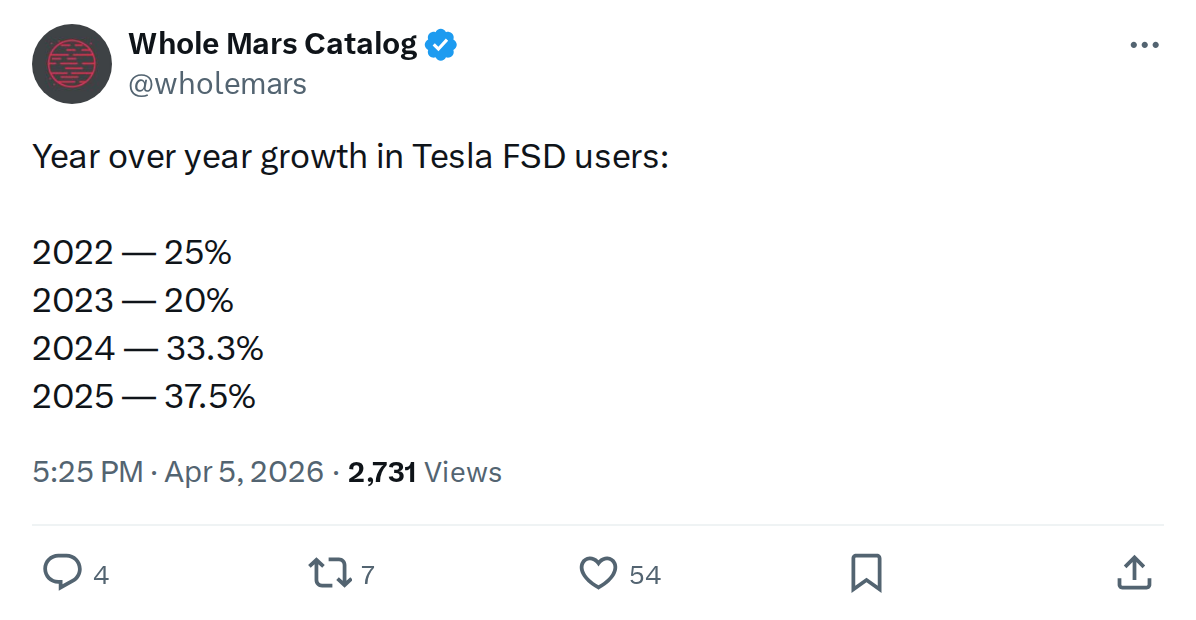
The News: New data shared by Whole Mars Catalog shows Tesla's Full Self-Driving user base grew 37.5% year-over-year in 2025, reaching 1.1 million active users — nearly triple the 400,000 recorded in 2021.
Why It Matters: Accelerating FSD adoption signals growing owner confidence in the technology, strengthens Tesla's recurring software revenue, and sets the stage for the subscription-only model now in effect.
Source: @wholemars on X
Tesla FSD Hits 1.1 Million Users: The Growth Story Behind the Numbers
For years, Tesla's Full Self-Driving user count was one of the most closely guarded figures in the EV industry. That changed with the Q4 2025 earnings report, which disclosed concrete subscriber figures for the first time. Now, data shared by Whole Mars Catalog puts the entire growth arc in sharp relief — and the acceleration is hard to ignore.

📊 Key Figures
| Year | Active FSD Users | Net Adds | YoY Growth |
|---|---|---|---|
| 2021 | 400,000 | — | — |
| 2022 | 500,000 | +100,000 | 25% |
| 2023 | 600,000 | +100,000 | 20% |
| 2024 | 800,000 | +200,000 | 33.3% |
| 2025 | 1,100,000 | +300,000 | 37.5% |
Source: Whole Mars Catalog / Tesla Q4 2025 Earnings Report

The Inflection Point: 2024 Changed Everything
The numbers tell a clear story: FSD adoption was steady but unspectacular through 2022 and 2023, adding 100,000 users each year. Then something shifted. In 2024, net additions doubled to 200,000 — a 33.3% growth rate that snapped a two-year deceleration trend. In 2025, Tesla added another 300,000 users, pushing the growth rate to 37.5% and crossing the psychologically significant 1 million threshold.
The timing of the 2024 acceleration is not coincidental. Tesla launched FSD v12 in early 2024, the first version built entirely on end-to-end neural networks — a fundamental architectural shift that drew widespread attention from owners who had previously dismissed the feature. The improvement in real-world performance gave fence-sitters a concrete reason to subscribe.
What 12.4% Take Rate Actually Means
According to Tesla's Q4 2025 earnings disclosure, the 1.1 million active FSD users represent approximately 12.4% of Tesla's cumulative global delivery base of 8.9 million vehicles. That figure cuts two ways.
On one hand, 12.4% is genuinely impressive for a premium software add-on — particularly one that carries a $99/month price tag. On the other hand, it means roughly 87.6% of Tesla owners on the road today are not using FSD. That is an enormous addressable market sitting inside Tesla's existing customer base, requiring no new vehicle sales to convert.
The ownership split is also worth noting: approximately 70% of active FSD users (~770,000 vehicles) hold outright purchases, while 30% (~330,000) are on monthly subscriptions. That ratio will shift dramatically going forward. Tesla discontinued the one-time purchase option after February 14, 2026, meaning every new FSD user from this point forward is a recurring subscriber. For Tesla's software revenue line, this is a structural change — lumpy upfront payments replaced by predictable monthly cash flow.
🔭 The BASENOR Take
Timeline: FSD user base grew from 400K (2021) to 1.1M (2025) — a 175% increase over four years.
Impact Level: 🟡 Medium-High — Meaningful for Tesla's software revenue trajectory and the autonomous driving roadmap, but the 12.4% take rate still leaves significant headroom.
Confidence: 🟢 High — Growth figures align precisely with Tesla's own Q4 2025 earnings disclosure. These are not estimates; they are confirmed numbers.
The acceleration from 2023 to 2025 is the most important signal here. Two consecutive years of slowing growth (2022 and 2023) followed by two consecutive years of re-acceleration suggests the technology itself — not marketing or pricing — is driving adoption. Owners who tried FSD v12 and later versions are, by and large, staying subscribed.
The shift to subscription-only also changes the analytical lens going forward. The relevant metric is no longer just user count — it is monthly active subscribers and churn rate. A user base of 1.1 million at $99/month represents roughly $109 million in monthly recurring revenue from FSD alone, before accounting for any Robotaxi or autonomous fleet revenue Tesla is targeting. If the 37.5% growth rate holds through 2026, that user base could approach 1.5 million by year-end.
📰 Deep Dive
The broader context for these numbers is Tesla's long-stated ambition to transform from a hardware company into a software and services company. FSD is the clearest expression of that strategy. Every owner who subscribes is, in effect, paying Tesla a recurring fee for capability improvements delivered over the air — a business model with dramatically higher margins than selling physical vehicles. For our FSD coverage, this milestone represents the moment the strategy started producing meaningful scale.
What the raw growth numbers do not capture is the quality of that growth. The 2024 and 2025 cohorts adopted FSD after experiencing v12 and its successors — versions that received substantially better real-world reviews than earlier iterations. Those users are less likely to be early adopters tolerating rough edges and more likely to be mainstream owners who found genuine utility. That distinction matters enormously for long-term retention.
The subscription-only transition introduces a new dynamic. Historically, a large portion of FSD 'users' were owners who purchased the package years ago and may rarely engage with it. Monthly subscribers, by contrast, are actively choosing to pay each month — a built-in retention signal. As the purchased-FSD cohort ages out and the subscriber base grows, Tesla will have far cleaner data on actual engagement and churn. That data, in turn, will shape pricing, feature prioritization, and the eventual Robotaxi rollout economics in ways that are difficult to model today but increasingly important to watch.

Marcus covers Tesla's software releases, FSD rollouts, and OTA changes. Background in automotive engineering. Based in Austin.
Sources verified at publish time. Spotted an inaccuracy? Email editorial@basenor.com.