30-Second Brief
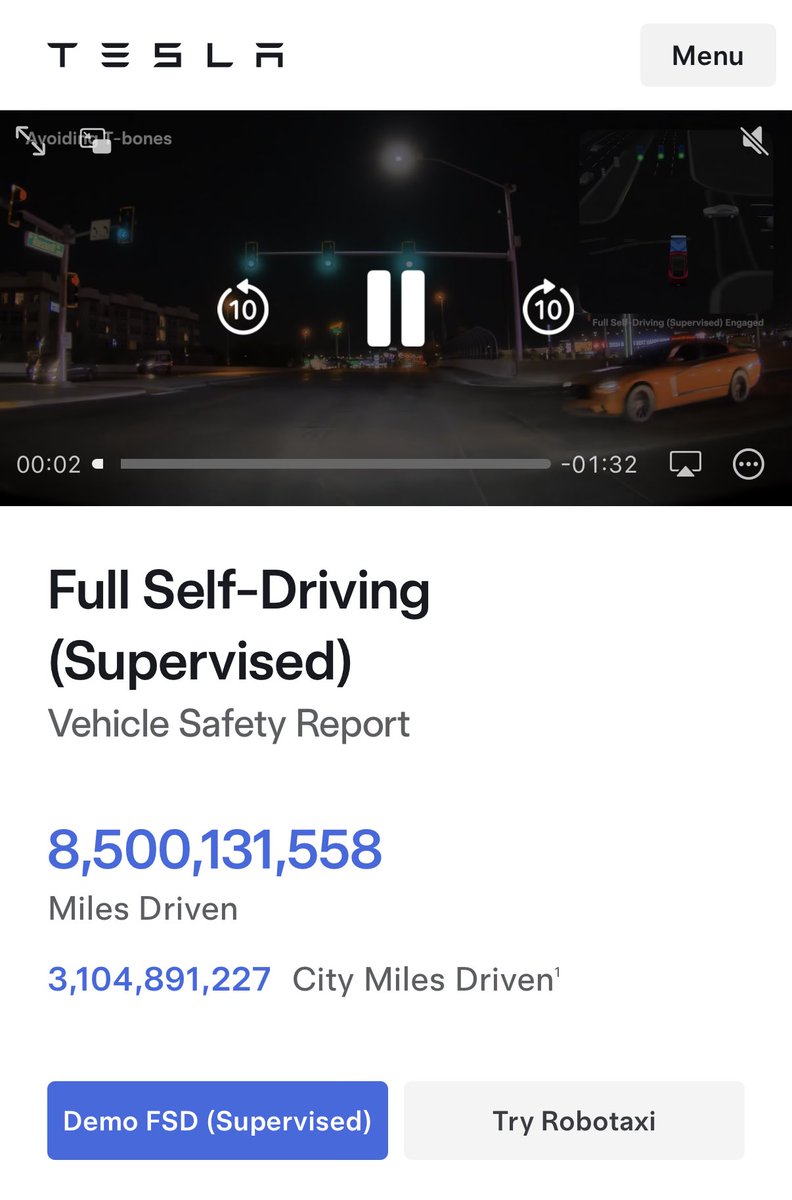
The News: Tesla's Full Self-Driving (Supervised) fleet has now accumulated 8.5 billion cumulative miles, equating to roughly one mile driven for every person on Earth.
Why It Matters: Every mile adds real-world training data that moves Tesla closer to the ~10 billion mile threshold Elon Musk has cited as a potential benchmark for safe, unsupervised autonomy — now potentially just months away.
Source: @wholemars on X
Tesla's Full Self-Driving (Supervised) system has hit a milestone that's hard to wrap your head around: 8.5 billion miles of real-world driving data, accumulated across a growing list of countries. To put that in human terms, that's approximately one mile driven by Tesla's FSD fleet for every single person alive on Earth today.


📊 Key Figures
| Metric | Value | Context |
|---|---|---|
| Cumulative FSD Miles | 8.5 billion | ~1 mile per person on Earth |
| Miles added in first 50 days of 2026 | 1 billion | ~20M miles/day |
| Musk's cited unsupervised threshold | ~10 billion | ~1.5B miles remaining |
| Safety vs. manual driving | 7× safer | Per Tesla safety page |
| FSD miles in 2025 | 4.25 billion | vs. 2.25B in 2024 |
| FSD miles in 2021 | ~6 million | 700× growth in 4 years |
From 6 Million to 8.5 Billion: The Growth Curve Is Staggering
The raw number is impressive, but the rate of growth is what should really get your attention. In 2021, Tesla's FSD fleet logged roughly 6 million miles for the entire year. By 2025, that figure was 4.25 billion miles — a roughly 700-fold increase in four years. And the acceleration isn't slowing down: in just the first 50 days of 2026, owners added another 1 billion miles to the total.
That pace works out to approximately 20 million miles per day. At that rate, the fleet is adding the equivalent of 2021's entire annual mileage every single morning before breakfast.
📈 Annual FSD Mileage Growth
Bars scaled relative to 2025 figure. Source: Tesla safety data.
The 10 Billion Mile Question
Elon Musk has previously indicated that approximately 10 billion miles of training data may be the threshold needed to achieve safe, unsupervised self-driving at scale. With 8.5 billion in the books and roughly 1.5 billion miles to go, Tesla is now within striking distance of that benchmark.
At the current accumulation rate, the fleet is on track to cross 10 billion miles by mid-2026 — potentially as early as this summer. That doesn't mean unsupervised FSD flips on the day the odometer ticks over, but it does mean the data foundation Tesla has been building is nearly complete by Musk's own stated measure.
FSD (Supervised) is currently available in the U.S., Canada, China, Mexico, Puerto Rico, Australia, New Zealand, and South Korea — and every active user in those markets is contributing to this dataset in real time.
🔭 The BASENOR Take
The 8.5 billion mile figure isn't just a vanity metric. It represents the largest real-world autonomous driving dataset ever assembled — by a significant margin. Every edge case, every unusual weather event, every unexpected pedestrian behavior is captured and fed back into Tesla's neural networks via its fleet learning system.
What makes this data uniquely valuable is its diversity. Unlike controlled test environments, Tesla's fleet encounters the full chaos of real roads across multiple countries, climates, and driving cultures. That breadth is precisely why Musk has framed the mileage threshold as a meaningful proxy for readiness.
For current FSD subscribers, the practical implication is straightforward: the system you're using today is meaningfully better than it was six months ago, and the gap between supervised and unsupervised capability is narrowing faster than most people realize. The 10 billion mile mark isn't a finish line — but it's a very significant signpost on the road to it. Keep your FSD coverage bookmarked.
📰 Deep Dive
The safety data behind this milestone is worth examining on its own terms. According to Tesla's official safety page, FSD (Supervised) records one major collision per 5,300,676 miles when engaged — compared to one per 855,132 miles for manual driving. That's a 7× safety improvement, and it's being validated across billions of real miles, not simulations.
The geographic expansion also matters. FSD is no longer a U.S.-only phenomenon. With active deployments in Canada, China, Mexico, Puerto Rico, Australia, New Zealand, and South Korea, the training data now reflects genuinely diverse road conditions. Chinese urban driving alone — with its unique traffic density and intersection behavior — adds a dimension of complexity that strengthens the model's generalization capability.
The year-over-year growth numbers tell a story of compounding adoption. Going from 2.25 billion miles in 2024 to 4.25 billion in 2025 represents an 89% increase — and 2026 is already outpacing that trajectory. As more vehicles ship with FSD included and subscription uptake grows, the daily mileage accumulation rate will continue to climb. The 10 billion mile mark, once a distant target, now looks like a 2026 certainty rather than a hope.
Related Gear
Gear up your Tesla with tested, custom-fit BASENOR accessories — shop Tesla accessories →
Sources & reporting notes
The links below identify the material source records used for this report.
- @wholemars on X (2026-03-06T00:33:12.000Z) — Direct source
- @wholemars on X (2026-03-06T00:31:45.000Z) — Direct source
Source links are preserved as published or accessed. See our editorial standards and corrections policy.
The BASENOR Editorial Desk covers Tesla, SpaceX, and related technology, curating reporting from primary sources — official accounts, regulatory filings, and software release data. Every article passes source-record and fact-checking review before publication. About the newsroom.
This report was curated by the BASENOR Editorial Desk from the sources listed above. Read our editorial standards or email editorial@basenor.com to report an error.