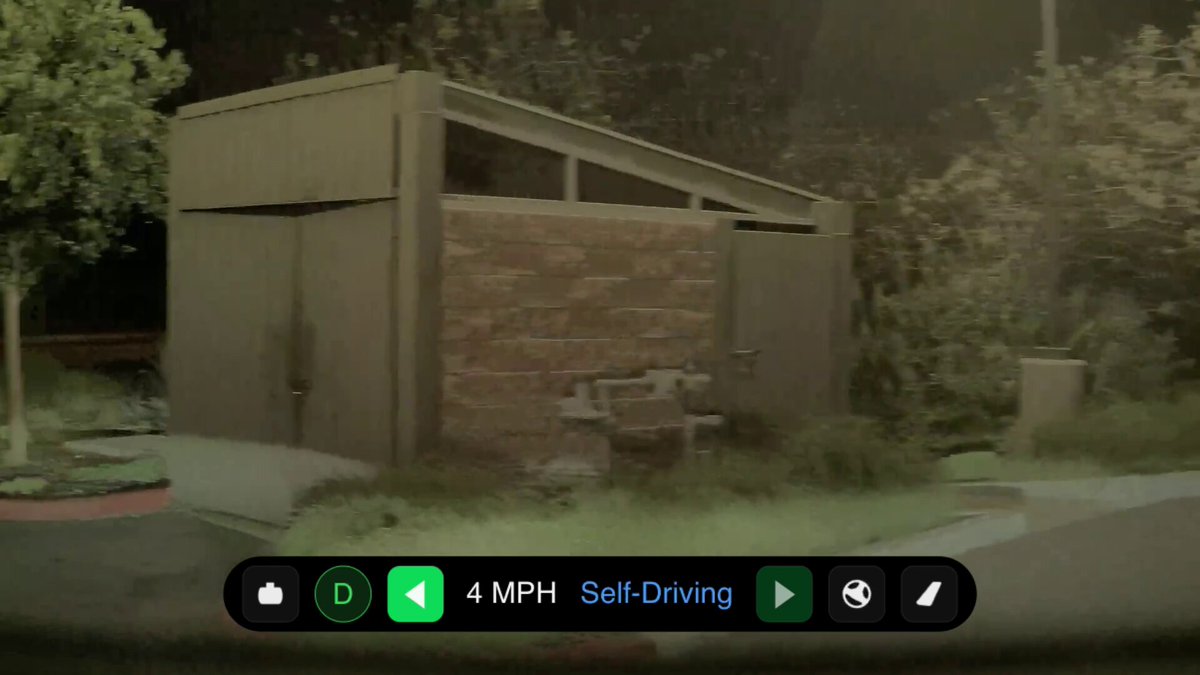
The News: A Tesla owner documented FSD autonomously reversing after a failed merge attempt, re-entering a property, and using an alternate exit to continue its planned route.
Why It Matters: This is a real-world demonstration of FSD's error recovery logic — the system didn't freeze or demand intervention, it problem-solved independently.
Source: @ray4tesla on X
Tesla's Full Self-Driving system just showed something that would have been unthinkable a few years ago: when it hit a dead end, it backed up, thought it through, and found another way. No driver takeover required.
Ray, a well-known Tesla owner and FSD observer, shared a video late Tuesday night capturing the moment FSD encountered traffic delineators blocking its intended merge lane. Rather than stopping, requesting intervention, or looping endlessly, the system reversed, re-entered the property it had just exited, and navigated out through a second exit to resume the original route.

📊 What This Behavior Actually Represents
This isn't just a cool clip — it illustrates a specific and meaningful capability in FSD's decision-making architecture. The system demonstrated three distinct behaviors in sequence:
| Stage | What FSD Did | Significance |
|---|---|---|
| 1. Obstacle Detection | Identified traffic delineators blocking the merge lane | Recognized a static obstacle as impassable |
| 2. Autonomous Reversal | Reversed back into the property without driver input | Executed a recovery maneuver instead of requesting takeover |
| 3. Alternate Route Execution | Located and used a second exit to resume the planned route | Replanned within the local environment to achieve the original goal |
This kind of multi-step error recovery — detect, reverse, replan, execute — is qualitatively different from simply stopping or handing control back to the driver. It suggests FSD is increasingly capable of handling unexpected low-speed scenarios in parking lots and private property environments, which have historically been among the trickiest edge cases for the system.
It's worth noting context: earlier FSD versions have struggled with similar situations. Background reports from late 2025 and early 2026 document cases where FSD 14.1.4 entered a loop at a blocked exit and required driver intervention. The behavior Ray captured appears to represent a meaningful step forward in parking-lot exit logic — an area that FSD 14.2.2.5 (included in software update 2026.2.9.1 as of March 19, 2026) has reportedly been refined to address.
🚦 Owner's Action Plan
Verdict: Informational — No action required, but worth knowing
Step 1 — Check your software version. If you want to be on the latest FSD build with the most refined low-speed recovery logic, verify you're running 2026.2.9.1 or later. Go to Controls → Software to check. If an update is pending, connect to Wi-Fi and let it install overnight.
Step 2 — Stay engaged during low-speed FSD maneuvers. This clip is impressive, but FSD is still a supervised system. Reversals in tight spaces — parking lots, driveways, private property — are exactly the moments where your attention matters most. Keep hands ready and monitor the surroundings.
Step 3 — Report your own edge cases. When FSD handles something unusual — whether it succeeds or fails — use the in-car feedback button (the thumbs up/down on the FSD screen) immediately after the event. These reports directly feed Tesla's training pipeline.
Step 4 — Watch for similar behavior in your own drives. If you use FSD regularly in areas with complex exits, parking structures, or construction zones with delineators, pay attention to how the system responds when its first attempt is blocked. Documenting these moments (dashcam or phone video) helps the broader owner community understand real-world capability.
📰 Deep Dive
What makes Ray's clip particularly notable is the completeness of the recovery loop. FSD didn't just stop when it hit the delineators — it executed a sequence that required spatial awareness of the surrounding environment, an understanding that reversing back onto private property was a viable option, and the ability to identify and navigate a second exit. That's a meaningful chain of reasoning for a scenario that wasn't the primary planned path.
This also lands at an interesting moment for FSD's regulatory trajectory. NHTSA upgraded its probe into Tesla's FSD technology to an engineering analysis in March 2026, covering over 3.2 million vehicles, with scrutiny focused on how FSD handles reduced visibility and unexpected road conditions. Meanwhile, the EU is reportedly expected to issue a statement on FSD approval in the Netherlands around April 10, 2026, following 1.6 million km of supervised testing. Real-world evidence of graceful error recovery — rather than abrupt disengagements — is exactly the kind of data that matters in those regulatory conversations.
It's a single data point from a single owner, and it shouldn't be overstated. But it's the kind of single data point that, when it accumulates across thousands of owners and millions of miles, tells a story about where FSD's capability curve is heading. For our FSD coverage, this is the type of real-world behavior worth tracking closely as Tesla pushes toward unsupervised operation.
📋 Tracking Tesla software? See every firmware, FSD and app version in one place in our Tesla Software Update Tracker.
Related Gear
Gear up your Tesla with tested, custom-fit BASENOR accessories — shop Tesla accessories →
Sources & reporting notes
The links below identify the material source records used for this report.
- @ray4tesla on X (2026-03-25T06:49:28.000Z) — Direct source
Source links are preserved as published or accessed. See our editorial standards and corrections policy.
The BASENOR Editorial Desk covers Tesla, SpaceX, and related technology, curating reporting from primary sources — official accounts, regulatory filings, and software release data. Every article passes source-record and fact-checking review before publication. About the newsroom.
This report was curated by the BASENOR Editorial Desk from the sources listed above. Read our editorial standards or email editorial@basenor.com to report an error.