30-Second Brief
The News: Tesla is pivoting FSD development toward a quality-first model — fewer releases, but each one more rigorously tested before it reaches your car.
Why It Matters: If you've been frustrated by inconsistent FSD behavior or updates that introduced regressions, this strategic shift is directly aimed at fixing that. Expect longer gaps between versions — but a more polished experience when they land.
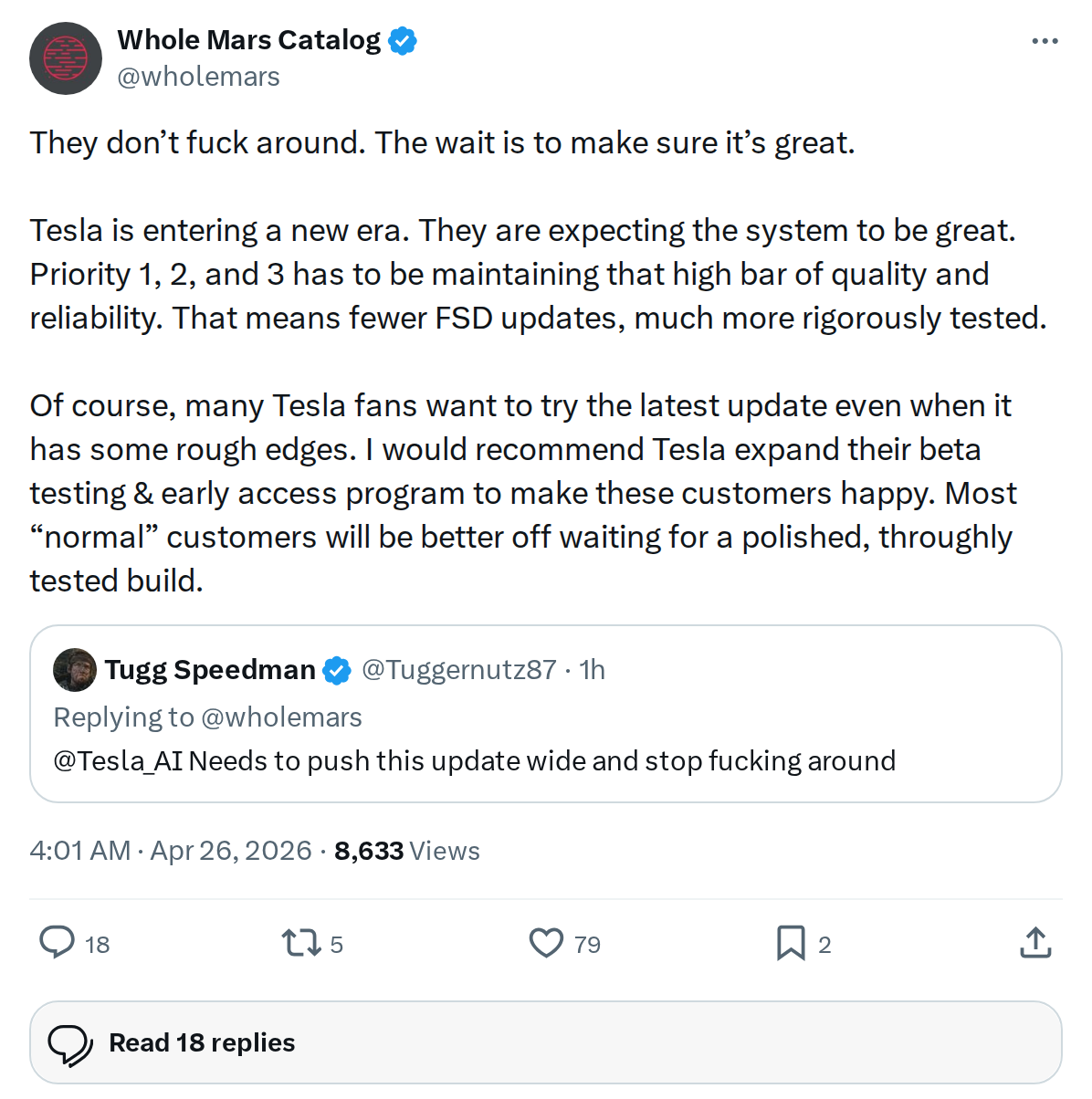
Source: @wholemars on X
Tesla FSD Strategy Shifts: Fewer Updates, Much Higher Quality Bar
Tesla's Full Self-Driving program is changing gears — and not in the way most people expected. According to a post from prominent Tesla analyst Whole Mars Catalog, the company is entering what insiders are calling a "new era" for FSD development: one defined by a relentless focus on quality and reliability over the rapid-fire update cadence owners have grown accustomed to.
The message is blunt: "Priority 1, 2, and 3 has to be maintaining that high bar of quality and reliability. That means fewer FSD updates, much more rigorously tested."

For owners who have tracked FSD through its many iterations, this signals a meaningful philosophical change inside Tesla's autonomy team. The era of weekly or bi-weekly pushes — sometimes introducing as many regressions as improvements — appears to be giving way to something more deliberate.
📊 Key Figures
| Milestone | Detail |
|---|---|
| Unsupervised FSD Target (Consumer) | Q4 2026 at earliest — confirmed on Q1 2026 earnings call |
| Hardware 3 Interim Update | "V14-lite" expected late June 2026; full unsupervised FSD requires HW replacement |
| EU Road Testing | 1.6 million km covered with FSD (Supervised) during EU approval process |
| Current Supervised FSD Markets | US, Canada, Mexico, Puerto Rico, Australia, New Zealand, South Korea, Abu Dhabi (trial) |
| FSD Architecture | End-to-end neural network (V12+), trained on billions of real-world video frames |
What's Actually Changing — and Why It Matters
This isn't just a PR reframe. The shift toward quality-over-cadence reflects where Tesla's FSD program actually is right now. Since FSD V12, Tesla has been running a fundamentally different kind of AI system — a purely neural network-driven, end-to-end architecture that learns directly from billions of real-world driving video frames, rather than following a hand-coded rulebook. That's a more powerful approach, but it also means testing and validation become dramatically more complex. You can't just check a list of rules; you have to verify that the network behaves correctly across an enormous range of edge cases.
The higher the stakes get — and they're getting very high, with unsupervised FSD targeted for consumer release in Q4 2026 — the more Tesla simply cannot afford to ship something that regresses. A bad update on a supervised system is embarrassing. A bad update on an unsupervised one is a different category of problem entirely.
That's the context behind the new philosophy. The wait is intentional. The bar is being raised.
What This Means If You're on Hardware 3
If your Tesla runs on Hardware 3, the picture is more nuanced. Elon Musk confirmed on the Q1 2026 earnings call that HW3 vehicles are not capable of running unsupervised FSD and will require complete hardware replacements to access those future capabilities. However, an interim software update — currently referred to as "V14-lite" — is expected to arrive for HW3 owners in late June 2026. That update is designed to bring meaningful improvements within the constraints of the existing hardware, while the longer-term unsupervised FSD roadmap plays out on HW4 and beyond.
For our FSD coverage, this is one of the most significant strategic signals we've seen from Tesla's autonomy team in some time.
🔭 The BASENOR Take
Timeline: Quality-first shift is happening now. Unsupervised FSD consumer rollout targeted Q4 2026. HW3 V14-lite expected late June 2026.
Impact Level: 🔴 High — affects every FSD subscriber's expectations for update frequency and feature delivery
Confidence: Medium-High — sourced from a well-connected community analyst, consistent with Tesla's public Q1 2026 earnings statements
Tesla has historically shipped FSD updates at a pace that kept enthusiasts engaged but frustrated owners who just wanted a consistent, reliable experience. The rapid cadence was partly a product of the old rules-based architecture — you could patch individual behaviors relatively quickly. The neural network approach doesn't work that way. Changes ripple through the entire system, and validating them takes real time and real mileage.
The new strategy is a direct acknowledgment of that reality. And frankly, it's the right call. The closer Tesla gets to unsupervised deployment — where a driver is no longer the backstop — the more every update has to be bulletproof before it goes wide. Fewer updates, but updates that actually hold up: that's the trade-off Tesla is making, and for owners who care about long-term reliability over short-term novelty, it's a trade worth making.
📰 Deep Dive
The quality-first pivot also has competitive logic behind it. Tesla's unsupervised FSD rollout — starting in geofenced areas of Austin and expanding gradually — will be scrutinized at a level no prior FSD release has faced. Regulators, media, and the public will be watching every incident. One high-profile failure could set the entire program back by months. Shipping fewer, better-tested updates is not just good engineering — it's risk management at the highest level.
Globally, Tesla is simultaneously navigating complex regulatory environments. The company has covered 1.6 million kilometers with FSD (Supervised) on EU roads as part of the UN R-171 approval process, with Netherlands approval anticipated imminently. China remains a work in progress due to data localization requirements, though Musk has projected full approval in 2026. Each new market adds validation requirements that make a slower, more rigorous internal testing cycle not just preferable but necessary.
There's also the subscription model transition to consider. Tesla is moving FSD to subscription-only in 2026, which means the value proposition shifts: owners are paying on an ongoing basis, and they'll expect the system to keep getting meaningfully better — not just incrementally tweaked. A quality-first approach, where each update delivers a genuinely noticeable improvement, is a stronger value story for a subscription product than a stream of minor patches that sometimes introduce new quirks.
The bottom line: if you've been refreshing your Tesla app waiting for the next FSD version, adjust your expectations. The gaps are going to get longer. But when the next version does land on your car, Tesla is betting it'll be worth the wait.

Marcus covers Tesla's software releases, FSD rollouts, and OTA changes. Background in automotive engineering. Based in Austin.
Sources verified at publish time. Spotted an inaccuracy? Email editorial@basenor.com.