📌 UPDATE — June 20, 2026
David Moss has officially crossed the 10,000-mile mark with zero safety-critical interventions on Tesla FSD — a first-of-its-kind milestone in consumer self-driving history. The achievement was highlighted by Whole Mars Catalog on X, who noted the FSD streak counter doesn't go beyond its current cap, prompting calls for Tesla to add confetti animations at the 10,000 and 100,000-mile marks. Whole Mars also jokingly demanded Tesla physically shower Moss with confetti at the Tesla Diner as a proper celebration. The milestone underscores just how far FSD reliability has come during this Canada-to-Mexico endurance run.


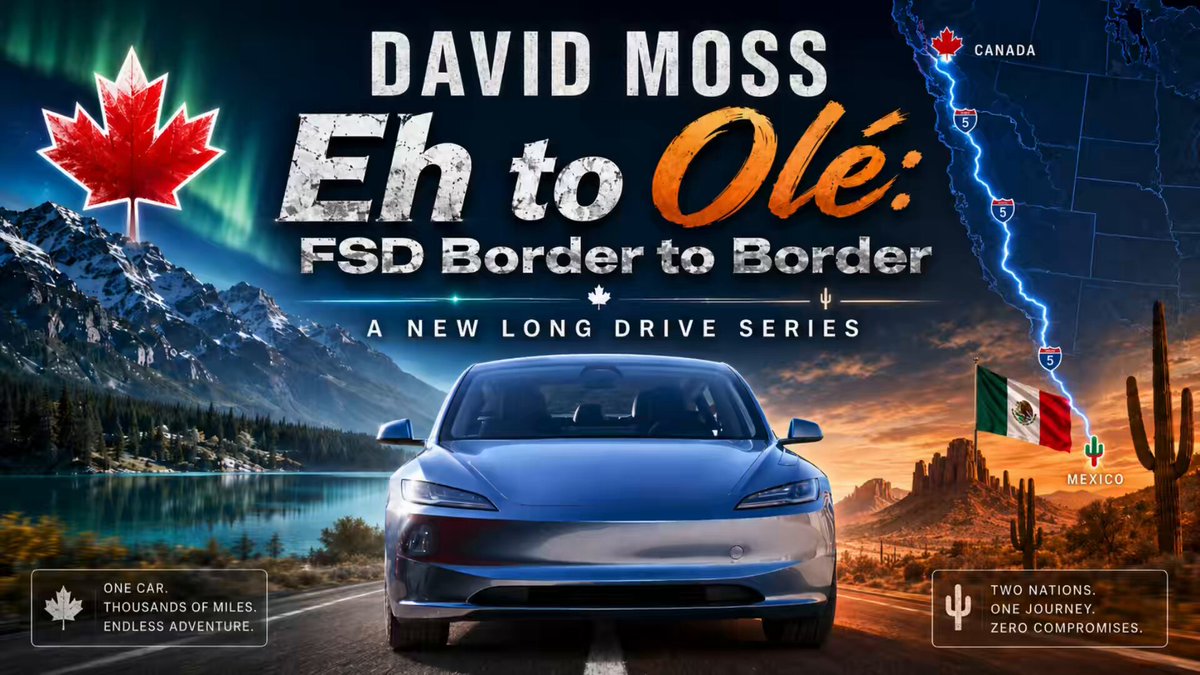
Tesla FSD's most prolific real-world tester is back on the road. This week, David Moss — the owner who has already driven coast-to-coast across both the United States and Canada using Full Self-Driving with zero interventions — is attempting his most ambitious run yet: a full north-to-south traverse of the continental U.S., from the Canadian border to the Mexican border, entirely on Tesla's autonomous driving system.

Who Is David Moss?
Moss isn't a casual Tesla enthusiast doing a weekend road trip. He's built a documented record of pushing FSD to its limits on some of the longest, most demanding routes in North America — and completing them without a single human intervention.
His track record heading into this week's attempt is remarkable. On December 31, 2025, Moss drove 2,732.4 miles from the Tesla Diner in Los Angeles to Myrtle Beach, South Carolina — coast-to-coast across the U.S. — in 2 days and 20 hours using FSD v14.2, with zero disengagements. Tesla officially featured the trip as a customer story in March 2026, and both CEO Elon Musk and VP of AI Software Ashok Elluswamy acknowledged it on X.
Then in late May 2026, Moss went even further. Starting May 23 and finishing May 29, he drove 3,760 miles across Canada — from Horseshoe Bay Terminal in Vancouver, British Columbia, to the Tesla Showroom in Halifax, Nova Scotia — in 4 days and 21 hours using FSD v14.3.3. Zero interventions again. Elluswamy acknowledged that feat as well. The Canadian crossing was roughly 1,000 miles longer than the U.S. run and covered a wider range of road and weather conditions.
What the North-South Route Represents
The prior two drives tested FSD across the horizontal axis of the continent — east to west, through the familiar interstate corridors that Tesla's training data knows well. A Canadian border to Mexican border run is a different kind of challenge. A true north-south traverse of the U.S. typically covers somewhere between 1,500 and 2,000+ miles depending on the route, and cuts through a diverse mix of terrain: northern plains, midwestern highways, desert Southwest, and border-region roads that vary significantly in lane markings, signage, and traffic patterns.
It's also a route that hasn't been publicly documented as a zero-intervention FSD run before — which is precisely why it's worth watching. Each of Moss's previous drives has served as a real-world stress test for whichever FSD version was current at the time, and the results have fed directly into the public narrative around how capable the system actually is outside controlled conditions.
The FSD Version Factor
Moss's U.S. crossing ran on FSD v14.2. His Canada crossing ran on v14.3.3, which began rolling out in May 2026 with software update 2026.14.6.6. The version he's running for this week's north-south attempt hasn't been confirmed yet, but given the timing — mid-June 2026 — it's likely to be v14.3.3 or a subsequent build. That matters because each version represents a different baseline of capability, and back-to-back documented drives across different versions give the community a clearer picture of how the system is actually improving.
Moss's vehicle throughout these tests has been a 2025 Model 3 equipped with AI4 hardware — Tesla's current production hardware platform. That's significant context: these aren't demonstrations on special pre-production hardware. They're runs on the same car configuration available to owners buying a Model 3 today.
Why This Matters Beyond the Milestone
Each of Moss's documented drives has moved the conversation about FSD from theoretical capability to demonstrated performance. The U.S. coast-to-coast run earned official recognition from Tesla. The Canada crossing pushed the distance record further and validated performance on roads outside Tesla's home market. A zero-intervention north-to-south run — if completed — would round out the picture of FSD's ability to handle the full geographic range of North American driving.
For owners who use FSD daily on shorter trips, these endurance tests serve as a proxy for system reliability. A system that can manage 3,000+ miles without intervention is a system that's handling edge cases, construction zones, rural highways, and urban intersections at a level that routine commute data doesn't fully capture. Follow our FSD coverage as this week's drive unfolds.
📋 Tracking Tesla software? See every firmware, FSD and app version in one place in our Tesla Software Update Tracker.
Related Gear
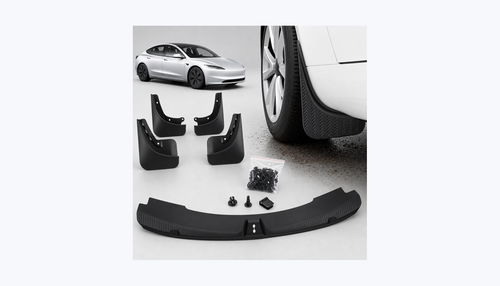
Gear up your Model 3 with tested, custom-fit BASENOR accessories — shop Model 3 accessories →
Sources & reporting notes
The links below identify the material source records used for this report.
- @wholemars on X (2026-06-18T23:04:42.000Z) — Direct source
- @wholemars on X (2026-06-20T01:23:38.000Z) — Direct source
- @wholemars on X (2026-06-20T01:34:42.000Z) — Direct source
Source links are preserved as published or accessed. See our editorial standards and corrections policy.
The BASENOR Editorial Desk covers Tesla, SpaceX, and related technology, curating reporting from primary sources — official accounts, regulatory filings, and software release data. Every article passes source-record and fact-checking review before publication. About the newsroom.
This report was curated by the BASENOR Editorial Desk from the sources listed above. Read our editorial standards or email editorial@basenor.com to report an error.