30-Second Brief
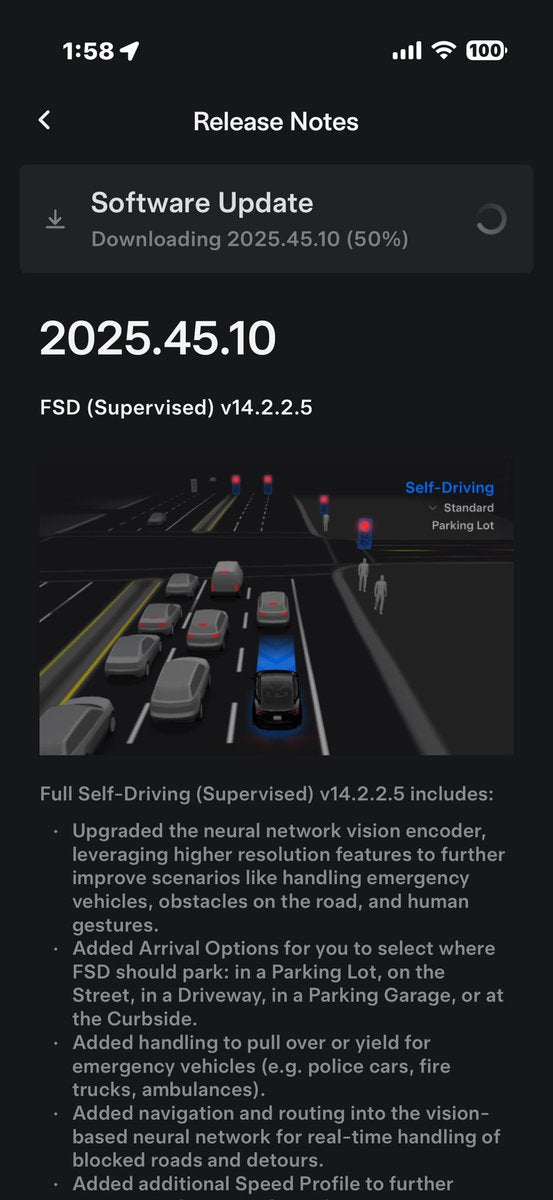
The News: Tesla has pushed a new wave of software update 2025.45.10, which officially delivers Full Self-Driving (Supervised) version 14.2.2.5 — hitting AI4-equipped vehicles now, with broader rollout waves expected.
Why It Matters: FSD v14.2.2.5 brings a smarter neural network, new arrival and parking options, emergency vehicle handling, and several driving refinements that directly improve the day-to-day supervised autonomy experience for Model Y, Model 3, and Cybertruck owners.
Source: @teslascope on X
Tesla FSD v14.2.2.5 Rolls Out via Software Update 2025.45.10: Every Change, Explained
Published February 21, 2026 · 6 min read
Tesla has kicked off a new distribution wave of software update 2025.45.10, carrying Full Self-Driving (Supervised) version 14.2.2.5. Tracking platform Teslascope confirmed the wave went out within a 30-minute window on February 18, with earlier sightings dating back to February 15. The rollout is currently prioritizing vehicles equipped with AI4 (Hardware 4) — specifically the Model Y, Model 3, and Cybertruck — before broader waves follow.

For most owners, the practical question is simple: what does this update actually change on my car? The answer is more substantial than a typical point release. Here is the full breakdown.
📊 Key Figures
| Metric | Detail | Context |
|---|---|---|
| Software Version | 2025.45.10 | Active rollout as of Feb 20, 2026 |
| FSD Version | 14.2.2.5 | Point release refinement over v14.2.2.4 |
| First Sighted | February 15, 2026 | Wider wave confirmed Feb 18 |
| Target Hardware | AI4 (Hardware 4) first | Model Y, Model 3, Cybertruck |
What FSD v14.2.2.5 Actually Changes
This is a refinement release — not a ground-up rewrite — but the list of targeted improvements is genuinely long. According to verified release notes reported by TeslaNorth and corroborated by community tracking, here is what changed inside FSD:
🧠 Smarter Vision Encoder
The neural network's vision encoder has been upgraded. The specific focus areas are emergency vehicle detection, obstacle recognition, and the ability to interpret human gestures — such as a flagman directing traffic or a pedestrian waving a car through. This is a foundational improvement that benefits nearly every FSD scenario rather than a single edge case.
🚨 Emergency Vehicle Handling
FSD will now more reliably pull over and yield when emergency vehicles approach. This has been one of the most scrutinized FSD behaviors by regulators and owners alike — the v14.2.2.5 update specifically targets this scenario with dedicated improvements.
🅿️ Arrival Options: Choose Where You Park
One of the most owner-facing additions is the new Arrival Options feature. When FSD is navigating to a destination, you can now specify your preferred parking type from a menu that includes:
- Parking Lot
- Street Parking
- Driveway
- Parking Garage
- Curbside Drop-off
This removes one of the persistent friction points in FSD navigation: the car making a parking decision that doesn't match your situation.
🗺️ Navigation Baked Into the Neural Network
Tesla has integrated routing and navigation awareness directly into the vision-based neural network. In practice, this means FSD can now handle blocked roads and detours in real time without breaking out of autonomous mode — a significant architectural improvement over previous versions where navigation changes often required manual intervention.
🎚️ New Speed Profile
An additional Speed Profile option has been added, giving owners more granular control over how aggressively or conservatively FSD drives. This joins the existing profiles and is aimed at owners who want a driving style that sits between the existing presets.
Other Targeted Fixes
- Improved handling of static and dynamic gates (garage doors, barrier arms)
- Better offsetting behavior when road debris is detected
- More reliable unprotected turns and lane change execution
- Smoother response to vehicle cut-ins
- Correct behavior around stopped school buses
- Improved system fault recovery — FSD handles unexpected states more gracefully
- New alert when residue build-up on the interior windshield is affecting the front camera
What Else Is in 2025.45.10 (Beyond FSD)
The FSD improvements share the update with two notable feature additions for the broader Tesla software stack:
Dashcam Viewer Upgrade: With Premium Connectivity active and an up-to-date app, dashcam clips now overlay real-time data — including speed, steering angle, and self-driving state — directly onto the footage. This makes reviewing dashcam clips significantly more informative for owners who use them for incident documentation or simply to review FSD behavior.
Automatic HOV Routing: Navigation now includes automatic HOV (High-Occupancy Vehicle) lane routing, with a toggle for express lanes in supported regions. For owners in major metros with carpool lanes, this removes the manual step of routing around or through restricted lanes.
🔭 The BASENOR Take
Active rollout — AI4 first, broader waves expected
Medium-High (meaningful refinements, not a generational leap)
High — sourced from verified release notes
📰 Deep Dive
The versioning tells part of the story: v14.2.2.5 is a point release, sitting between the v14.2 generation and the much-anticipated v14.3 that Elon Musk has previously described as the "last puzzle piece" of the current FSD development arc. That framing matters for managing expectations — this update is not the step-change that v14.3 is being positioned as. What it is, however, is a substantive batch of fixes and targeted improvements that addresses real pain points owners have reported through the v14.2.x cycle.
The Arrival Options feature deserves particular attention because it represents a shift in how FSD thinks about the final 200 meters of a trip — historically one of the messiest parts of the autonomous experience. Giving owners explicit control over parking type at route creation time is a practical quality-of-life improvement that reduces the likelihood of FSD making an inconvenient or incorrect parking decision at journey's end.
The AI4-first rollout strategy is now standard practice for Tesla. Hardware 4 vehicles carry more capable sensor arrays and the newer compute platform, making them the natural proving ground before Tesla widens deployment. If you are on AI3 (Hardware 3), expect to see your wave in the coming days to weeks — the pattern with previous releases suggests a staged expansion rather than a hard cutoff.
With v14.3 still on the horizon, the community of FSD testers is watching this release closely for clues about what the next major version might address. For now, v14.2.2.5 via 2025.45.10 is the most complete version of Tesla's supervised autonomy stack available to production vehicles — and if the release notes translate to real-world behavior, owners should notice the difference, particularly on emergency vehicle interactions and complex arrival scenarios.