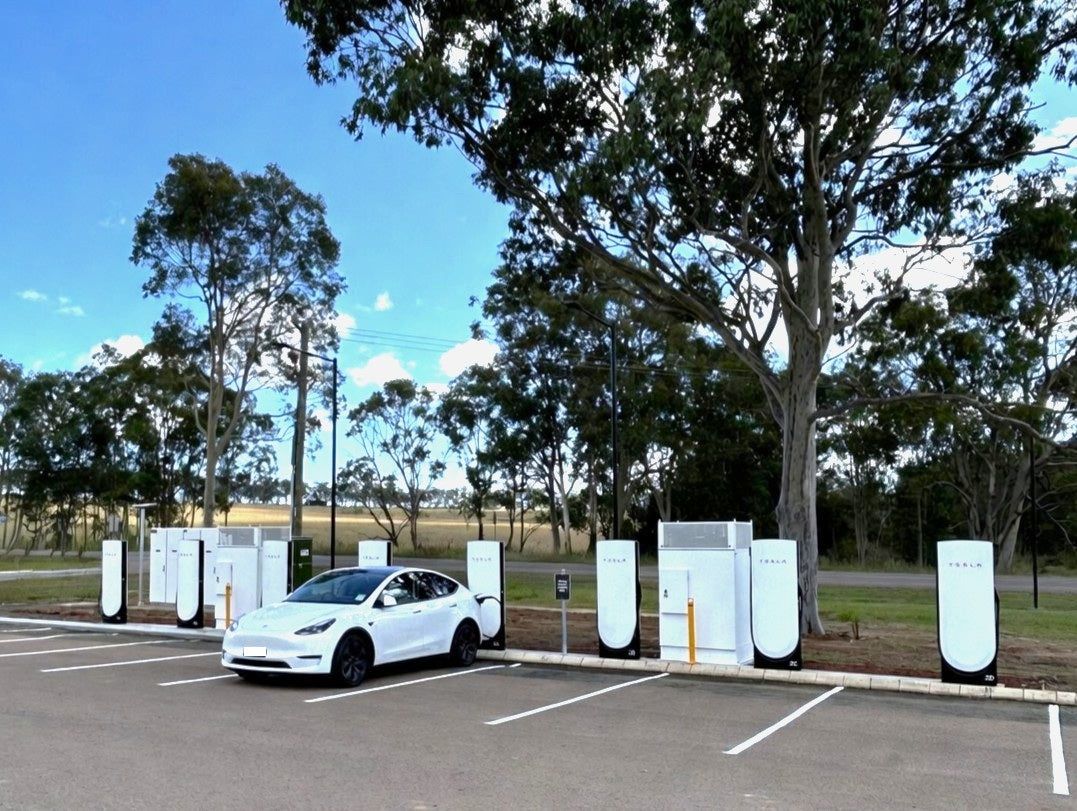
The News: Tesla Australia & New Zealand has officially reached 150 Supercharger sites across Australia, with the 150th station opening in Pokolbin, Hunter Valley on March 31, 2026.
Why It Matters: The milestone cements Tesla's charging dominance in Australia and signals continued rapid expansion — including a record-breaking 25+ stall site coming to Mackay, Queensland.
Source: @TeslaAUNZ on X
Tesla Hits 150 Supercharger Sites in Australia — and the Network Is Just Getting Started
Tesla Australia & New Zealand marked a significant charging infrastructure milestone on March 31, 2026: 150 Supercharger sites now operational across the country. From the outback to the Hunter Valley wine region, Australian Tesla owners have more fast-charging options than ever — and the pace of expansion shows no signs of slowing.

The 150th Site: Hunter Valley Gets V4 Supercharging
The milestone station isn't just a number — it's a statement. The 150th Supercharger site opened in Pokolbin, nestled in New South Wales' Hunter Valley wine region. The site features 8 V4 Supercharger stalls equipped with CCS2 connectors, delivering up to 250 kW of peak charging power per bay. That's enough to add hundreds of kilometres of range during a winery lunch stop.
The Hunter Valley location is a strategically smart choice. It's a high-traffic tourism destination roughly two hours north of Sydney — exactly the kind of regional route where range anxiety has historically held back EV adoption. Placing a premium V4 site there sends a clear message: Tesla is filling the gaps, not just the cities.
🔌 Australia Supercharger Network — Snapshot
Source: Tesla Australia & New Zealand / verified reporting
📊 Key Figures
| Metric | Value | Context |
|---|---|---|
| Total Active Sites | 150 | Up from 148 in mid-March 2026 |
| Sites Open to Non-Tesla EVs | 80+ | ~53% of network, CCS2 compatible |
| 150th Site Location | Pokolbin, Hunter Valley NSW | 8 V4 stalls, CCS2 connectors |
| Previous Largest Site | Goulburn, NSW — 20 stalls | Opened ~August 2025 |
| Upcoming Largest Site | Mackay, QLD — 25+ stalls | V4, up to 250 kW per bay |
Open to All EVs: A Bigger Story Than the Number
The headline is 150 sites. The more significant story might be what those sites represent for the broader Australian EV market. Over 80 of the active Supercharger locations — more than half the network — are now open to non-Tesla electric vehicles with CCS2 connectors. That's a deliberate shift in strategy that transforms Tesla's charging infrastructure from a competitive moat into a public utility.
For Tesla owners, this has a nuanced implication: more vehicles sharing the network. But it also accelerates the political and commercial case for Tesla to keep building, since a broader user base justifies larger sites and faster rollout timelines. The Mackay site, with 25+ stalls planned, is a direct product of that logic.
What's Next: Mackay Sets a New Bar
The upcoming Mackay, Queensland site is worth watching closely. At 25+ V4 stalls, it will become the largest Supercharger facility in Australia by a significant margin — surpassing the previous record holder in Goulburn, NSW, which opened with 20 stalls in August 2025. Mackay sits on the Bruce Highway corridor, a critical long-distance route connecting Brisbane to Cairns. A high-capacity V4 hub there meaningfully reduces the friction of driving the Queensland coast in an EV.
🔭 The BASENOR Take
Timeline: 150 sites as of March 31, 2026 — Mackay site timeline not yet confirmed
Impact Level: 🟢 High — meaningful range confidence boost for Australian owners, especially on regional routes
Confidence: ✅ Verified — confirmed by Tesla Australia & New Zealand official account and corroborated by multiple regional tech publications
Analysis: Australia's EV adoption curve has been slower than Europe or North America, partly due to geography and partly due to charging infrastructure gaps. Reaching 150 sites is a credibility milestone — it signals to fence-sitters that the network is mature enough to support everyday and long-distance use. The CCS2 open access policy is equally important: it positions Tesla as infrastructure, not just a car brand. That's a long-term play that builds goodwill with regulators, encourages government co-investment, and ultimately benefits Tesla owners through a faster-expanding, better-funded network. The Mackay announcement is the clearest signal yet that Tesla is building for scale in Australia, not just ticking boxes.
📰 Deep Dive
Australia presents a unique charging challenge that most global EV markets don't face at the same scale: vast distances between population centres, extreme heat in the north, and a tourism economy that puts EVs on regional roads far more than urban charging infrastructure alone can support. Tesla's 150-site network is a genuine response to that geography — not just a marketing milestone.
The choice to make the 150th site a V4 station in the Hunter Valley rather than a metropolitan area is telling. It suggests Tesla's site selection team is prioritising route coverage over density, which is the right call for Australia. Urban owners in Sydney, Melbourne, and Brisbane already have reasonable access to destination charging. The gap has always been the middle — the drives between cities, the wine regions, the coastal highways. Pokolbin plugs one of those gaps directly.
The open-access CCS2 policy deserves more attention than it typically gets. With over 80 sites now accessible to non-Tesla EVs, Tesla is effectively subsidising the charging confidence of every CCS2 EV owner in Australia. That's a competitive risk in the short term — more demand on the same infrastructure — but a strategic win in the long term. It accelerates Australia's overall EV adoption, which grows the addressable market for Tesla's vehicles and creates political pressure to expand charging investment. Tesla has run this playbook in Europe with measurable success.
For current Australian Tesla owners, the practical takeaway is straightforward: the network you rely on is growing faster than at any point in its history, the hardware is getting better (V4 at 250 kW versus older V2/V3 stalls), and the largest site in the country's history is on the way. The 150 milestone is worth celebrating — but it's really just a waypoint.
Related Gear
Gear up your Tesla with tested, custom-fit BASENOR accessories — shop Tesla accessories →
Sources & reporting notes
The links below identify the material source records used for this report.
- @TeslaAUNZ on X (2026-04-01T02:17:00.000Z) — Direct source
Source links are preserved as published or accessed. See our editorial standards and corrections policy.
The BASENOR Editorial Desk covers Tesla, SpaceX, and related technology, curating reporting from primary sources — official accounts, regulatory filings, and software release data. Every article passes source-record and fact-checking review before publication. About the newsroom.
This report was curated by the BASENOR Editorial Desk from the sources listed above. Read our editorial standards or email editorial@basenor.com to report an error.