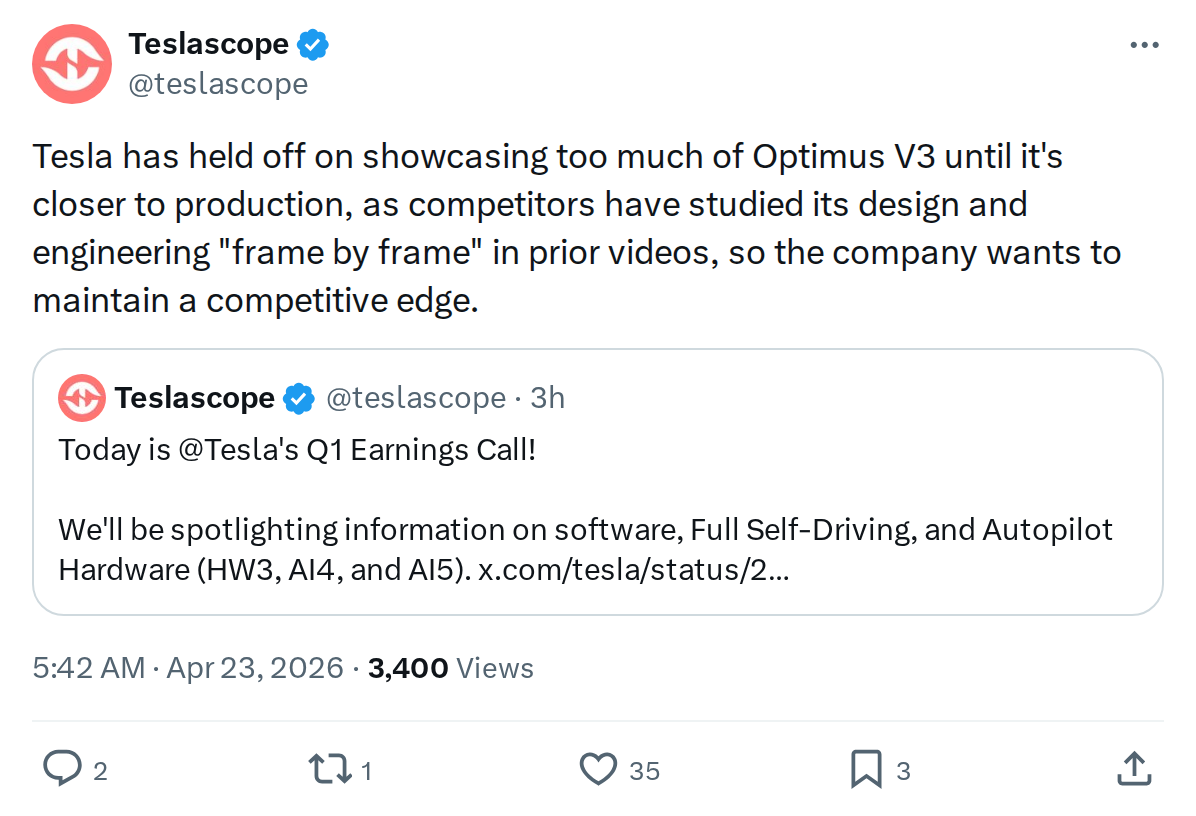
The News: Tesla will unveil Optimus V3 in late July to early August, timed to coincide with the start of production — using the freed-up Model S/X line at Fremont.
Why It Matters: Model S and X production ends in May, and that factory floor becomes ground zero for the most ambitious robotics ramp in Tesla's history. The four-month sprint from teardown to first unit is, by Tesla's own admission, "insane."
Source: @teslascope — April 22, 2026
The Timeline Tesla Just Laid Out
Tesla has quietly been one of the most tight-lipped companies in robotics — and now we know exactly why. According to details shared by Teslascope, Tesla confirmed it has deliberately withheld Optimus V3 footage and specifications because competitors have studied prior robot videos "frame by frame" to reverse-engineer its design. The strategic decision: don't show your hand until you're already at the table.

That strategy has a concrete deadline now. The Optimus V3 reveal is targeted for late July to early August 2026 — pushed deliberately close to when production actually begins, minimizing the window competitors have to react.

Model S/X Production Ends in May — The Line Becomes Optimus Territory
Here's the detail that will sting for some longtime Tesla fans: Model S and X production ends in May 2026. Disassembly of the existing line has already begun in parts, with the remainder coming down after the final vehicles roll off. That freed-up floor space at Fremont becomes the foundation for Optimus manufacturing.

The new Optimus production line will be installed shortly after teardown completes, but Tesla is clear-eyed about what comes next: testing and validation will take "several months." That puts the math in sharp focus — dismantling a car line, installing a robotics line, testing it, and shipping product, all within roughly four months. Tesla's own word for this challenge: "insane."

📊 Key Figures
| Metric | Detail | Context |
|---|---|---|
| V3 Reveal Window | Late July – Early August 2026 | Timed to coincide with production start |
| Model S/X Production End | May 2026 | Line repurposed for Optimus manufacturing |
| Production Ramp Timeline | "Several months" of testing post-install | S-curve ramp expected; high volume targeted Summer 2027 |
| 2026 Production Target | 50,000 – 100,000 units | Per Elon Musk at Abundance Summit, March 2026 |
| Gen 3 Hand Actuators | 50 total (25 per side), 22 degrees of freedom | 4.5x increase over Gen 2; confirmed production-ready Feb 17, 2026 |
| Long-Term Capacity Goal | 1M units/year (Fremont); 10M units/year (Gigafactory Texas) | Texas target applies to Optimus 4+ generation |
🔭 The BASENOR Take
Timeline: May 2026 (S/X line shutdown) → Late July/Early August 2026 (V3 reveal + production start) → Summer 2027 (high-volume ramp)
Impact Level: 🔴 High — End of an era for Tesla's flagship sedans; beginning of its most consequential product bet
Confidence: Medium-High — Timeline sourced from Teslascope reporting on Tesla's internal communications; production rate remains explicitly uncertain
📰 Deep Dive
The decision to time the V3 reveal as close to production as possible is one of the more strategically interesting moves Tesla has made in recent memory. In prior Optimus generations, detailed footage gave competitors a detailed blueprint — down to joint geometry and actuator placement. By compressing the gap between "world sees it" and "world can buy it," Tesla is trying to make imitation economically impractical. By the time a competitor could react to V3's design, Tesla would already be shipping at scale.
The Model S and X line conversion is the harder story to sit with. These are vehicles with a genuine fanbase — the S in particular has been Tesla's engineering showcase since 2012. Ending their production to make room for Optimus is a clear statement of where Tesla believes its next decade of value creation lives. It's not in premium sedans; it's in humanoid robots. Elon Musk has said publicly that Optimus could eventually be worth more than the rest of Tesla combined. The Fremont line conversion is the first concrete, irreversible step toward proving that thesis.
What's genuinely uncertain — and Tesla is refreshingly honest about this — is the production rate. For a brand-new product category with no established supply chain benchmarks, predicting output is nearly impossible. The stated 2026 target of 50,000–100,000 units is ambitious given the compressed timeline. Tesla's plan to start with "simple skills and build up from there" suggests the first units will be operationally limited, likely deployed internally before any broad commercial rollout. The S-curve ramp is real, and the steep part of that curve is probably 2027, not 2026.
For Tesla owners watching this space: the V3 reveal in late July will be the moment to watch. That's when Tesla will show its full hand — and the robotics industry will be watching just as closely as the investment community.

Sarah focuses on Tesla Energy, SpaceX missions, and the broader Musk AI portfolio. Former data analyst in clean energy. Based in San Francisco.
Sources verified at publish time. Spotted an inaccuracy? Email editorial@basenor.com.