📌 UPDATE — April 2, 2026
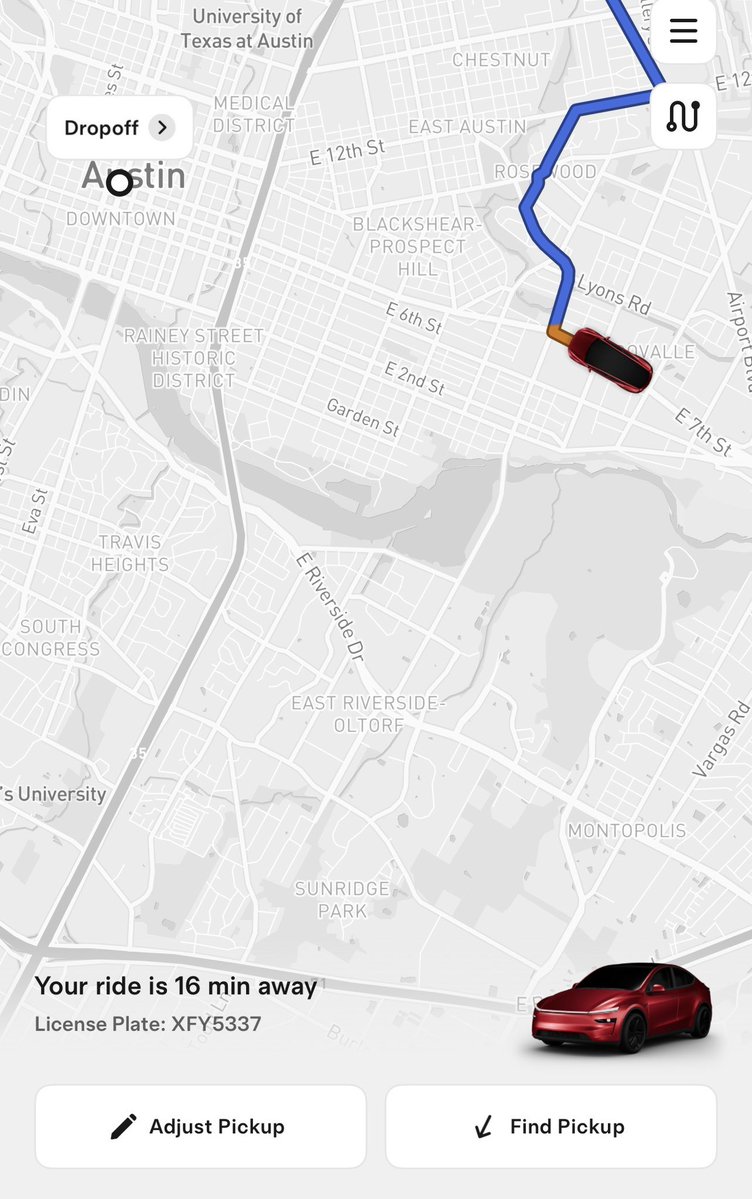
Tesla's Austin Robotaxi service has now moved beyond internal fleet operations into a public trial phase. Members of the public can reportedly download an app from the App Store and hail a fully driverless Tesla Model Y in Austin, Texas — a major escalation from the supervised 20% unsupervised milestone reported earlier. This marks Tesla's first publicly accessible, app-based autonomous ride-hailing experience, putting it in direct competition with Waymo's existing robotaxi model. Early footage shared on X shows what appears to be a driverless Model Y responding to ride requests in Austin.
@wholemars · Apr 2, 2026
"Try Tesla Robotaxi in Austin, Texas — Download it on the app store, call a driverless Tesla Model Y."

📌 UPDATE — April 1, 2026
A clarification from prominent Tesla watcher @wholemars is pushing back on widespread misconceptions about how Tesla Robotaxis actually operate. The post confirms that it is the vehicle's onboard AI — not a remote human operator — that is actively driving these cars. Remote monitoring and intervention capabilities exist solely as an emergency backstop, not as the primary control mechanism. This directly reinforces the significance of the 20% milestone: those vehicles operating without a safety monitor are genuinely running on autonomous AI, not quietly supervised by humans behind the scenes.
"It is the car's AI, not a remote human, that is controlling these cars. Of course, all Robotaxis have the ability to be remotely monitored and controlled in an emergency…"
— @wholemars, April 1, 2026

📌 UPDATE — March 31, 2026
Tesla's official Robotaxi account has confirmed a significant expansion of the operational map for unsupervised rides in Austin, marking another key milestone beyond the previously reported 20% driverless fleet figure. The expanded coverage area means more Austin riders will now have access to fully unsupervised Tesla Robotaxi service across a broader range of routes and neighborhoods. This map expansion follows closely on the heels of the driverless fleet milestone, suggesting Tesla is accelerating its autonomous deployment in the city on multiple fronts simultaneously. No specific boundaries of the expanded map have been officially detailed yet, but the confirmation from Tesla's own Robotaxi account signals this is an official rollout update rather than a third-party report.

📣 @TeslaNewswire via X — Tesla's Robotaxi account officially confirms Austin map expansion for unsupervised rides.
📌 UPDATE — March 31, 2026
Tesla has significantly expanded the unsupervised Robotaxi geofence in Austin, now stretching into downtown — a major step beyond the initial deployment zone. The expanded coverage area suggests Tesla is gaining confidence in its unsupervised FSD performance across more complex, high-density urban environments. This geofence expansion comes on top of the already-notable milestone of 20% of the fleet running without a safety monitor, signaling that the Austin rollout is accelerating faster than many anticipated.
@TeslaNewswire · Mar 31, 2026
"Here is the estimated expansion of the Robotaxi's unsupervised geofence (green) in Austin. Tesla has significantly expanded the area, now including downtown."

📌 UPDATE — March 31, 2026
Tesla has expanded the unsupervised geofence for its Robotaxi service in Austin, Texas, marking another significant step forward in the program's rollout. This geofence expansion means more of the city is now accessible to driverless Tesla vehicles operating without a safety monitor onboard. The move suggests Tesla is gaining confidence in its autonomous system's performance across a broader range of Austin's road conditions and environments. Combined with the previously reported 20% unsupervised fleet milestone, this expansion signals accelerating momentum in Tesla's push toward a fully commercial robotaxi operation.
📌 UPDATE — March 31, 2026
Tesla has significantly expanded the geofence for its Unsupervised Robotaxi service in Austin, marking a major milestone: rides are now available north of the Colorado River for the first time, pushing into downtown Austin proper. This represents a meaningful geographic leap beyond the initial service area and signals growing confidence in the driverless system's ability to handle denser, more complex urban environments. The expansion was first reported by @SawyerMerritt on X.

📸 @SawyerMerritt via X · March 31, 2026
📌 UPDATE — March 29, 2026 🔍
The unsupervised fleet is actively expanding: a new Unsupervised Model Y has been confirmed joining the Austin robotaxi fleet, and reports indicate safety supervisors are actively being removed from additional vehicles — signaling a faster-than-expected ramp beyond the original 20% figure. First-hand rider reactions from March 29 captured the system navigating tight real-world scenarios, including yielding for a parallel-parking car, prompting genuine awe from passengers.
Tesla also issued a rare public clarification on March 29, emphasizing that FSD Supervised is not restricted to select highways or specific conditions — it operates wherever available, from daily commutes to cross-country trips. While this applies to the consumer FSD product, the statement underscores the breadth of the underlying system now powering unsupervised rides in Austin.


30-Second Brief
The News: 20% of Tesla's active Robotaxi fleet in Austin is now operating without any in-car safety monitor — up from 18% as of March 1, 2026.
Why It Matters: This is the clearest real-world signal yet that Tesla's unsupervised FSD program is scaling — and that the path from Robotaxi to consumer-grade unsupervised driving is accelerating.
Source: @wholemars on X
Tesla's Austin Robotaxi Fleet: 1-in-5 Rides Now Fully Driverless
Tesla's unsupervised Robotaxi program in Austin just crossed a meaningful threshold. According to a report from Whole Mars Catalog — one of the most reliable on-the-ground observers of Tesla's Austin operations — 20% of the active fleet is now running without a safety monitor inside the vehicle. No one in the front seat. No chase vehicle. Just the car, the road, and Tesla's FSD stack.

📊 How the Numbers Have Moved
| Date | Unsupervised % | Context |
|---|---|---|
| Jan 22, 2026 | ~13% | Public Robotaxi launch, first unsupervised rides |
| Mar 1, 2026 | 18% | 8 of 42 Model Ys running driverless |
| Mar 29, 2026 | 20% | Latest report — 1 in 5 rides fully unsupervised |
📈 Unsupervised Rollout Progress
20% of Austin fleet — and climbing. Source: @wholemars
What's Actually Happening in Austin
Tesla launched its public Robotaxi service in Austin on January 22, 2026 — the first time the company removed an in-car safety monitor for public rides. Tesla AI head Ashok Elluswamy confirmed at the time that unsupervised vehicles were being mixed into the broader fleet, with the ratio intended to grow over time. That intention is now clearly being executed.
It's worth being precise about what "no safety monitor" means here. These vehicles operate within a geofenced area of Austin, at limited speeds, on a pre-approved set of streets. They do use remote operator software and a human remote supervisor — capabilities that are not part of the consumer FSD system you have in your driveway. This is a controlled commercial deployment, not a free-roaming autonomous vehicle.
That said, the trend line is unambiguous: 13% → 18% → 20% in roughly two months. Tesla is systematically expanding the unsupervised share of the fleet, and the pace is consistent with what Ashok Elluswamy described as a deliberate, incremental scale-up.
🔍 Evidence: What Makes This an Undocumented Development
Tesla has not issued any official press release or update log documenting the 20% milestone. This figure comes from direct observation and reporting by Whole Mars Catalog, who has been tracking Austin Robotaxi operations on the ground. The progression from 18% to 20% was not announced by Tesla — it was discovered through field observation, consistent with how previous percentage increases were reported.
Evidence type: Field observation / multiple community reports. Confidence: Medium — the source is credible and consistent with prior verified data points, but no official Tesla confirmation has been issued.
FSD v14.3: The Software Behind the Milestone
According to background research, FSD v14.3 is currently in internal testing and is widely believed to be the software version powering at least some of the driverless Austin Robotaxis. A broad consumer release is anticipated in early-to-mid April 2026. For context, FSD v14.2.2.5 began rolling out to Hardware 4 vehicles in mid-March 2026 — so the version cadence is moving quickly. For our FSD coverage, this is the most significant operational milestone since the Austin launch.
🚦 Owner's Action Plan
Verdict: Informational
No immediate action required for consumer FSD owners. This is a fleet-level operational development, not a consumer software rollout.
- If you're in Austin and want to try a Robotaxi ride: Download the Tesla app and request a ride in the Austin service area. You now have a roughly 1-in-5 chance of getting a fully unsupervised vehicle — no one in the front seat.
- If you own a Hardware 4 Tesla: Watch for FSD v14.3. It's in internal testing now and expected to roll out in April 2026. This version is believed to be what's powering the driverless Austin fleet.
- If you're on FSD (Supervised) today: Keep your hands on the wheel. Consumer FSD remains supervised. The Austin Robotaxi program uses additional infrastructure (remote operators, geofencing) that isn't part of your vehicle's current software.
- Track the rollout: The unsupervised percentage has climbed steadily. If Tesla maintains this pace, expect further increases announced informally through community observers before any official Tesla communication.
📰 Deep Dive
The 20% figure is more than a data point — it's a signal about Tesla's operational confidence. When the Austin Robotaxi service launched in January, the unsupervised component was clearly a proof-of-concept layer sitting on top of a supervised majority. Two months later, Tesla has nearly doubled the unsupervised share. That's not accidental. It reflects a deliberate internal decision to trust the system at a higher rate.
What's particularly notable is the absence of any public incident reports tied to the unsupervised vehicles during this scale-up period. Tesla's remote operator infrastructure appears to be functioning as designed — providing a safety net without requiring a physical presence in the car. This is the operational model Tesla will need to validate before any meaningful expansion beyond Austin, whether to other cities or to a broader consumer unsupervised mode.
The timing relative to FSD v14.3 is also worth watching. If that version delivers a meaningful capability jump over v14.2.x — as internal testing reports suggest — Tesla may accelerate the unsupervised percentage significantly in Q2 2026. The question isn't whether the number will keep climbing. It's how fast, and whether the next milestone is 30%, 50%, or something more dramatic.
For consumer FSD owners, the practical implication is this: every percentage point increase in the Austin unsupervised fleet represents real-world validation miles that feed back into Tesla's training pipeline. The Robotaxi program isn't just a commercial product — it's the most demanding test environment Tesla has ever run at scale, and it's running right now, on public roads, without anyone in the driver's seat.
📋 Tracking Tesla software? See every firmware, FSD and app version in one place in our Tesla Software Update Tracker.
🚕 Following the Robotaxi rollout? See every operating city, launch date and announced market in our Tesla Robotaxi Tracker.
Related Gear
Gear up your Tesla with tested, custom-fit BASENOR accessories — shop Tesla accessories →
Sources & reporting notes
The links below identify the material source records used for this report.
- @wholemars on X (2026-03-29T21:54:00.000Z) — Direct source
- @Tesla on X (2026-03-29T22:14:07.000Z) — Direct source
- @SawyerMerritt on X (2026-03-29T22:42:00.000Z) — Direct source
- @SawyerMerritt on X (2026-03-29T22:39:21.000Z) — Direct source
- @wholemars on X (2026-03-29T22:54:42.000Z) — Direct source
- @SawyerMerritt on X (2026-03-31T15:00:14.000Z) — Direct source
- @TeslaNewswire on X (2026-03-31T16:25:06.000Z) — Direct source
- @TeslaNewswire on X (2026-03-31T18:12:11.000Z) — Direct source
- @TeslaNewswire on X (2026-03-31T19:51:51.000Z) — Direct source
- @wholemars on X (2026-04-01T14:08:36.000Z) — Direct source
- @wholemars on X (2026-04-02T18:43:40.000Z) — Direct source
Source links are preserved as published or accessed. See our editorial standards and corrections policy.
The BASENOR Editorial Desk covers Tesla, SpaceX, and related technology, curating reporting from primary sources — official accounts, regulatory filings, and software release data. Every article passes source-record and fact-checking review before publication. About the newsroom.
This report was curated by the BASENOR Editorial Desk from the sources listed above. Read our editorial standards or email editorial@basenor.com to report an error.