📌 UPDATE — March 23, 2026
Tesla has shared major new details about the Semi in a 47-minute Jay Leno video featuring Chief Designer Franz von Holzhausen and Senior Semi Engineering Manager Dan Priestley. The production-ready redesigned Tesla Semi Standard Range (325 mi) — which has a shorter wheelbase than the Long Range (500 mi) model — boasts a turning radius comparable to a Model Y, a remarkable feat for a Class 8 truck that visibly impressed Leno during his drive. Tesla also confirmed it is actively working on automated conductive/wireless charging for the Semi and future Tesla vehicles, describing a "drive over, conductive charge" solution. These developments underscore Tesla's push to make the Semi not just capable on the highway, but practical in real-world depot and urban logistics environments.


📌 UPDATE — March 23, 2026 🔍
Tesla has officially revealed the redesigned Tesla Semi via a 47-minute Jay Leno's Garage video — making Leno the first non-Tesla employee to drive it. Tesla engineer Dan Priestley confirmed the new Semi is ~1,000 lbs lighter than its predecessor and features a fully electric steering assist (replacing the previous hydraulic system), beefed-up Cybertruck actuators, a 48-volt architecture, and 4680 battery cells engineered for a 1 million-mile lifespan. On real-world fleet performance, Tesla revealed the existing "few hundred" Semis on the road have collectively logged 13.5 million miles — with one truck alone hitting 440,000 miles — at a remarkable 95% uptime. Running costs are now confirmed at 50% cheaper than diesel in California and 20% cheaper on a per-mile basis nationwide.


📌 UPDATE — March 20, 2026
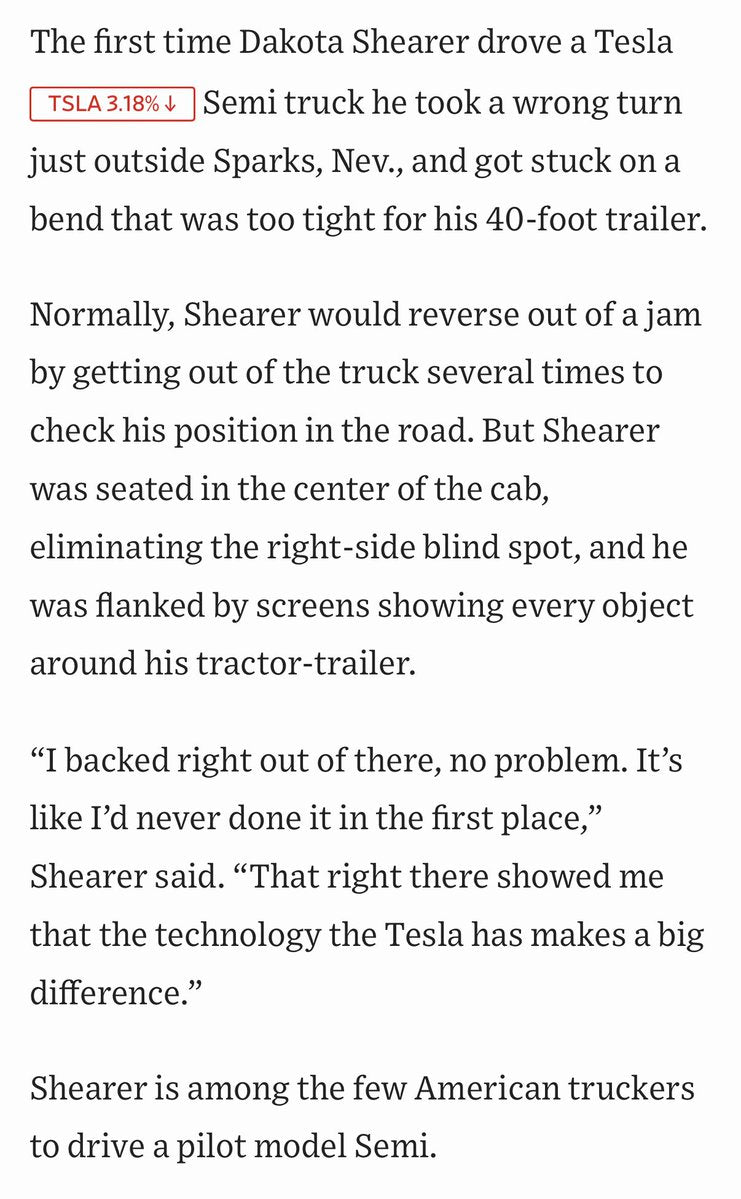
A new Wall Street Journal report confirms the Tesla Semi is already a hit with truckers in pilot tests, with drivers specifically praising its centered driving position, faster charging speeds, and longer range — all at roughly $100,000 less than competing battery-electric trucks. Elon Musk also personally weighed in, calling the Semi "super fun to drive." The WSJ coverage marks a significant mainstream media validation of what early adopters have been saying, and the price advantage over rivals adds a compelling commercial argument ahead of mass production in 2026.


The News: Real-world truckers and early fleet operators are reporting overwhelmingly positive experiences with the Tesla Semi, signaling a genuine market breakthrough in heavy-duty commercial transport.
Why It Matters: With high-volume production launching in 2026 and fleet operators already expanding their Semi deployments, the commercial trucking industry is at a genuine inflection point — and Tesla is leading it.
Source: @wholemars on X
Tesla Semi Is Winning Over Truckers — Here's What the Data Shows
The Tesla Semi has spent years as a promise. In 2026, it's becoming a proven workhorse — and the people driving it don't want to go back to diesel. Reports from fleet operators and professional truckers are painting a consistent picture: the Tesla Semi isn't just competitive, it's changing expectations for what a commercial truck can be.


📊 Key Figures
| Metric | Value | Context |
|---|---|---|
| Long Range variant range | 500 miles | At full 82,000 lbs GCW |
| Standard Range variant range | 325 miles | At full 82,000 lbs GCW |
| Peak charging speed | 1.2 MW | Long Range via MCS 3.2 |
| Range recovered in 30 min | 60% | Via Megawatt Charging System |
| Drive power output | 800 kW (~1,073 hp) | 3 independent rear motors |
| Real-world efficiency (Mone Transport) | 1.64 kWh/mile | Over 7,500 km in Texas |
| PepsiCo fleet size | 50 trucks | California facility |
| CA subsidy applications for Semi | ~900 | 2025 electric truck subsidy scheme |
| Target annual production capacity | 50,000 units | Nevada factory at full ramp |
What Truckers Are Actually Saying
The most telling signal isn't a spec sheet — it's driver behavior. According to Elon Musk, Pepsi drivers who have tested the Semi have expressed a preference not to return to traditional diesel trucks. That's a meaningful data point. Professional drivers are notoriously skeptical of new technology, and their endorsement carries weight that no marketing campaign can manufacture.
DHL confirmed its Tesla Semi operates daily in California, covering approximately 100 miles per day and requiring charging only about once a week. For a logistics operator running tight schedules, that kind of operational simplicity is a major selling point. Meanwhile, Mone Transport reported achieving an efficiency of just over 1.64 kWh per mile over 7,500 km of real-world testing in Texas — closely matching Tesla's official consumption figure of 1.7 kWh per mile. Real-world performance aligning with manufacturer claims is rare in the trucking industry, and it's fueling confidence among prospective buyers.
PepsiCo has already expanded its fleet to 50 Tesla Semis at its California facility. Customers including DHL and RoadOne have reported performance exceeding expectations. And in 2025, applications linked to California's electric truck subsidy scheme indicated requests for almost 900 Semis — a figure that speaks to pent-up commercial demand well beyond the early-adopter crowd.
The Hardware Behind the Enthusiasm
The Semi's appeal isn't accidental. The Long Range variant delivers up to 500 miles at a full 82,000 lbs gross combination weight — enough to cover most U.S. regional trucking routes on a single charge. Three independent rear motors produce up to 800 kW of drive power (roughly 1,073 horsepower), giving the Semi performance characteristics that diesel competitors struggle to match, particularly on grades and in acceleration from stops.
Charging infrastructure has historically been the sticking point for electric commercial vehicles. Tesla addressed this with Megawatt Charging System (MCS 3.2) support, enabling the Long Range model to charge at up to 1.2 MW — recovering 60% of range in just 30 minutes. For a fleet operator planning routes around charging stops, that's a workable window. An updated design revealed in 2025 also brought a new chassis, enhanced headlights, and improved aerodynamics, and both variants include an electric Power Take-Off (ePTO) delivering up to 25 kW for auxiliary equipment.
Crucially, both Semi variants are designed for autonomy — a capability that positions the truck for the next decade of commercial transport, not just today's requirements.
🔭 The BASENOR Take
Timeline: High-volume production confirmed for 2026. Nevada factory nearing completion with equipment installation underway.
Impact Level: 🔴 High — This is a genuine commercial market breakthrough, not a pilot program.
Confidence: High — Multiple independent fleet operators reporting consistent results across different use cases and geographies.
Analysis: The trucking industry is one of the hardest markets to crack. Operators run on thin margins, drivers are resistant to change, and the cost of downtime is severe. The fact that professional truckers are voluntarily preferring the Semi over diesel — and that fleet operators are expanding rather than pausing deployments — is the strongest possible validation Tesla could receive at this stage. With ~900 California subsidy applications and a 50,000-unit annual production target on the horizon, the question is no longer whether the Tesla Semi works. It's whether Tesla can build them fast enough to meet demand.
📰 Deep Dive
The Tesla Semi's trajectory in early 2026 mirrors a pattern Tesla has executed before: limited early deployments with marquee partners, real-world validation that outpaces skeptics, and then a production ramp that catches the broader market off guard. The difference with the Semi is the scale of the industry it's entering. Commercial trucking moves the global economy, and it has been one of the most resistant sectors to electrification — not because of ideology, but because the operational demands are unforgiving.
What's changed is that the Semi is now demonstrating it can meet those demands. The DHL use case — daily operation, once-a-week charging — is exactly the kind of low-friction integration that fleet managers need to justify the capital investment. The Mone Transport efficiency data from Texas adds geographic credibility beyond California's mild climate. And PepsiCo's expansion to 50 trucks signals that the initial deployment wasn't a PR exercise but a genuine operational decision.
The autonomy angle deserves attention too. Both Semi variants being designed for autonomy means Tesla is building a platform, not just a truck. As FSD technology matures and regulatory frameworks for autonomous commercial vehicles develop, fleets that have already integrated Tesla Semis will be positioned to upgrade capabilities through software rather than hardware replacement. That's a fundamentally different value proposition than any diesel alternative can offer — and it's one that sophisticated fleet operators are beginning to factor into their long-term procurement decisions.
The 2026 production ramp at the Nevada factory will be the real test. Early adopter satisfaction is one thing; sustaining quality and delivery timelines at 50,000 units annually is another. But the foundation — proven hardware, validated real-world performance, and drivers who don't want to go back — is stronger than most industry observers anticipated at this point in the Semi's lifecycle.
Related Gear
Gear up your Tesla with tested, custom-fit BASENOR accessories — shop Tesla accessories →
Sources & reporting notes
The links below identify the material source records used for this report.
- @wholemars on X (2026-03-20T00:41:40.000Z) — Direct source
- @wholemars on X (2026-03-20T00:40:50.000Z) — Direct source
- @elonmusk on X (2026-03-20T01:40:24.000Z) — Direct source
- @SawyerMerritt on X (2026-03-20T01:07:16.000Z) — Direct source
- @SawyerMerritt on X (2026-03-20T01:07:17.000Z) — Direct source
- @SawyerMerritt on X (2026-03-23T17:45:02.000Z) — Direct source
- @SawyerMerritt on X (2026-03-23T17:45:01.000Z) — Direct source
- @SawyerMerritt on X (2026-03-23T17:21:03.000Z) — Direct source
- @SawyerMerritt on X (2026-03-23T17:10:02.000Z) — Direct source
- @SawyerMerritt on X (2026-03-23T17:02:54.000Z) — Direct source
- @SawyerMerritt on X (2026-03-23T17:02:54.000Z) — Direct source
- @SawyerMerritt on X (2026-03-23T18:18:08.000Z) — Direct source
- @SawyerMerritt on X (2026-03-23T18:06:54.000Z) — Direct source
- @TeslaNewswire on X (2026-03-23T18:52:20.000Z) — Direct source
Source links are preserved as published or accessed. See our editorial standards and corrections policy.
The BASENOR Editorial Desk covers Tesla, SpaceX, and related technology, curating reporting from primary sources — official accounts, regulatory filings, and software release data. Every article passes source-record and fact-checking review before publication. About the newsroom.
This report was curated by the BASENOR Editorial Desk from the sources listed above. Read our editorial standards or email editorial@basenor.com to report an error.