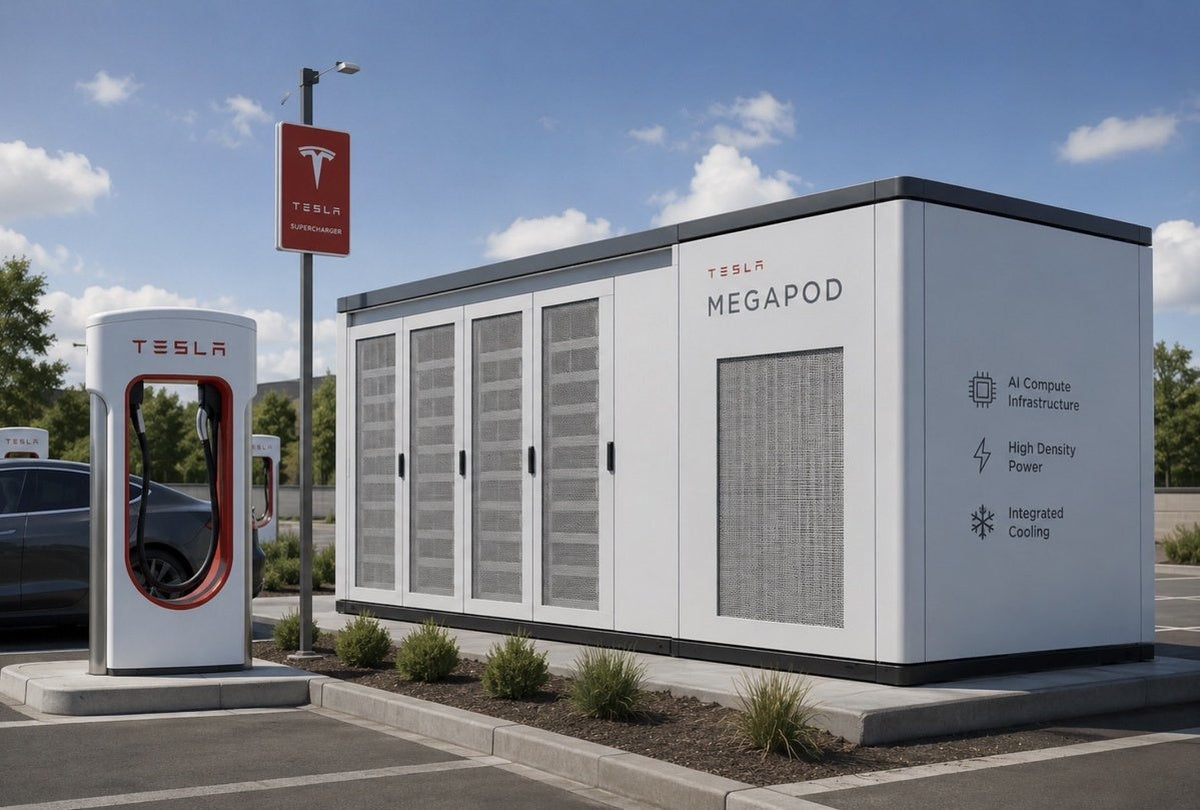
Tesla quietly filed a trademark application for the name MEGAPOD with the United States Patent and Trademark Office on June 18, 2026 — and the official description points directly at the company's ambitions to turn Supercharger stations into distributed AI computing hubs. For owners who've been following the Digital Optimus rollout, this is the clearest signal yet that Tesla has a branded product identity ready for that initiative.

What the USPTO Filing Actually Says
The trademark application — serial number 99893717 — registers MEGAPOD as a standard character wordmark. The goods and services description is specific: "Modular data center hardware systems for artificial intelligence computing, comprised of computer servers, computer hardware for artificial intelligence." That language — modular, self-contained, scalable — is not incidental. It describes infrastructure designed to be deployed at scale across thousands of locations, not a one-off data center build.
The application lists Tesla, Inc. at 1 Tesla Road, Austin, Texas 78725 as the applicant, and is currently pending assignment to an examining attorney. Standard USPTO review timelines typically run three to five months before a first office action.
The Digital Optimus Connection
The MEGAPOD filing lands squarely on top of Tesla's previously announced Digital Optimus initiative. In March 2026, Elon Musk stated that Tesla intends to deploy "millions of dedicated Digital Optimus units in the field at Superchargers where we have ~7 gigawatts of available power." The concept: use the grid infrastructure already built for charging to co-locate AI server hardware, creating a massive distributed compute network.
Digital Optimus is planned to run on Tesla's AI4 chip — the same silicon powering the latest Full Self-Driving hardware in vehicles. Supercharger stations, with their dedicated high-capacity grid connections, provide the power density that AI inference workloads demand without the land and permitting costs of a traditional data center campus.
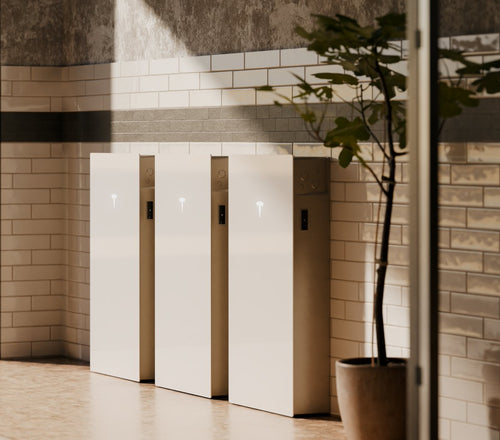
If MEGAPOD is the branded name for those physical server units, it fits the pattern Tesla has used before: give infrastructure hardware a product identity (think Megapack, Megacharger) that signals both scale and modularity.
Timeline to Watch
Musk's March 2026 statement suggested an initial Digital Optimus user experience within six months of that announcement — putting a rough target around September 2026. The trademark filing, coming just three months before that window, suggests Tesla is moving from concept to deployment-ready branding. Trademark filings typically precede product launches by months, not years.
What remains unanswered is whether MEGAPOD refers to the individual server units installed at each station, a rack-level assembly, or the broader platform brand. The "modular" and "scalable" language in the USPTO filing suggests it could span multiple form factors — small deployments at urban Superchargers, larger installations at highway hubs with more available power.
For Tesla owners, the practical implication is straightforward: the Supercharger stop you make today may eventually double as a node in one of the world's largest distributed AI networks. Whether that changes the charging experience directly — faster in-car AI responses, more capable onboard compute — depends on how Tesla routes the workloads MEGAPOD handles. That architecture hasn't been disclosed yet, but the trademark clock is now running.
🤖 Tracking Tesla's humanoid robot? See every Optimus production milestone and appearance in our Tesla Optimus Tracker.
Related Gear
Gear up your Tesla with tested, custom-fit BASENOR accessories — shop Tesla accessories →
Sources & reporting notes
The links below identify the material source records used for this report.
- @TeslaNewswire on X (2026-06-20T12:34:46.000Z) — Direct source
Source links are preserved as published or accessed. See our editorial standards and corrections policy.
The BASENOR Editorial Desk covers Tesla, SpaceX, and related technology, curating reporting from primary sources — official accounts, regulatory filings, and software release data. Every article passes source-record and fact-checking review before publication. About the newsroom.
This report was curated by the BASENOR Editorial Desk from the sources listed above. Read our editorial standards or email editorial@basenor.com to report an error.