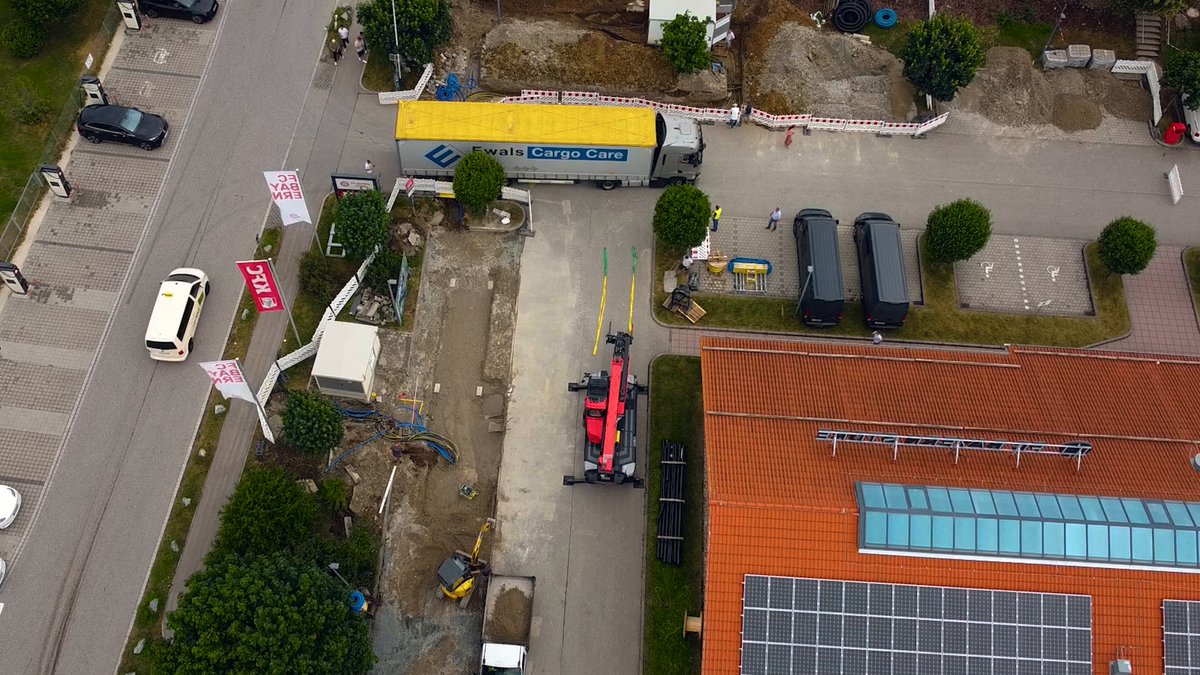
Tesla Charging has unveiled its first Accordion Supercharger — a factory pre-assembled unit designed to solve one of the network's longest-standing friction points: getting stalls into tight, curb-free parking environments. The announcement comes with hard numbers: 16 stalls per truck shipment, a 20% cost reduction, and deployment speeds roughly twice as fast as before. Here's what the design actually involves and why it could accelerate the network's expansion meaningfully.

1. It's Built Around a Parking-Space Problem
Traditional Supercharger installations rely on placing equipment behind a curb — a layout that works in many lots but fails in structured parking garages, urban lots, and sites where stalls run perpendicular to walls. The Accordion Supercharger is explicitly designed for the space between parking stalls, not behind them. That single constraint drove the entire mechanical design, and it opens up site categories that were previously impractical or cost-prohibitive to develop.
2. The Folding Structure Is the Core Innovation
Each unit — formally called a Folding Unit (FU) Supercharger — consists of eight V4 charging posts and a power cabinet mounted on a hinged metal base. The hinge allows the unit to fold flat for transport and then unfold and reposition on-site to fit the specific geometry of the space. Pre-wired cables from the factory mean electrical work on-site is minimal. Telescopic light poles fold down for shipping and extend during deployment, eliminating a separate installation step. According to reporting on the design, this is designated Rev1, with further iterations already in development.
3. Logistics Efficiency Jumps Significantly
Two Folding Units load onto a single truck, delivering 16 Supercharger stalls per shipment. According to background research on the design, that's a 33% improvement over previous prefabricated units, which maxed out at 12 stalls per truck. For a network scaling aggressively across multiple continents, that kind of logistics gain compounds quickly — fewer trucks, fewer deliveries, lower freight cost per stall installed.
4. Installation Cost Drops 20%
Tesla Charging confirmed the 20% cost reduction directly in the announcement. Max de Zegher, Tesla's Senior Director of Charging, has noted the savings come from reduced civil, electrical, and logistics costs — not from cutting hardware quality. The units still use V4 Supercharger technology, capable of delivering up to 500 kW per stall, with the power cabinet supporting up to 1.2 MW total. Lower installation cost per stall means the economics of marginal sites improve, making locations that previously didn't pencil out viable.
5. Deployment Speed Roughly Doubles
Because the units arrive pre-assembled and pre-wired, on-site labor is reduced dramatically. According to verified reporting on the design, deployment time is cut by approximately half compared to conventional installation methods. Faster deployment matters beyond just economics — it shortens the gap between site approval and a stall going live, which is often where network expansion stalls in practice.
6. Europe Got the First Installation, More Regions Expected
The first batch of Accordion Superchargers was commissioned at a site in Norway by June 2026, according to background research. The September 15 announcement from @TeslaCharging appears to mark a broader public rollout of the design and signals Tesla's intent to deploy it more widely. Given that the format addresses parking constraints common across dense European and urban Asian markets — and increasingly in US urban cores — expect this configuration to show up in locations where traditional Supercharger layouts have been absent. For owners who've noticed gaps in urban coverage, this is the infrastructure answer Tesla has been building toward.
Related Gear
Gear up your Tesla with tested, custom-fit BASENOR accessories — shop Tesla accessories →
Sources & reporting notes
The links below identify the material source records used for this report.
- @TeslaCharging on X (2026-09-15T19:53:40.000Z) — Direct source
Source links are preserved as published or accessed. See our editorial standards and corrections policy.
The BASENOR Editorial Desk covers Tesla, SpaceX, and related technology, curating reporting from primary sources — official accounts, regulatory filings, and software release data. Every article passes source-record and fact-checking review before publication. About the newsroom.
This report was curated by the BASENOR Editorial Desk from the sources listed above. Read our editorial standards or email editorial@basenor.com to report an error.