30-Second Brief
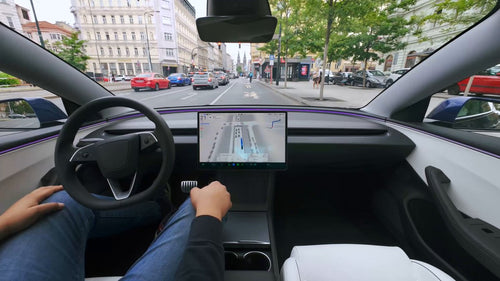
The News: Tesla Autopilot Director Ashok Elluswamy posted a two-word signal — 'Real-world intelligence' — alongside a video, marking a public milestone in Tesla's shift from task-based autonomous driving to generalized AI reasoning.
Why It Matters: This framing unifies Tesla's FSD, Robotaxi, and Optimus programs under a single AI philosophy — and suggests the breakthroughs happening in your car's software are the same ones powering the company's humanoid robot ambitions.
Source: @aelluswamy on X
Tesla's Autopilot Director Signals a 'Real-World Intelligence' AI Leap — What It Means for FSD, Robotaxi, and Optimus
By BASENOR Editorial Team • February 27, 2026
In a post that says everything by saying very little, Ashok Elluswamy — Tesla's Director of Autopilot Software and Head of AI — shared a video with just two words: "Real-world intelligence." For anyone following Tesla's AI trajectory, the phrase is a deliberate signal, not a casual caption. It reflects a fundamental shift in how Tesla describes and builds its autonomous systems, one that stretches well beyond keeping a car in its lane.

📊 Key Figures
| Metric | Value | Context |
|---|---|---|
| FSD Paid Customers (Q4 2025) | ~1.1 million | ~70% upfront purchases |
| Robotaxi Miles (Austin, no safety driver) | 250,000+ | As of Oct 2025 |
| Robotaxi Miles (Bay Area, with safety driver) | 1 million+ | Regulatory requirement |
| FSD Neural Network Speed | 36Hz | 36 decisions/second |
| Driving Data Growth | ~2x | Mar 2025 → Jan 2026 |
| Gaussian Splatting Speed | 220ms | 3D scene from 2D video |
| 2026 CapEx Target | $20B+ | Factories, AI compute, fleet |
What 'Real-World Intelligence' Actually Means
The phrase isn't marketing language. Tesla defines real-world intelligence as a closed-loop learning system: one that perceives the physical environment, reasons about it autonomously, and updates its own models in real time — without human labeling at every step. This is meaningfully different from the rule-based or modular systems that dominated early autonomous driving development.
Elluswamy presented on this exact theme at Scaled ML 2026 on February 2, discussing foundational models for robotics at Tesla. The core thesis: the same AI that processes your car's eight cameras at 36 frames per second to navigate a crowded intersection is the same AI backbone being transferred to the Optimus humanoid robot. The vehicle fleet is essentially a trillion-mile training ground for general-purpose physical intelligence.
According to Tesla's Q4 2025 earnings call, this system now serves nearly 1.1 million paid FSD customers globally, generating driving data that has approximately doubled from March 2025 to January 2026. That data flywheel is not an accident — it's the engine of the real-world intelligence loop Elluswamy is describing.
Where the Reasoning Is Actually Shipping
This isn't purely theoretical. According to Teslarati, reasoning features initially targeted for FSD v14.3 began partially shipping in FSD v14.2.2.2 as of January 2026. These early implementations affect how the car handles navigation route changes when it encounters construction zones and how it evaluates parking options — scenarios that previously stumped rules-based logic.
The underlying architecture making this possible: a single end-to-end neural network that ingests raw video from eight cameras alongside navigation data, kinematic states, and audio — all processed simultaneously to determine vehicle actions. No separate object detection module. No handoff between systems. One network, seeing everything, deciding everything, 36 times per second.
Tesla has also developed the ability to generate photorealistic 3D scenes from 2D video using Gaussian Splatting in just 220 milliseconds — faster than existing commercial tools — which accelerates both model training and debugging of edge-case scenarios the fleet encounters in the wild. For our FSD coverage, this represents one of the more technically significant infrastructure advances of recent quarters.
The Robotaxi Connection
As of October 2025, Tesla's Robotaxi service in Austin had covered over 250,000 miles without a safety driver. In the Bay Area, regulatory requirements still mandate a safety driver, but accumulated mileage there has crossed 1 million miles. An unsupervised FSD pilot in Texas is planned for the first half of 2026 — a program that only makes sense if the real-world intelligence loop is closing reliably.
Tesla claims its self-driving system is at least two times safer than manual driving, based on billions of miles of fleet data. That claim, and the confidence behind Elluswamy's post today, rests on the same foundation: a growing, self-improving dataset that no competitor can replicate at equivalent scale.
🔭 The BASENOR Take
Elluswamy is not a prolific social media poster. When he does post, it tends to be deliberate — a signal ahead of something larger. 'Real-world intelligence' as a phrase is showing up with increased frequency in Tesla's internal and external communications, and it almost certainly precedes a more formal product or capability announcement.
The strategic picture is clear: Tesla's AI is not being built vertically for one product. The reasoning stack in FSD v14.x is the same stack being ported to Optimus. The data generated by 1.1 million FSD customers feeds the same models being used to train a humanoid robot. This is Tesla's version of a general-purpose AI platform, just one that lives in the physical world instead of a data center.
For Tesla owners, the practical implication is straightforward: each software update from here forward is not a car update — it's a node in a larger intelligence network getting smarter in real time. Elluswamy's 2026 warning to employees that this would be the 'hardest year' makes more sense in this light. The targets — Robotaxi at scale, Optimus production beginning — require this AI architecture to actually generalize. This post suggests it is.
📰 Deep Dive
What separates Tesla's approach from virtually every other player in autonomous driving is the rejection of the sensor-fusion orthodoxy. Elluswamy has stated explicitly that the autonomous driving problem is one of AI information extraction, not sensor limitation — meaning the answer to better self-driving is not more radar or LIDAR, it's a smarter model processing what cameras already see. That bet is increasingly looking correct, as demonstrated by the Robotaxi mileage accumulating without incident in Austin.
The Gaussian Splatting capability is worth lingering on. Being able to reconstruct a full 3D scene from 2D video in 220 milliseconds means Tesla can synthetically re-simulate any real-world scenario the fleet encounters — including rare edge cases that might only appear once in billions of miles — and train on them repeatedly at massive scale. This transforms data scarcity from an obstacle into a solved problem, at least within Tesla's existing operational domain.
With $20 billion in capital expenditure projected for 2026 — split across six new factories, AI compute infrastructure, and fleet expansion — Tesla is making the largest physical bet on real-world AI of any company on the planet. Elluswamy's two-word post this afternoon is the human face of that bet. Whether the H1 2026 unsupervised FSD pilot and the Optimus production ramp deliver on the timeline will be the test of whether 'real-world intelligence' is a vision or a product.
📋 Tracking Tesla software? See every firmware, FSD and app version in one place in our Tesla Software Update Tracker.
🚕 Following the Robotaxi rollout? See every operating city, launch date and announced market in our Tesla Robotaxi Tracker.
🤖 Tracking Tesla's humanoid robot? See every Optimus production milestone and appearance in our Tesla Optimus Tracker.
Related Gear
Gear up your Tesla with tested, custom-fit BASENOR accessories — shop Tesla accessories →
Sources & reporting notes
The links below identify the material source records used for this report.
- @aelluswamy on X (2026-02-27T18:44:39.000Z) — Direct source
Source links are preserved as published or accessed. See our editorial standards and corrections policy.
The BASENOR Editorial Desk covers Tesla, SpaceX, and related technology, curating reporting from primary sources — official accounts, regulatory filings, and software release data. Every article passes source-record and fact-checking review before publication. About the newsroom.
This report was curated by the BASENOR Editorial Desk from the sources listed above. Read our editorial standards or email editorial@basenor.com to report an error.