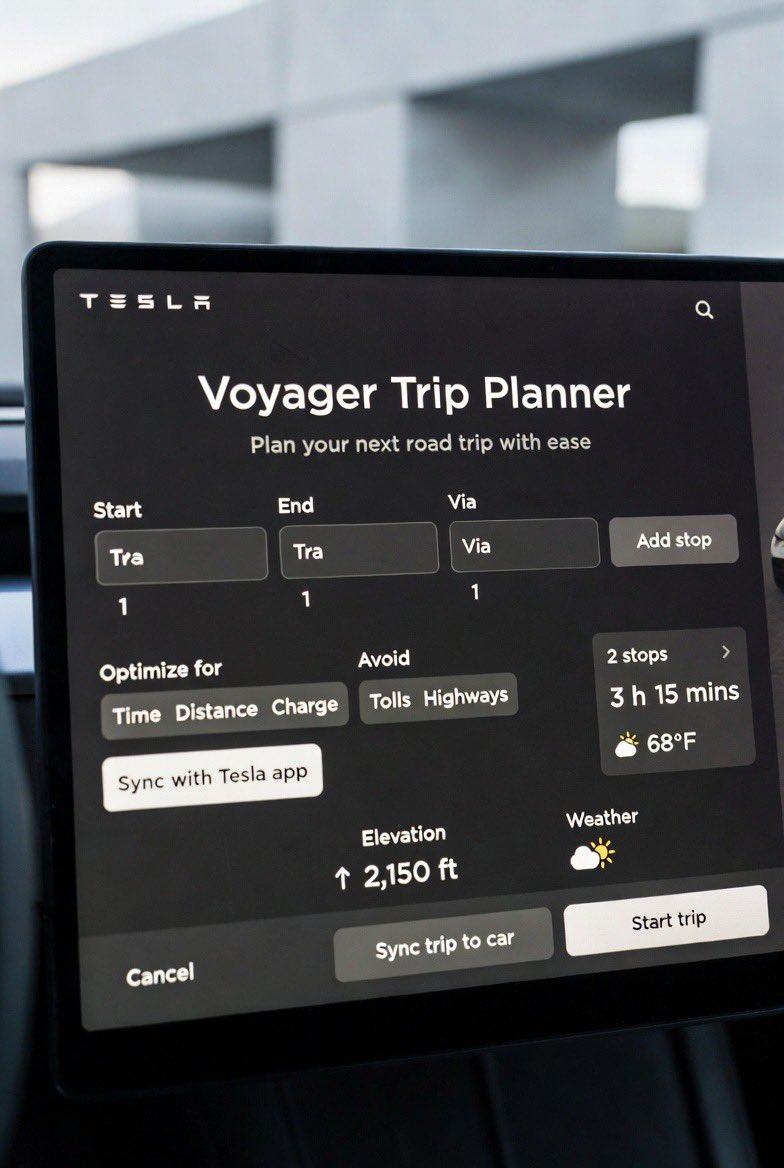
The News: Tesla is deploying a brand new routing engine, hinted at by prominent Tesla community account @wholemars and corroborated by verified details inside the FSD v14.2.2.5 update rolling out with software version 2026.2.9.1.
Why It Matters: This isn't a minor tweak — it's a fundamental shift in how your Tesla plans and re-plans routes in real time, with navigation now baked directly into the vehicle's vision neural network. Every Tesla owner using FSD or standard navigation stands to benefit.
Source: @wholemars on X

What Is Tesla's New Routing Engine?
For years, Tesla's navigation worked like most other mapping systems — a separate software layer that calculated routes independently of what the car's cameras and neural networks were actually seeing on the road. That separation created a ceiling on how smart and responsive routing could be.
With FSD v14 — and specifically v14.2.2.5 now rolling out inside software update 2026.2.9.1 — Tesla has fundamentally changed that architecture. The new routing engine integrates navigation directly into the vision neural network, enabling real-time dynamic route planning based on what the car is actually perceiving, not just what a map database says should be there.
Think of it this way: the old system looked at a map and said "turn left in 400 feet." The new system looks at the road, understands the context, and decides the best path forward — adjusting on the fly if conditions change.
📊 What Changed
| Area | Before | After (FSD v14.2.2.5) |
|---|---|---|
| Routing Architecture | Separate navigation layer | Integrated into vision neural network |
| Detour Handling | Reactive, map-dependent | Real-time dynamic replanning |
| Speed Profiles | Speed offset adjustment | New SLOTH and MAD MAX profiles via scroll wheel |
| Arrival Options | Basic destination drop-off | Parking Lot, Street, Driveway, Garage, or Curbside — saved per destination |
| Neural Network Scale | Previous FSD generation | 10x larger (HW4 vehicles) |
| Hardware Requirement | HW3 and HW4 | Full Vision-Based Navigation on HW4 only |
Why Vision-Based Navigation Is a Big Deal
The core innovation in FSD v14's routing engine is what Tesla calls Vision-Based Navigation. By folding route planning into the same neural network that processes camera feeds, the car can respond to real-world conditions — a blocked lane, an unexpected road closure, emergency vehicles — without waiting for a map database to catch up.
For long-distance driving, this matters enormously. Tesla's own messaging has leaned into this, noting that FSD (Supervised) makes an 8-hour drive feel like a 30-minute errand. That claim only holds up if the routing is genuinely intelligent — and the architectural shift in v14 is what makes that credible.
The neural network powering this on HW4 vehicles is 10 times larger than previous FSD versions. That's not a marketing number — it directly translates to more nuanced decision-making at every junction, merge, and unexpected obstacle your car encounters.
🚦 Owner's Action Plan
Step 1 — Check Your Software Version
Verdict: Essential
Go to Controls → Software on your touchscreen. You're looking for version 2026.2.9.1 or later. If you're not on it yet, tap "Check for Updates" to join the queue. This update began rolling out on March 5, 2026.
Step 2 — Confirm Your Hardware Generation
Verdict: Essential (for full benefit)
The full Vision-Based Navigation routing engine is available on Hardware 4 (HW4) vehicles. To check: Controls → Software → Additional Vehicle Information. HW4 is standard on Model 3 Highland (late 2023+), Model Y Juniper, Cybertruck, and refreshed Model S/X from mid-2023 onward. HW3 vehicles still receive FSD improvements but won't get the full neural-network-integrated routing.
Step 3 — Explore the New Speed Profiles
Verdict: Recommended
Once updated, the right scroll wheel on your steering wheel now adjusts your Speed Profile rather than a raw speed offset. You'll see new options including SLOTH (relaxed, efficiency-focused) and MAD MAX (aggressive, performance-focused). Your saved driver profile will also have a stronger influence on the maximum speed FSD selects. Try both on a familiar route to find your preference.
Step 4 — Set Your Arrival Preferences
Verdict: Recommended
The new routing engine also brings smarter arrival options. When navigating to a destination, you can now specify how you want to arrive: Parking Lot, Street, Driveway, Parking Garage, or Curbside. Better yet, the car saves your preference per destination — so your home always defaults to Driveway, your office to Parking Garage, and so on. Set these up on your first few trips after updating.
Step 5 — Check Your FSD Transfer Deadline
Verdict: Time-Sensitive
If you have a purchased FSD license you're considering transferring to a new vehicle, the deadline for vehicle delivery is March 31, 2026. Tesla recently tightened the terms — it's no longer sufficient to have placed an order by that date. If your new vehicle delivery is scheduled beyond March 31, contact Tesla support to understand your options before the window closes.
What About Non-FSD Owners?
Even if you don't subscribe to FSD, the routing engine improvements in 2026.2.9.1 touch standard navigation behavior. Dynamic detour handling and improved arrival options are part of the broader software package — not gated exclusively behind the FSD subscription. The most dramatic gains (real-time neural-network routing, the 10x larger model) are FSD-specific, but everyday navigation users will notice a more responsive system. For more on all software updates, check our full coverage.
📰 Deep Dive
The phrase "brand new routing engine" carries more weight than it might initially appear. Routing has historically been one of the most underappreciated components of the autonomous driving stack. A car can have perfect object detection and flawless lane-keeping, but if the routing layer sends it on a suboptimal path — or fails to adapt when conditions change — the overall experience degrades fast. Tesla's decision to merge routing directly into the vision neural network with FSD v14 is a structural bet that the two problems (what do I see? and where do I go?) are better solved together than separately.
The timing of this hint from @wholemars is notable. It comes just days after 2026.2.9.1 began its rollout on March 5, suggesting the update is now reaching enough vehicles that community members are starting to notice real-world differences in routing behavior — not just reading patch notes. That's the kind of organic signal that tends to precede broader community confirmation of a genuine improvement.
Looking at the broader FSD v14 picture, the routing engine upgrade doesn't exist in isolation. It's paired with a 10x larger neural network (on HW4), new speed profiles that give drivers more expressive control over FSD's driving style, and expanded geographic availability — with FSD road testing now underway in Japan and the UAE. Each of these developments reinforces the others: a smarter routing engine is more valuable when the car can also handle a wider variety of road conditions and driving styles. For owners who have been tracking our FSD coverage, this update represents the most significant architectural shift since FSD v12 moved to end-to-end neural networks.
The practical upshot for owners is straightforward: if you have HW4 and FSD, this update is worth installing promptly and actively exploring — particularly on longer drives where dynamic rerouting and arrival preferences will have the most visible impact. If you're on HW3, the update still brings meaningful improvements, but the full vision-integrated routing remains a hardware-gated feature for now.
📋 Tracking Tesla software? See every firmware, FSD and app version in one place in our Tesla Software Update Tracker.
Related Gear
Gear up your Tesla with tested, custom-fit BASENOR accessories — shop Tesla accessories →
Sources & reporting notes
The links below identify the material source records used for this report.
- @wholemars on X (2026-03-08T03:40:33.000Z) — Direct source
Source links are preserved as published or accessed. See our editorial standards and corrections policy.
The BASENOR Editorial Desk covers Tesla, SpaceX, and related technology, curating reporting from primary sources — official accounts, regulatory filings, and software release data. Every article passes source-record and fact-checking review before publication. About the newsroom.
This report was curated by the BASENOR Editorial Desk from the sources listed above. Read our editorial standards or email editorial@basenor.com to report an error.