📌 UPDATE — July 19, 2026
The Cybercab rollout is expanding well beyond Miami. Steering-wheel-free Cybercabs have now been spotted in California for the first time, and separately, multiple units have appeared in Peabody, Massachusetts — confirming that Tesla is deploying or staging vehicles across at least three distinct U.S. regions simultaneously. The California sightings are particularly notable given the state's stricter autonomous vehicle regulatory environment. No official launch dates for these new markets have been announced by Tesla.

📸 via @SawyerMerritt & @TeslaNewswire · July 19, 2026
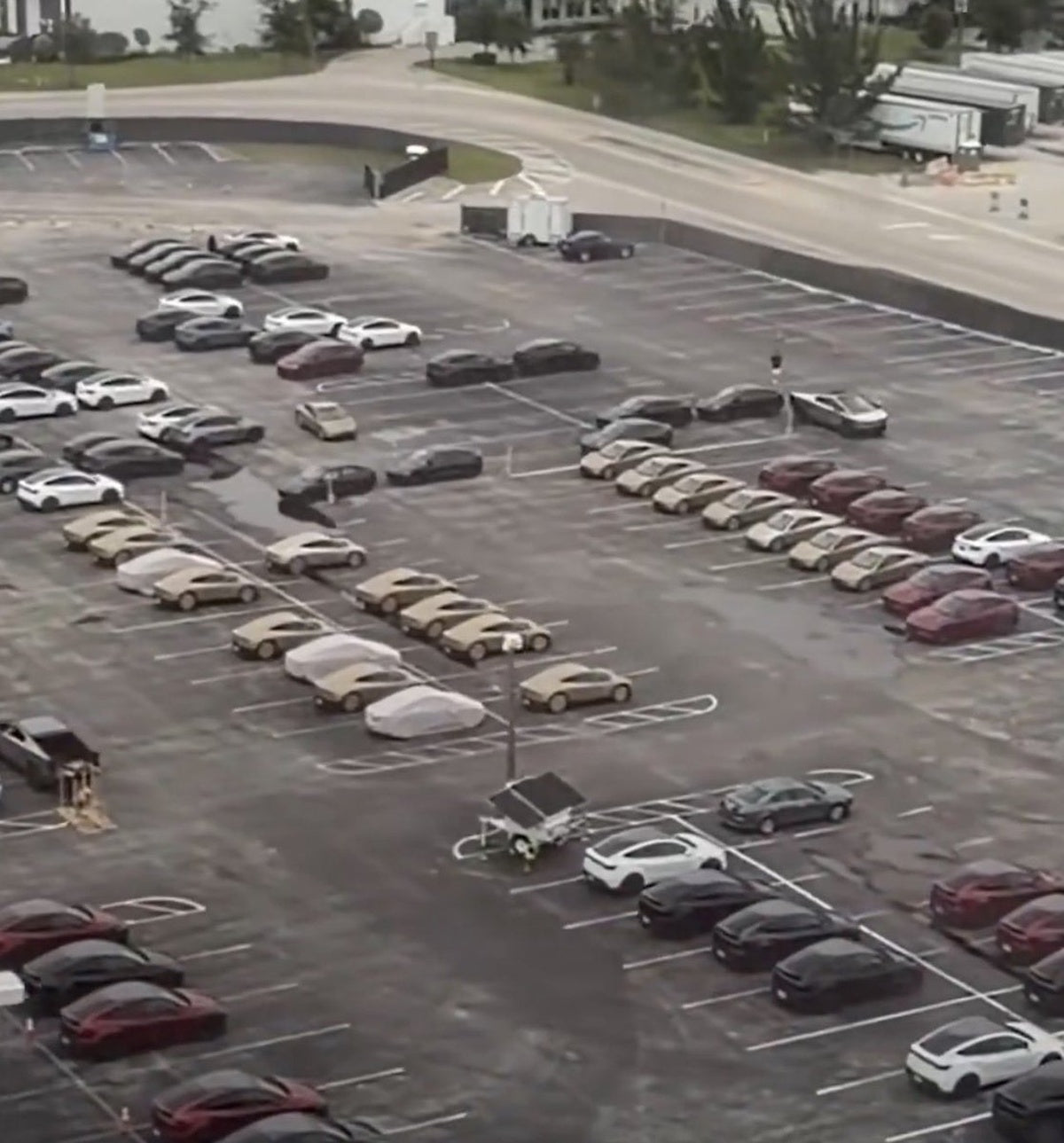
A dedicated Tesla Robotaxi Hub has been spotted near Miami International Airport — the first confirmed sighting of its kind — with approximately 21 Cybercabs bearing Florida license plates staged on the lot. The discovery offers the clearest window yet into how Tesla is quietly building the infrastructure behind its autonomous ride-hailing ambitions, just nine days after the Miami service went live.

1. The service launched just nine days ago — with two Model Ys
Tesla's unsupervised Robotaxi service went live in Miami on July 3, 2026, confirmed by Tesla's Head of AI, Ashok Elluswamy. The launch fleet was deliberately minimal: two Model Y vehicles on day one, growing to three within 48 hours. No Cybercabs were in commercial service at launch. The staging hub sighting suggests Tesla has been moving Cybercab hardware into position in parallel with the Model Y soft launch — a classic Tesla playbook of running operations quietly before a larger reveal.
2. Around 21 Cybercabs are now staged near Miami International Airport
The spotted facility holds approximately 21 Cybercabs, all with Florida license plates — the first confirmed presence of the dedicated autonomous vehicle in the Miami market. Some observers have reported seeing around two dozen units in the lot. The proximity to Miami International Airport is notable: it provides easy highway access to the current service zone in western Miami-Dade County, and positions Tesla to expand the geofence toward one of the city's highest-demand corridors when the time comes.
3. The Cybercab is a fundamentally different vehicle — no wheel, no pedals
Unlike the Model Y units currently carrying passengers, the Cybercab is purpose-built for autonomy. It is a two-seat vehicle with no steering wheel, no brake pedal, and no manual driving controls of any kind. There is no fallback to human operation. That design choice means Tesla cannot simply flip a switch to put these 21 units into service — regulatory sign-off on a fully driverless, control-free vehicle is a separate and higher bar than the unsupervised Model Y approval already in hand.
4. The current service zone is compact — and intentionally so
Miami's active Robotaxi geofence covers roughly 10 to 20 square miles in western Miami-Dade County, centered on West Miami and extending toward Doral and Sweetwater. Downtown Miami, Miami Beach, and most of Coral Gables are currently excluded. This constrained zone lets Tesla accumulate real-world autonomous miles in a controlled environment before expanding. The Robotaxi Hub's airport-adjacent location sits at the edge of this zone — well-placed for a future boundary push eastward into higher-density areas.
5. No public timeline exists for when Cybercab rides will be bookable
Tesla has not announced when Miami residents will be able to hail a Cybercab through the app. As of the latest field observations, none of the staged Cybercabs had entered commercial service. The gap between hardware being on-site and rides being available could be days or months — Tesla will need to complete operational validation, likely including internal test rides, before opening the Cybercab fleet to the public. The Model Y fleet serves as the revenue-generating bridge in the meantime.
6. The economics behind the Cybercab make the hub strategy make sense
Tesla has stated targets of a sub-$30,000 purchase price and an operating cost of approximately $0.20 per mile for the Cybercab — figures that only pencil out at scale. A dedicated hub model, where vehicles return to a central facility for charging, cleaning, and software updates rather than relying on a distributed Supercharger network, is the operational architecture that makes those unit economics achievable. What was spotted in Miami is not just a parking lot — it is the physical template for how Tesla intends to run autonomous ride-hailing at city scale.
The Miami hub sighting confirms that Tesla is further along in its Cybercab deployment preparations than the current two-Model-Y service footprint suggests. The open question is timing: with 21 Cybercabs already on Florida plates and staged near an active service zone, the gap between preparation and public availability is narrowing. Watch the geofence boundaries and the app's vehicle selection screen — those will be the first signals that the Cybercab era in Miami has actually begun.
🚕 Following the Robotaxi rollout? See every operating city, launch date and announced market in our Tesla Robotaxi Tracker.
Related Gear
Gear up your Tesla with tested, custom-fit BASENOR accessories — shop Tesla accessories →
Sources & reporting notes
The links below identify the material source records used for this report.
- @TeslaNewswire on X (2026-07-12T06:42:50.000Z) — Direct source
- @TeslaNewswire on X (2026-07-12T06:59:05.000Z) — Direct source
Source links are preserved as published or accessed. See our editorial standards and corrections policy.
The BASENOR Editorial Desk covers Tesla, SpaceX, and related technology, curating reporting from primary sources — official accounts, regulatory filings, and software release data. Every article passes source-record and fact-checking review before publication. About the newsroom.
This report was curated by the BASENOR Editorial Desk from the sources listed above. Read our editorial standards or email editorial@basenor.com to report an error.