📌 UPDATE — May 10, 2026
It's now confirmed that Tesla has simultaneously ended production of both the Model S and Model X at Fremont — not just the Model S as initially reported. The Model X, which launched in 2015, completed an 11-year production run alongside the Model S's 14-year farewell. Both vehicles rolled off the Fremont line for the last time on the same day, closing out an entire era of Tesla's flagship lineup in a single moment.
@TeslaNewswire · May 10, 2026
"Tesla has officially produced the last Model S and the last Model X at the Fremont Factory!
✅ Model S: 2012–2026 / 14 years
✅ Model X: 2015–2026 / 11 years"
📌 UPDATE — May 10, 2026
Tesla has now confirmed that both the Model S and Model X have ceased production at Fremont — not just the Model S. The Model X ends an 11-year run alongside its sedan sibling, with Tesla's official account posting a salute to both vehicles. Combined, approximately 750,000 units of the two models were delivered worldwide since the Model S launched in 2012 and the Model X in 2015. Tesla marked the occasion with photos of the final units on the factory floor.

@Tesla · May 10, 2026 — "The last Model S & the last Model X have been produced at Fremont Factory. 14 years of history for Model S, 11 years for Model X 🫡"
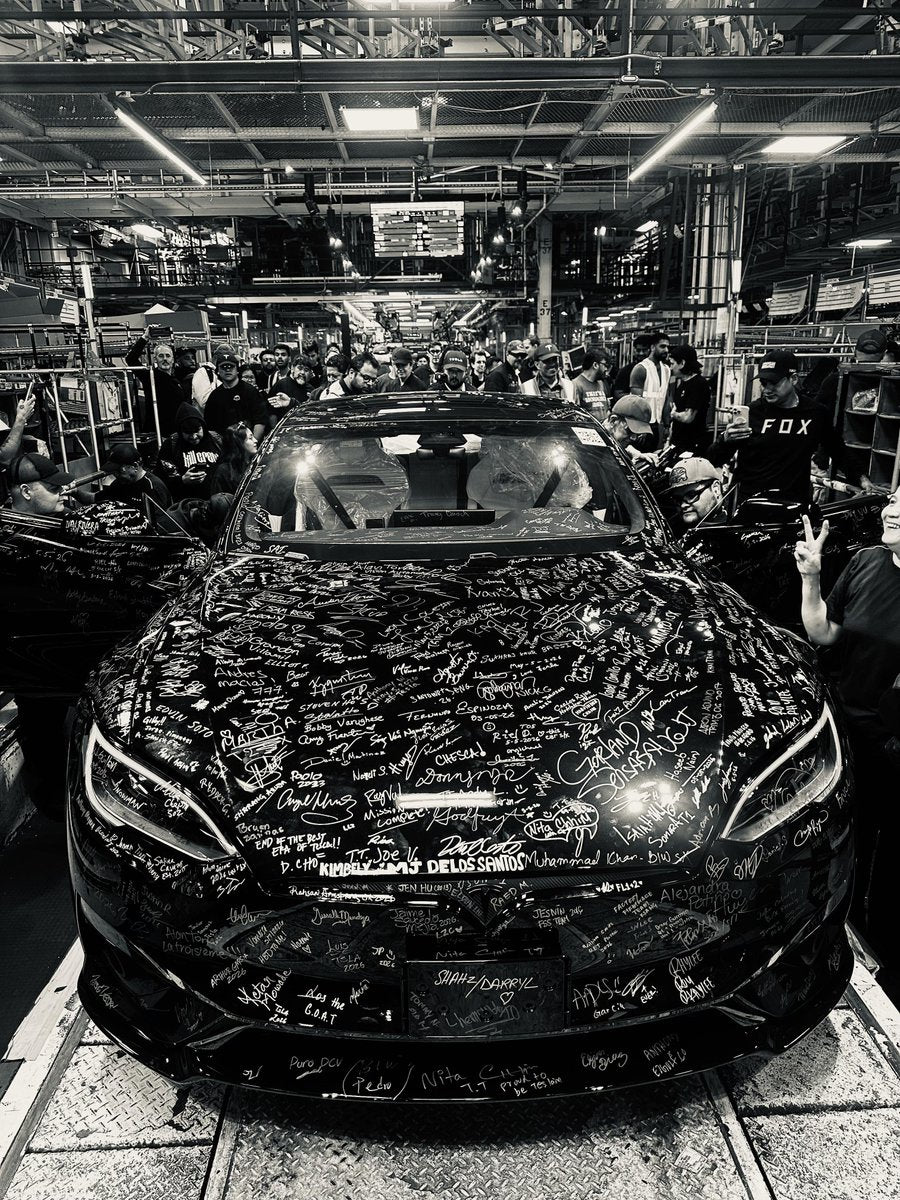
The last Tesla Model S to ever be built at the Fremont factory rolled off the production line on May 9, 2026 — and the employees who built it signed it. After 14 years and roughly 750,000 combined Model S and Model X deliveries, the car that arguably created the modern electric vehicle industry has reached the end of its production run.

End of an Era, Not an Accident
This wasn't a sudden decision. Elon Musk publicly confirmed on April 1, 2026 that custom Model S and Model X orders would cease, describing the discontinuation as an "honorable discharge" for both vehicles. Production was always slated to wind down in Q2 2026, and that timeline held.
The Model S launched in June 2012 at a time when the prevailing assumption was that electric cars were slow, ugly, and short-range. Tesla dismantled that assumption systematically — with a sedan that outran most sports cars, offered real-world range above 200 miles, and introduced over-the-air software updates as a standard feature of car ownership. The Model X followed in 2015 with falcon-wing doors and the first SUV to clear 300 miles of EPA range. Together, the two vehicles delivered over 610,000 units across their production lifetimes, according to verified production records.

What Comes Next at Fremont
The factory floor space previously dedicated to Model S and Model X production is being repurposed for Optimus humanoid robot manufacturing — a signal of where Tesla's strategic priorities now sit. Tesla VP Lars Moravy has framed this shift as part of a broader move toward "transportation as a service" rather than traditional vehicle sales volume.
For owners who still want a new Model S or Model X, a small window remains. As of early April, approximately 295 Model S and 301 Model X units were still in global inventory, primarily in the United States. Tesla's configurator now redirects buyers directly to that existing stock rather than allowing custom builds.
A special Signature Edition marks the final production run: 250 Model S units and 100 Model X units, totaling 350 vehicles worldwide. These cars carry exclusive Garnet Red paint, gold Tesla "T" badges front and rear, a gold Plaid badge on the trunk lid, white interior with gold piping, Alcantara accents, and a numbered dashboard plate. An invite-only delivery event for these "first of the last" vehicles is scheduled for May 12, 2026, at the Fremont factory — timed deliberately to coincide with the facility's transition toward Optimus production.
What It Actually Meant
It's easy to understate what the Model S accomplished. When it launched, Tesla was a company with one niche sports car to its name and serious questions about whether it would survive. The Model S answered those questions by winning Motor Trend Car of the Year in 2013 — the first time a car from a non-traditional automaker had done so — and by forcing every major automaker to accelerate their own EV programs. Every long-range electric vehicle sold today owes something to the engineering and market proof that the Model S provided.
The employees who signed that final car understood the weight of the moment. So did the broader Tesla community — the reaction online was immediate and, for a tech company's product discontinuation, unusually emotional. That reaction tells you something about what the Model S was: not just a car, but a turning point.
The Fremont line moves on to robots. The Model S moves into history. Both feel like very Tesla things to do at the same time.

Marcus covers Tesla's software releases, FSD rollouts, and OTA changes. Background in automotive engineering. Based in Austin.
Sources verified at publish time. Spotted an inaccuracy? Email editorial@basenor.com.