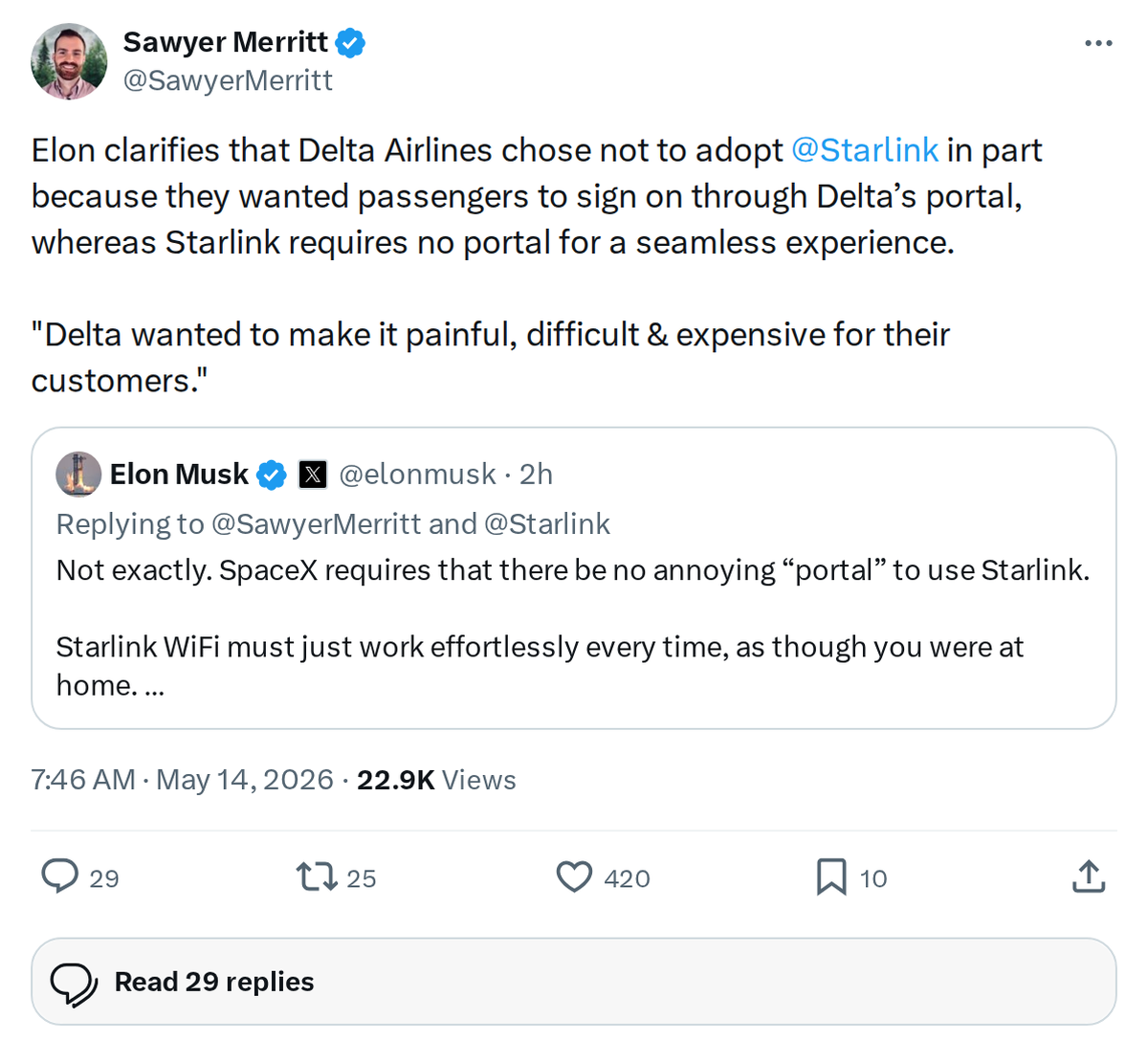
Delta Air Lines won't be getting Starlink in-flight Wi-Fi — and now we know exactly why. Elon Musk has clarified that the deal fell apart because Delta insisted passengers access the service through its own branded portal, a requirement that directly conflicts with how Starlink operates. According to Musk, that approach would make the experience 'painful, difficult & expensive' for customers, and Starlink wasn't willing to compromise on it.

Starlink's standard airline partnership model requires a seamless, no-portal connection experience — passengers connect directly, with prominent Starlink branding, and the service is provided free of charge. Delta's 'Delta Sync' portal concept was reportedly non-negotiable on their end, making the two positions incompatible. Delta has since announced it will deploy Amazon's LEO satellite service instead, with installations on roughly 500 aircraft beginning in 2028.
The contrast with United Airlines is stark. United is proceeding with a full fleet-wide Starlink rollout, expected to be complete by the end of 2027. That deal presumably met Starlink's terms — a frictionless experience that keeps the passenger, not the airline's branding apparatus, at the center. Musk's framing of Delta's position as deliberately making things harder for customers is pointed, and it signals that Starlink is willing to walk away from major contracts rather than dilute the product experience.
It's a meaningful strategic stance. Starlink is already the dominant in-flight connectivity provider for operators who've signed on, backed by a laser-mesh network of over 9,000 satellites with coverage over oceans and polar regions. Whether Delta's bet on Amazon's system delivers a comparable experience by 2028 is the real question — and passengers on both carriers will eventually get to compare notes firsthand.
Sources & reporting notes
The links below identify the material source records used for this report.
- @SawyerMerritt on X (2026-05-13T23:46:59.000Z) — Direct source
Source links are preserved as published or accessed. See our editorial standards and corrections policy.
The BASENOR Editorial Desk covers Tesla, SpaceX, and related technology, curating reporting from primary sources — official accounts, regulatory filings, and software release data. Every article passes source-record and fact-checking review before publication. About the newsroom.
This report was curated by the BASENOR Editorial Desk from the sources listed above. Read our editorial standards or email editorial@basenor.com to report an error.