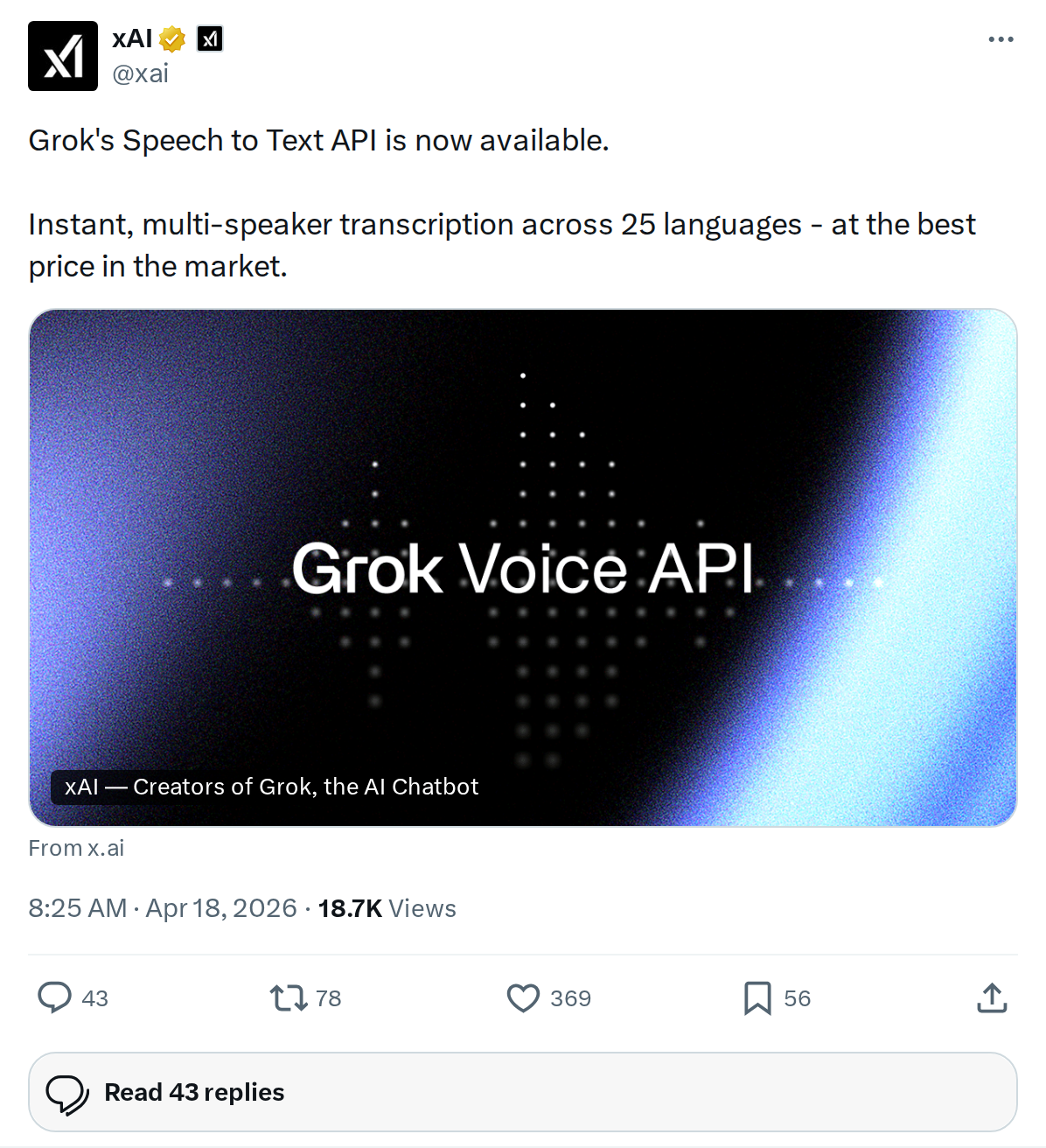
The News: xAI has launched the Grok Speech to Text API, offering real-time and batch transcription across 25+ languages at $0.10–$0.20 per hour.
Why It Matters: The same underlying technology powers voice features in Tesla vehicles — this launch signals how rapidly xAI is productizing its AI stack beyond Grok chat.
Source: @xai on X
xAI Launches Grok Speech to Text API: Multi-Speaker Transcription Across 25 Languages at Market-Low Pricing
xAI officially launched its Grok Speech to Text (STT) API on April 18, 2026, bringing enterprise-grade transcription capabilities to developers at what the company calls the best price in the market. With support for 25+ languages, real-time streaming, and speaker diarization built in, this is a significant step in xAI's push to become a full-stack AI infrastructure provider — not just a chatbot company.
For Tesla owners and the broader xAI ecosystem, the timing is notable: according to xAI, this same technology stack already powers Grok Voice, Tesla vehicles, and Starlink customer support. The API launch essentially opens that infrastructure to outside developers for the first time.

📊 Key Figures
| Metric | Value | Context |
|---|---|---|
| Batch Transcription Price | $0.10 / hr | xAI claims market-low |
| Streaming Transcription Price | $0.20 / hr | Real-time WebSocket API |
| Languages Supported | 25+ | Seamless language switching |
| Transcription Modes | 2 | Batch (REST) + Streaming (WebSocket) |
| Launch Date | April 18, 2026 | Available now |
What the Grok STT API Actually Does
This isn't a stripped-down developer preview. xAI has launched with a full feature set that covers the key pain points developers typically encounter with transcription APIs:
- Speaker Diarization: Automatically identifies and separates multiple speakers in a single audio recording — critical for meeting transcription, interviews, and customer support logs.
- Word-Level Timestamps: Each word is timestamped individually, enabling precise audio-text alignment for subtitling, search, and editing workflows.
- Multi-Channel Audio: Handles recordings from multiple microphone channels simultaneously.
- Intelligent Inverse Text Normalization: Converts spoken phrases like "fourteen ninety-nine" into structured written output like "$14.99" — handling numbers, dates, and currencies automatically.
- Dual API Modes: A REST API for batch processing large audio files, and a low-latency WebSocket API for real-time streaming transcription.
The combination of word-level timestamps and speaker diarization in particular puts this API in the same tier as enterprise offerings, but at a price point that undercuts the market according to xAI's own positioning.
🔭 The BASENOR Take
Timeline: API live as of April 18, 2026. No staged rollout — available to developers immediately.
Impact Level: Medium-High for the xAI developer ecosystem; High for understanding where Tesla's voice infrastructure is headed.
Confidence: High — confirmed by xAI's official account and corroborated by verified technical documentation.
The detail that deserves the most attention from Tesla owners isn't the pricing — it's this line from xAI's documentation: the STT API is built on the same stack that powers Grok Voice inside Tesla vehicles. That means the transcription quality, language support, and speaker separation you'd experience through the API is functionally equivalent to what's running in your car today.
By opening this as a commercial API, xAI is doing two things at once: generating direct developer revenue, and stress-testing the infrastructure at scale. Every third-party app that integrates the Grok STT API effectively becomes a load test for the same systems Tesla relies on. That's a smart way to harden production infrastructure while building an external developer ecosystem simultaneously.
The pricing strategy also signals intent. At $0.10 per hour for batch transcription, xAI is clearly prioritizing adoption over margin — a classic land-and-expand play. Get developers dependent on the API at a low entry price, then layer in premium features or higher-tier plans as the ecosystem matures. It's the same playbook that made cloud compute dominant, applied to AI inference.
For Tesla specifically, the broader implication is that xAI's AI capabilities are becoming a genuine platform — not just features bolted onto Grok chat. Voice commands, in-car transcription, and potentially future agentic features in Tesla vehicles all draw from this same well. The faster xAI scales and refines this infrastructure externally, the more capable the in-vehicle experience is likely to become. Follow our FSD coverage for updates on how AI developments translate into Tesla's autonomous stack.