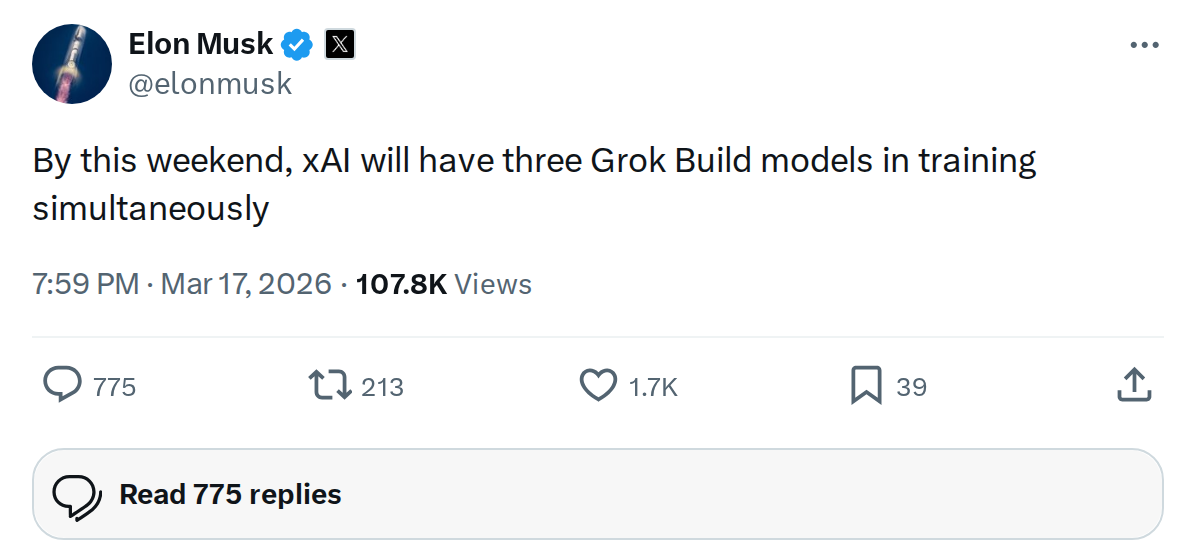
The News: Elon Musk announced that xAI will have three separate Grok Build models in simultaneous training by the end of this week.
Why It Matters: Running three model builds in parallel signals a dramatic acceleration in xAI's development cadence — the AI powering Tesla's future is being iterated faster than ever.
Source: @elonmusk on X — March 17, 2026

Three Models at Once: Why This Is a Big Deal
Training a frontier AI model is not like running a software build pipeline. It requires tens of thousands of GPUs, weeks of compute time, and enormous coordination. Running three simultaneously means xAI is no longer iterating sequentially — it is running parallel experiments at a scale that few AI labs in the world can match.
This is the kind of development velocity that compounds. Each simultaneous run generates data that informs the others, compressing what would normally be months of sequential iteration into weeks. For context, most AI labs — even well-funded ones — train one major model at a time and iterate from there.
📊 Key Figures
| Metric | Value | Context |
|---|---|---|
| Simultaneous builds in training | 3 | Up from sequential single-model runs |
| Colossus GPU cluster size | 200,000+ NVIDIA GB200 | One of the largest GPU clusters on Earth |
| Grok 4.20 context window | 2 million tokens | Launched beta February 2026 |
| Grok Heavy agents | 16 specialized agents | For deep multi-agent tasks |
| Terafab launch | March 21, 2026 | Includes xAI training infrastructure |
Where Grok Stands Right Now
To understand why three simultaneous builds matter, you need to know where xAI's model lineup currently sits:
- Grok 3 — Released February 2025, xAI's first dedicated reasoning model. Trained on Colossus using 200,000+ GPUs. Still capable, now considered the baseline.
- Grok 4.20 — Launched in beta February 2026, with API updates rolling through March. Features multi-agent collaboration (4 standard agents, 16 in Heavy mode), a 2 million token context window, and high output throughput.
- Grok 5 — Currently in training on the Colossus supercluster. No official benchmarks or release date yet, but it is one of the builds expected to be part of this week's parallel training push.
The jump from Grok 3 to Grok 4.20 took roughly a year. If parallel training compresses that cycle, Grok 5 could arrive significantly faster than the market expects.
The Infrastructure Behind the Acceleration
None of this is possible without the compute to back it up. xAI's Colossus supercluster — already running more than 200,000 NVIDIA GB200 GPUs — is one of the largest AI training facilities ever built, with plans to scale toward 1 million GPUs. That kind of raw compute is what makes running three frontier-scale training runs in parallel a realistic proposition rather than a marketing claim.
Adding to this, the Tesla Terafab project — confirmed by Musk to launch March 21, 2026 — includes infrastructure specifically tied to xAI's Grok training operations. The timing is not coincidental: Terafab comes online the same week the three-model parallel training begins.
🔭 The BASENOR Take
Timeline: Parallel training begins by weekend of March 22-23, 2026
Impact Level: 🟡 Medium-term — no immediate change for users, significant for AI roadmap
Confidence: High — direct statement from Elon Musk, corroborated by known infrastructure buildout
Here is the honest read on what this means: xAI is not just building a chatbot. Grok is the AI backbone for Tesla's in-car assistant, FSD decision-making research, and the Optimus robot program. The faster xAI can iterate on Grok, the faster those downstream Tesla products improve.
Three simultaneous builds also suggests xAI is running architectural experiments in parallel — testing different model configurations against each other rather than committing to one direction and waiting months for results. This is how you close the gap on OpenAI and Google fast.
For Tesla owners, the near-term impact is indirect. But if even one of these three builds produces a meaningful capability jump, you could see that reflected in your car's voice assistant, FSD behavior, or the Tesla app's AI features within months — not years. The pace of xAI's development is now the pace of Tesla's AI-powered features. This week's announcement makes that pace considerably faster.

Sarah focuses on Tesla Energy, SpaceX missions, and the broader Musk AI portfolio. Former data analyst in clean energy. Based in San Francisco.
Sources verified at publish time. Spotted an inaccuracy? Email editorial@basenor.com.