Tesla Cybertruck Guide · Updated May 2026
Tesla Cybertruck Sunshades: What You Need to Know in 2026
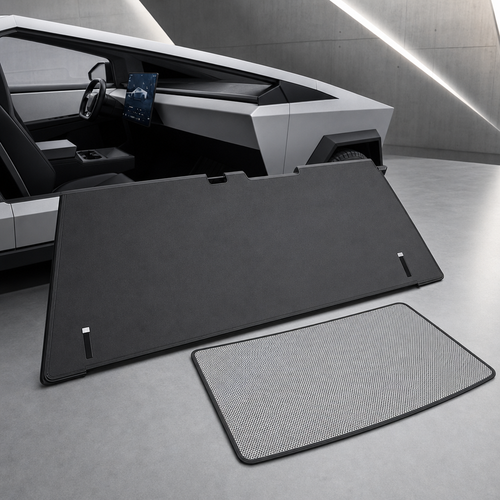
The Cybertruck has a huge windshield, a panoramic glass roof, and a cabin that can heat up quickly when parked in direct sun. We tested the decision path most owners actually need: windshield shade first for parked heat, roof shade second for overhead radiant heat, and exact Cybertruck fitment before any universal shortcut.
Bottom Line Up Front
1. Start with the windshield: it is the largest heat-soak surface drivers touch first — dash, steering area, screen, and front seats.
2. Add the roof shade if passengers feel overhead heat: the roof shade is a comfort layer, not a replacement for preconditioning or safe heat habits.
3. Do not buy by “Tesla” alone: Cybertruck glass geometry is unique, so Model 3/Y/S shades should not be assumed to fit.
Which Cybertruck sunshade should you buy first?
The simplest answer is: windshield first, roof second. When a Cybertruck parks outside, the windshield loads the front cabin directly. That heat hits the dash, steering area, touchscreen surround, and the front seating zone before you even start driving. A windshield shade also gives the fastest daily-use payoff because it goes in during parking and comes out before you move.
The roof shade solves a different problem. It reduces overhead glare and radiant heat through the glass roof, which matters most when the truck sits in strong sun, carries rear passengers, or spends time in Arizona, Nevada, Texas, Florida, Southern California, or similar high-sun markets. If your Cybertruck is garaged most of the day, the roof shade can wait. If the cabin feels hot from above even after preconditioning, move the roof shade up the list.
Neutral heat-safety sources support the category, not any single product claim. CDC warns that a parked vehicle can heat rapidly, and PubMed-indexed vehicle-temperature research found sun-exposed cabins can exceed ambient temperature by more than 20°C. That is why we treat sunshades as a practical heat-management layer — useful, reversible, and low-risk — but never as a safety guarantee for children, pets, or anyone left in a parked car.
Cybertruck fitment rules we would not skip
| Question | Our rule | Why it matters |
|---|---|---|
| Will a Model Y roof shade fit? | No — do not assume cross-fit. | Cybertruck glass shape and edge geometry are unique. |
| Roof or windshield first? | Windshield for parking, roof for overhead comfort. | They block different solar-load paths. |
| Can I drive with it installed? | Remove windshield shades before driving. | Anything covering driver visibility must be removed. |
| Does a shade replace preconditioning? | No — use both in hot weather. | Shade reduces load; HVAC lowers cabin air temperature. |
Our fitment rule is intentionally conservative: if a listing does not say Cybertruck and the product is shaped to glass, skip it. Soft universal shades can look close in photos and still leave edge gaps, sag near the mirror area, or become annoying to fold after a week. The Cybertruck deserves a truck-specific cut.
BASENOR tested picks for Cybertruck heat control


Our recommended Cybertruck shade stack
Daily outdoor parking: windshield shade first, because it changes the steering-wheel and front-cabin feel every time you return to the truck.
Hot-climate or passenger use: add the roof shade, especially if rear passengers or kids complain about overhead sun.
Garage-first owners: wait until the first hot week before buying both. If the truck mostly lives indoors, a single windshield shade may be enough.
Install and storage notes
15-second rule: if a shade takes too long to place or store, owners stop using it. Build a fixed routine: place it when parking outside, remove it before driving, and store it in the same cabin or cargo spot every time.
Do not force clips or edges if the shade is misaligned. A fitted shade should sit naturally against the intended glass area; pressure marks, bent frames, or large gaps are signs that the product is either installed wrong or not cut for the truck. Also avoid leaving a damp shade folded after rain, washing, or heavy condensation — dry it before long storage so the material stays clean.
Sunshades also work best with Tesla’s built-in climate habits. Precondition before departure when the truck has been parked in direct sun, and use the shade to reduce the solar load the HVAC has to recover from. The shade is a comfort tool; the climate system is what actually lowers cabin air temperature.
Three buying scenarios we see with Cybertruck owners
The driveway parker: buy the windshield shade first. This owner feels the pain after errands, work parking, school pickup, airport lots, and weekend trips. The front cabin is what you touch first, so front-glass heat control has the highest daily-use payoff.
The family or passenger hauler: add the roof shade earlier. Rear passengers notice overhead radiant heat faster than the driver does, especially when the truck has been sitting in open sun before a short drive. The roof shade is also the better comfort layer for kids who sit under the glass for repeated local trips.
The garage-first owner: do not overbuy before the first hot week. If the truck spends most daylight hours indoors, start with one shade and test your routine. A sunshade is only valuable if you actually install it during the moments when heat is building.
Common mistakes to avoid
- Buying a universal shade for a shaped-glass job. Large gaps reduce the reason you bought a fitted product in the first place.
- Leaving the windshield shade loose. If it can slide, bend, or block visibility, remove and store it before driving.
- Expecting the shade to cool the truck by itself. It reduces solar load; preconditioning and HVAC still do the cooling work.
- Ignoring storage. A shade needs a repeatable home in the truck, or it becomes cargo you stop using.
- Assuming every 2024-2026 Tesla accessory crosses models. Cybertruck-specific fitment matters most for glass, console, and molded cabin parts.
FAQ
Do Cybertruck owners need both a windshield and roof sunshade?
Not always. Start with the windshield shade if the truck parks outside, then add the roof shade if overhead glare or passenger comfort is still a problem.
Will a Model Y or Model 3 sunshade fit the Cybertruck?
Do not assume it will. Cybertruck glass geometry is different, so use a product that explicitly lists Cybertruck fitment.
Is a roof shade useful if Tesla glass already blocks UV?
Yes, in hot or high-sun use cases. Factory glass helps, but a removable shade adds another barrier for radiant heat and glare. BASENOR’s nano ice-crystal shade material measured 99.2% UV blocking in our lab test.
Can I leave the windshield shade up while driving?
No. Any windshield shade must be removed before driving because it blocks visibility. Use it only while parked.
Do sunshades make a parked car safe for kids or pets?
No. A sunshade can reduce solar load, but it is not a safety system. Heat-health sources warn that vehicle interiors can become dangerous quickly.
Build the Cybertruck heat-control setup in the right order
Start with the windshield shade for parked heat, add the roof shade for overhead comfort, and match every glass part to Cybertruck-specific fitment.
Shop Cybertruck accessoriesSources
About the author
Daniel Zhang leads BASENOR product engineering reviews for fitment, material, and installation notes. His team checks Tesla accessory samples against real vehicle geometry before a recommendation reaches the guide.
Last updated: May 2026 — Verified active Cybertruck sunshade product coverage, refreshed heat-safety sources, and added Cybertruck-specific fitment rules.
How to choose between the windshield shade and roof shade
Cybertruck owners usually need to solve two different heat problems. The windshield is the quick parking problem: direct sun lands on the dash, front seats, steering area, and touchscreen, so a windshield shade is the first pick if the truck sits outside during errands, school pickup, trailhead stops, or daily work parking. The roof glass is the long-exposure comfort problem: overhead heat builds while you are driving or when the cabin sits in sun for hours, so a roof shade becomes more important for summer road trips, rear-seat passengers, pets waiting during short supervised stops, and owners who park without covered storage.
If you only buy one, start with the windshield shade when your main pain is parked-cabin heat and dashboard glare. Add the roof shade when the complaint is overhead radiant heat, rear-cabin comfort, or repeated afternoon driving where the glass roof makes the cabin feel warmer even after preconditioning. The best setup for hot climates is both: windshield protection for parking and roof coverage for sustained sun exposure.
Fitment matters more on Cybertruck than on a conventional SUV because the glass geometry is unusual and small gaps are obvious. Before keeping any shade, install it once in full daylight, check the perimeter from both front seats, and make sure it does not sag into the driver’s sightline or interfere with normal mirror and camera visibility. BASENOR’s Cybertruck windshield and roof sunshades are useful because they are product-specific, not universal cut-to-fit panels.
Installation and storage habits that make sunshades last longer
Do not force a folded shade into position while the cabin is already hot and the material is stiff from storage. Open it fully outside the truck, let the panel relax for a few seconds, then seat the corners in sequence. For the windshield shade, start with the lower edge near the dash, lift the top edge into place, and then check the side coverage. For the roof shade, work from one side to the other and confirm the support points are evenly seated instead of relying on one corner to hold tension.
When removing the shade, fold it along its natural seam instead of twisting it randomly. Store it flat or in the supplied bag rather than under heavy cargo in the vault. That small habit prevents warped edges, which are the main reason a shade that fit well on day one starts showing daylight gaps after a few weeks of summer use.
Which setup fits your parking pattern?
Street and open-lot parking: choose the windshield shade first, then add the roof shade if you regularly return to the truck after several hours of sun. Open-lot parking exposes the wide windshield for long periods, so the front cabin surfaces warm quickly. A windshield shade is the fastest habit to build because it goes in when you park and comes out before driving.
Garage at home, outdoor parking at work: the roof shade becomes more attractive because the truck may leave home cool but sit under afternoon sun for the longest part of the day. In this use case, owners often notice overhead heat during the drive home even if they precondition before departure. The roof shade helps reduce that radiant feeling from above, while the windshield shade keeps the dash and front seating area from taking the direct hit.
Road trips and camping: use both shades. The windshield shade helps during charging stops, trailhead parking, and meal breaks. The roof shade is the comfort piece for passengers who spend hours under glass while the sun angle changes. If you carry both, store the windshield shade where it can be reached without unloading the vault, because it is the piece you will use most often during short stops.
Cool climates: you may not need both immediately. Start with the pain point you can feel. If the dash and front seats are the issue, buy the windshield shade. If the cabin feels bright and warm from above even while driving, buy the roof shade. The goal is not to over-accessorize the truck; it is to remove the specific heat and glare problem that makes daily driving less comfortable.
Common Cybertruck sunshade mistakes to avoid
- Buying a universal shade: universal panels often leave edge gaps on Cybertruck’s unusual glass shape. Those gaps are where glare and heat still get through.
- Ignoring storage: a shade that is crushed under gear can develop bent edges. Bent edges are harder to seat cleanly and can make a good product look poorly fitted.
- Using the roof shade as a windshield substitute: roof coverage improves overhead comfort, but it does not protect the dash and front seats from direct windshield sun.
- Skipping the daylight fit check: install the shade once before a hot trip and inspect the perimeter. It is much easier to adjust at home than in a parking lot with a hot cabin.
- Forgetting visibility: no shade should sag into the driver’s view, interfere with mirror use, or create a loose panel near the windshield area before driving.
The best sunshade is the one you will actually use every time the truck is parked in sun. That is why product-specific fit, fast setup, and clean storage matter as much as the reflective material itself.
The simple buying rule
If the truck is mostly parked outside, buy the windshield shade first because it protects the surfaces you touch immediately after returning to the cabin. If the truck is mostly driven in long afternoon sun, add the roof shade because it addresses the overhead heat and glare that passengers feel while the vehicle is moving. If you live in a hot region or use the Cybertruck for family road trips, the pair is the cleaner solution: one shade solves parked heat, the other solves glass-roof exposure.
For BASENOR shoppers, the important detail is that both recommended Cybertruck shades were verified as active product pages with available inventory during this draft’s product check. That keeps the guide focused on products a customer can actually buy instead of discontinued or universal accessories that create fitment risk.
One last check: after installation, sit in both front seats and the rear row during daylight. A shade that looks centered from outside can still show a small edge gap from the passenger position, and catching that early helps you reseat the panel before a long hot drive.