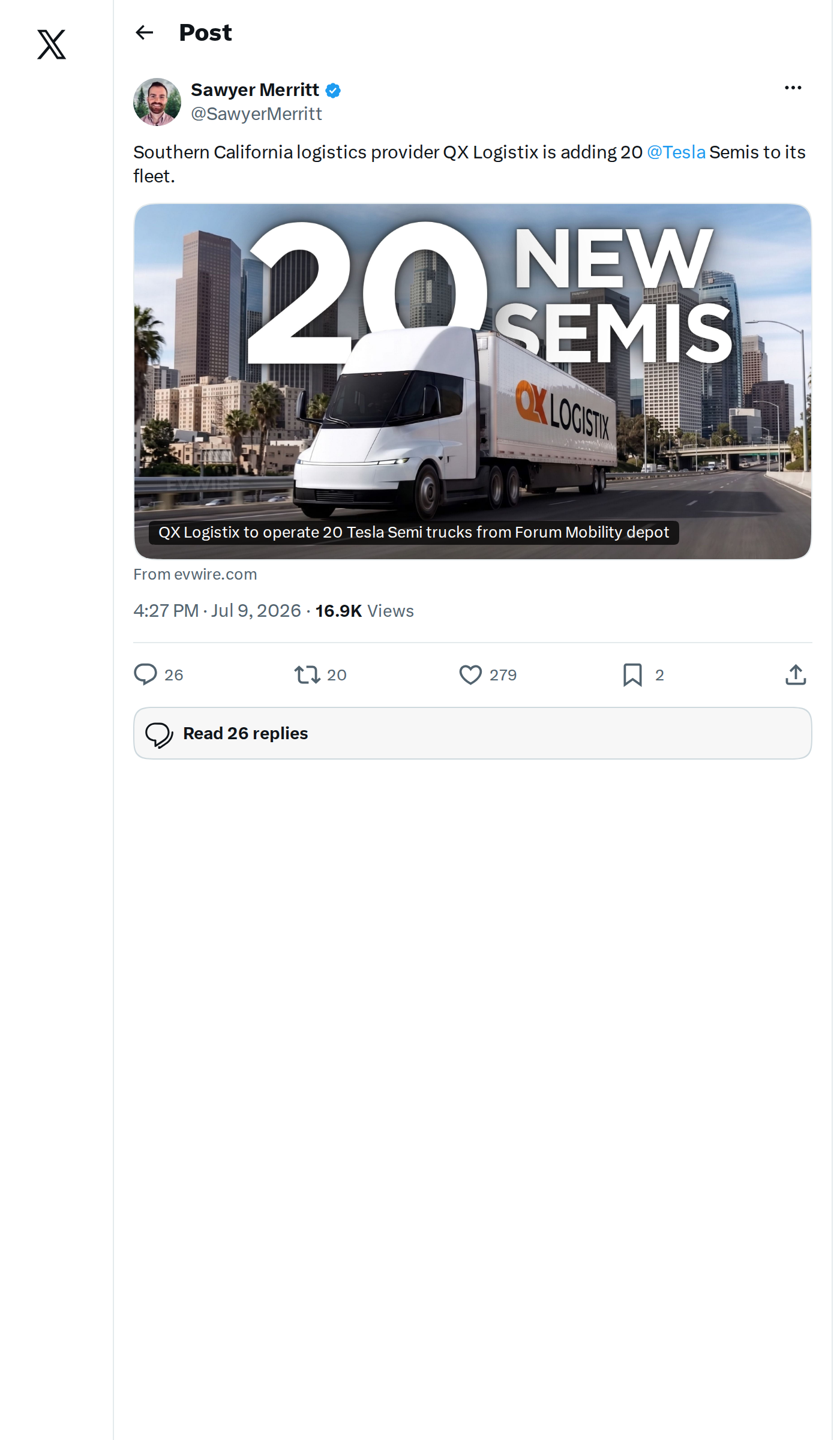
Southern California logistics provider QX Logistix is adding 20 Tesla Semis to its fleet, targeting operations between the Ports of Los Angeles and Long Beach. The announcement is one of the more concrete signs yet that Tesla's heavy-duty electric truck is moving beyond early adopters and into mainstream commercial freight — and the details behind this deal are worth unpacking.

1. The Route Is Purpose-Built for the Tesla Semi's Strengths
QX Logistix is deploying the Semis specifically for container traffic between the Ports of Los Angeles and Long Beach and the surrounding logistics centers and warehouses. This is a high-frequency, relatively short-haul corridor — exactly the kind of predictable, high-utilization route where the Tesla Semi's 500-mile range (long-range model) is more than sufficient and where the economics of electric trucking are hardest to argue against. Port drayage is one of the most polluted freight segments in the country, making it a logical beachhead for electrification.
2. Operations Are Slated to Begin in Early 2027
According to verified reports, the 20 Tesla Semis are planned to become operational in early 2027. That timeline aligns with Tesla's volume production ramp — Tesla began volume production of the Semi on April 29, 2026, at Gigafactory Nevada. A fleet of this size coming online within roughly a year of volume production launch suggests QX Logistix secured an early position in the order queue, and that Tesla's delivery pipeline is beginning to flow at scale.
3. Charging Is Handled Through a Third-Party Hub — No Infrastructure Build Required
One of the biggest barriers for fleet operators considering electric trucks is charging infrastructure. QX Logistix sidesteps that entirely by partnering with Forum Mobility's charging hub, eliminating the need to build or own any charging assets. This is a meaningful development for the broader industry: as third-party charging hubs purpose-built for Class 8 electric trucks come online, the infrastructure argument against fleet electrification weakens considerably. It also signals a maturing ecosystem around the Tesla Semi, not just the truck itself.
4. The Semi's Specs Make It a Credible Workhorse for This Application
For anyone still skeptical about the Tesla Semi's commercial viability, the numbers are worth reviewing. The long-range model delivers approximately 500 miles of range at 1.7 kWh per mile, can haul up to 45,000 lbs of payload, and fast-charges to 60% capacity in roughly 30 minutes via MCS 3.2. Its three independent rear motors produce up to 800 kW of drive power, while the curb weight of under 23,000 lbs for the long-range variant leaves meaningful room for payload. For port drayage cycles that rarely push beyond 150-200 miles per shift, the Semi is operating well within its comfort zone.
5. This Is Part of a Broader Electrification Wave at Southern California Ports
The LA/Long Beach port complex has been under sustained regulatory pressure to clean up its drayage fleet, with California's Advanced Clean Fleets rule pushing operators toward zero-emission vehicles on an accelerating timeline. QX Logistix's move isn't happening in isolation — it reflects a structural shift in how Southern California freight operators are planning their fleets over the next several years. As more charging infrastructure like Forum Mobility's hub comes online near the ports, expect more operators to follow a similar playbook: lease or purchase electric trucks, plug into third-party charging, and avoid the capital cost of building their own depot infrastructure.
With volume production now underway at Gigafactory Nevada and real fleet deployments beginning to materialize, the Tesla Semi is graduating from a compelling prototype into a commercial product with a growing order book. The QX Logistix deal won't be the last announcement of its kind — the question is how quickly Tesla can scale production to meet what appears to be genuine demand from operators who have run the numbers and like what they see.
Related Gear
Gear up your Tesla with tested, custom-fit BASENOR accessories — shop Tesla accessories →
Sources & reporting notes
The links below identify the material source records used for this report.
- @SawyerMerritt on X (2026-07-09T16:27:38.000Z) — Direct source
Source links are preserved as published or accessed. See our editorial standards and corrections policy.
The BASENOR Editorial Desk covers Tesla, SpaceX, and related technology, curating reporting from primary sources — official accounts, regulatory filings, and software release data. Every article passes source-record and fact-checking review before publication. About the newsroom.
This report was curated by the BASENOR Editorial Desk from the sources listed above. Read our editorial standards or email editorial@basenor.com to report an error.