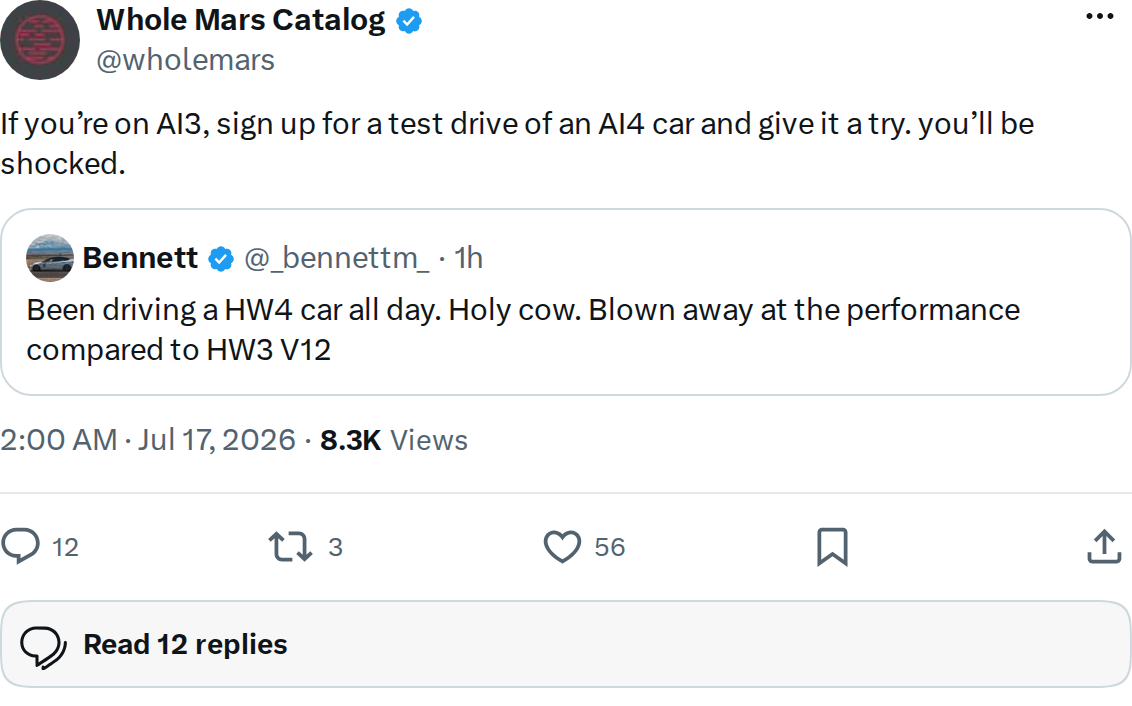
Whole Mars Catalog, one of the more plugged-in Tesla observers on X, posted a simple but pointed recommendation this week: if you're still driving a car with AI3 hardware, book a test drive in an AI4 vehicle. His word for the experience? Shocked. That's not hyperbole — the gap between the two hardware generations is measurable, documented, and frankly larger than most owners realize. Here's what the numbers actually show.

1. Raw Computing Power: 243 TOPS vs. 72 TOPS
This is the headline number. AI3 (Hardware 3) delivers 72 Trillion Operations Per Second. AI4's dual-chip configuration hits approximately 243 TOPS — a 3x to 5x increase, a figure Elon Musk has cited publicly. That isn't a spec-sheet abstraction. More compute means the car can process more sensor data per second, run more complex neural net models, and react faster to edge-case scenarios. Everything downstream — lane changes, intersection handling, unprotected left turns — runs on that foundation.
2. Camera Resolution: A Fundamentally Different Picture
AI4 ships with higher-resolution cameras across the board. The front-facing cameras reach 2896 pixels wide, a significant step up from AI3's camera suite. Higher resolution means the car sees finer detail at greater distances — a pedestrian at the edge of a crosswalk, a faded lane marking, a stop sign partially obscured by a tree branch. For FSD, more pixels at the input layer translates directly to better scene understanding before the neural net even starts processing.
3. FSD Behavior on the Same Route
Owners who have driven both hardware generations on identical routes consistently report that AI4 feels more decisive and less hesitant. The car holds its lane with more confidence, handles merges with less phantom braking, and navigates complex urban intersections more smoothly. This isn't just perception — the underlying compute headroom means FSD can run more sophisticated model versions that AI3 hardware physically cannot support at full fidelity. As Tesla continues pushing FSD updates, the divergence between what AI3 and AI4 can run will only widen.
4. Future-Proofing: The Gap Will Keep Growing
Tesla's FSD software is trained and optimized for the hardware it runs on. As neural net models grow in complexity and Tesla ships increasingly capable FSD versions, AI4's headroom becomes a structural advantage. AI3 vehicles will continue receiving updates, but there's a ceiling — some model improvements require compute that AI3 simply doesn't have. Owners who plan to keep their car for several more years are effectively choosing between a platform with room to grow and one approaching its limits.
5. The Test Drive Is Free — and the Point
Whole Mars Catalog's recommendation isn't casual. Tesla offers test drives at its showrooms and delivery centers, and booking one in an AI4-equipped vehicle costs nothing. The suggestion is deliberate: experiencing the difference firsthand is more persuasive than any spec comparison. If you're on AI3 and on the fence about an upgrade path, an hour behind the wheel of an AI4 car on a route you know well is the most honest benchmark you can run. Schedule one through the Tesla app or at tesla.com/drive.
The hardware generation gap between AI3 and AI4 is one of those things that looks modest on paper until you're actually in the car. For owners who bought before AI4 became standard, the test drive recommendation is worth taking seriously — especially as Tesla's FSD ambitions continue to push the boundaries of what the underlying compute can handle.
Related Gear
Gear up your Tesla with tested, custom-fit BASENOR accessories — shop Tesla accessories →
Sources & reporting notes
The links below identify the material source records used for this report.
- @wholemars on X (2026-07-17T02:00:04.000Z) — Direct source
Source links are preserved as published or accessed. See our editorial standards and corrections policy.
The BASENOR Editorial Desk covers Tesla, SpaceX, and related technology, curating reporting from primary sources — official accounts, regulatory filings, and software release data. Every article passes source-record and fact-checking review before publication. About the newsroom.
This report was curated by the BASENOR Editorial Desk from the sources listed above. Read our editorial standards or email editorial@basenor.com to report an error.