
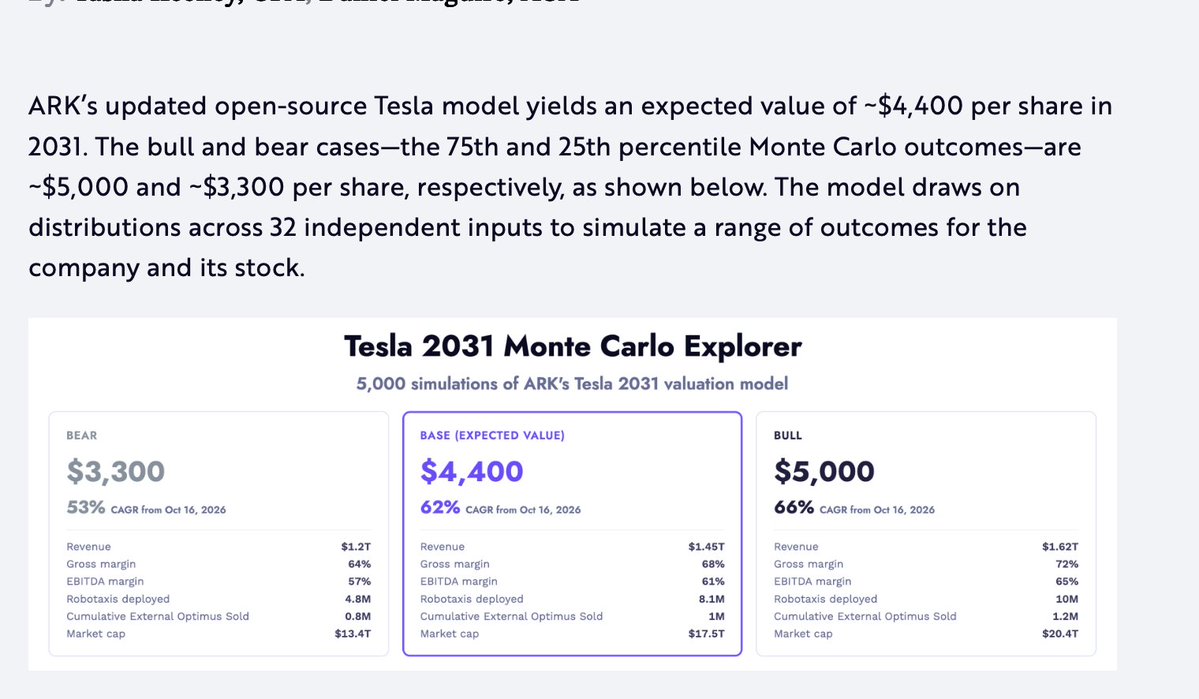
ARK Invest published an updated open-source valuation model for Tesla on October 19, 2026, projecting the company could reach a $17.5 trillion market capitalization by 2031 in its base case — and as high as $20.4 trillion in a bull scenario. The headline number is striking, but the more revealing detail is what ARK thinks gets Tesla there: not cars, but robots.

The Numbers Behind the Projection
ARK's base case lands at approximately $4,400 per share in 2031. To put that in context, that figure implies a valuation roughly on par with — or exceeding — the largest companies ever recorded by market cap. ARK is not known for conservative modeling, and this report continues that tradition. But the firm does publish its assumptions openly, which at least makes the reasoning auditable.
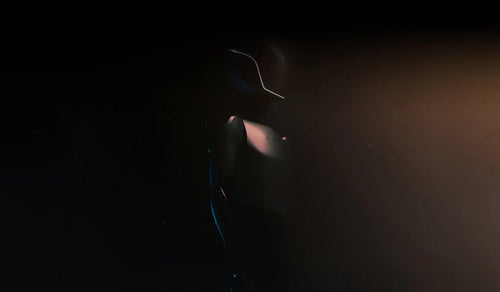
The single largest driver in ARK's model isn't Tesla's automotive business or even its energy division. It's Optimus. According to the projection, Tesla selling approximately 1 million Optimus robots externally generates around $212 billion in revenue by 2031. That one line item alone would represent a business larger than most Fortune 50 companies today.

Why Optimus Is Doing the Heavy Lifting
ARK's thesis has been evolving for years, but this model represents perhaps the clearest statement yet that the firm views Tesla primarily as an AI and robotics company that happens to manufacture vehicles. The logic isn't unreasonable on its face: if Tesla can produce humanoid robots at automotive scale and price them competitively for industrial and commercial buyers, the addressable market dwarfs anything in the car business.
The 1 million external unit figure for 2031 is aggressive. Tesla has been ramping Optimus production internally — using robots on its own factory floors — but external commercial sales at that volume would require a step-change in both manufacturing capacity and enterprise adoption. ARK is essentially betting that both happen within five years.
It's worth noting that ARK's prior Tesla price targets have frequently drawn skepticism and, in some cases, proven prescient over long time horizons even when the near-term timing was off. Investors and analysts tend to treat ARK projections as a directional signal rather than a precise forecast.
What This Means for Tesla Owners and Investors
For Tesla owners, the practical takeaway is that the company's strategic center of gravity is shifting. The vehicles you drive are increasingly the platform through which Tesla trains its AI systems — and that data advantage is a core input to ARK's bull case. Every mile driven by a Tesla on FSD contributes to the same neural network infrastructure that underpins Optimus's autonomy stack, at least in theory.
For anyone watching Tesla's stock, ARK's model sets a clear benchmark for what the bull case requires: Optimus needs to ship externally at scale, and it needs to happen on a timeline that starts generating meaningful revenue well before 2031. If robot deployments stall or margins disappoint, the $4,400 base case unravels quickly — the automotive and energy businesses alone don't get you to a $17.5 trillion valuation.
ARK's full open-source model is available directly from their site, and given the firm's transparency about inputs, it's worth examining the assumptions yourself rather than taking the headline figure at face value. The $17.5 trillion number will generate attention; the Optimus unit economics buried in the spreadsheet are where the real argument lives.
🤖 Tracking Tesla's humanoid robot? See every Optimus production milestone and appearance in our Tesla Optimus Tracker.
Related Gear
Gear up your Tesla with tested, custom-fit BASENOR accessories — shop Tesla accessories →
Sources & reporting notes
The links below identify the material source records used for this report.
- @SawyerMerritt on X (2026-10-19T21:58:55.000Z) — Direct source
- @SawyerMerritt on X (2026-10-19T21:58:55.000Z) — Direct source
Source links are preserved as published or accessed. See our editorial standards and corrections policy.
The BASENOR Editorial Desk covers Tesla, SpaceX, and related technology, curating reporting from primary sources — official accounts, regulatory filings, and software release data. Every article passes source-record and fact-checking review before publication. About the newsroom.
This report was curated by the BASENOR Editorial Desk from the sources listed above. Read our editorial standards or email editorial@basenor.com to report an error.