📌 UPDATE — March 24, 2026
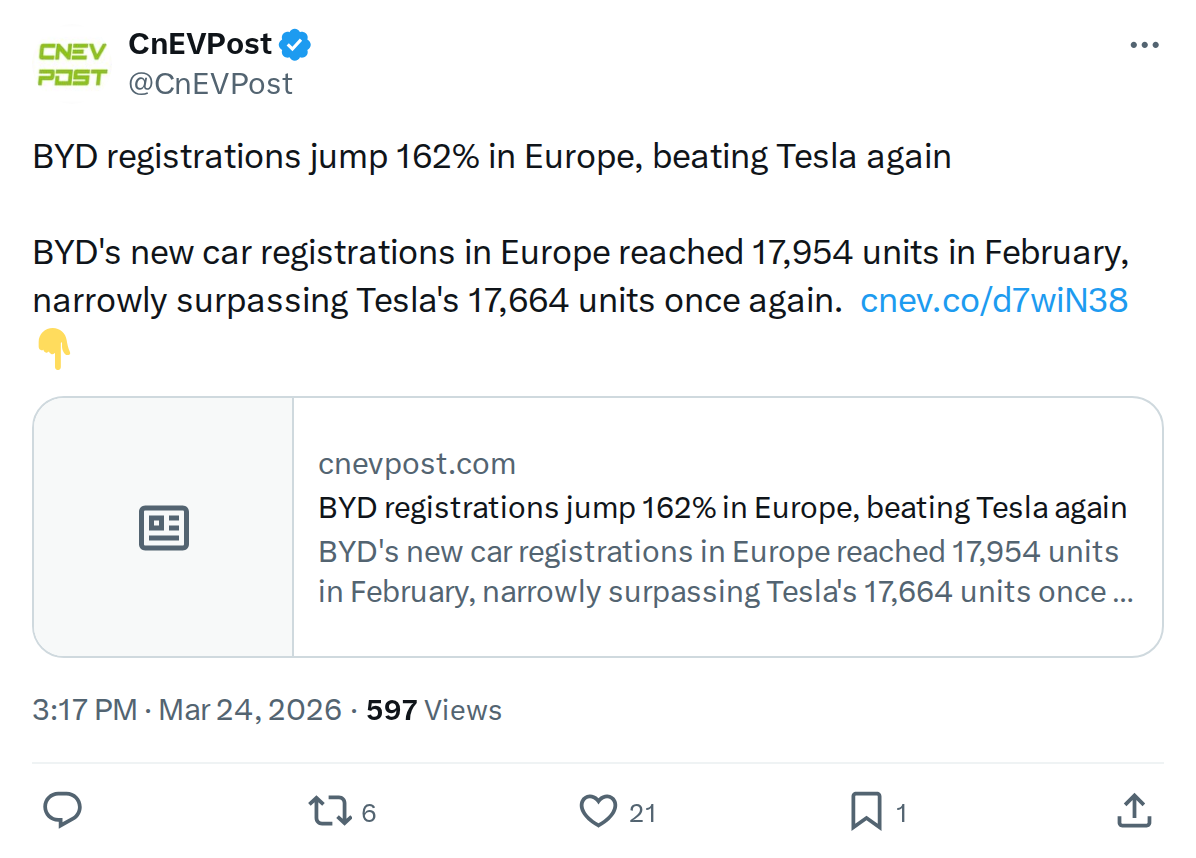
Official February 2026 registration figures are now confirmed: BYD recorded 17,954 units across Europe, edging out Tesla's 17,664 units by a margin of just 290 vehicles. The razor-thin gap underscores how competitive the two brands have become in the region, with BYD's European registrations surging 162% year-over-year. Full breakdown data has been published by CnEVPost.
The News: BYD registered 17,954 new cars in Europe in February 2026, narrowly edging Tesla's 17,664 units — the second consecutive month BYD has outregistered Tesla in the region.
Why It Matters: Tesla's European position is under genuine competitive pressure, though February also marks Tesla's first year-over-year registration growth in Europe after 13 straight months of declines.
Source: @CnEVPost — March 24, 2026

📊 Key Figures: February 2026 European Registrations
🇪🇺 Europe (EU + EFTA + UK) — February 2026
| Brand | Registrations | YoY Change | Market Share |
|---|---|---|---|
| BYD | 17,954 | +162.3% | 1.8% |
| Tesla | 17,664 | +11.8% | 1.8% |
🇪🇺 EU Only — February 2026
| Brand | Registrations | YoY Change | Market Share |
|---|---|---|---|
| BYD | 15,438 | +185.3% | 1.8% |
| Tesla | 13,740 | +29.1% | 1.6% |
🔭 The BASENOR Take
| Timeline | 2nd consecutive month BYD leads in Europe (Jan–Feb 2026) |
| Impact Level | 🟠 Medium — Competitive pressure is real, but Tesla is recovering |
| Confidence | 🟢 High — Official registration data, released March 24, 2026 |
The Gap Is Narrowing — But BYD's Trajectory Is Steep
In January 2026, BYD more than doubled Tesla in European registrations: 18,242 units versus Tesla's 8,075. February tells a very different story. Tesla came back hard — 17,664 registrations, up 11.8% year-over-year — and closed what was a massive gap down to just 290 units. That's a margin of less than 1.7%.
That recovery matters. Tesla's February result ends a 13-month streak of year-over-year registration declines in Europe. Whether January was a genuine demand trough or a supply/logistics anomaly, February's rebound suggests the brand isn't in freefall — it's fighting.
One Critical Caveat: BYD Counts PHEVs, Tesla Doesn't
This is the number that often gets buried in headlines. BYD's 17,954 European registrations include both battery electric vehicles (BEVs) and plug-in hybrid electric vehicles (PHEVs). Tesla sells exclusively BEVs. That means a direct unit-for-unit comparison overstates BYD's EV-specific competitiveness. If you strip out PHEVs, the BYD-versus-Tesla picture looks considerably closer — or potentially reversed, depending on the PHEV share of BYD's European mix.
That said, registrations are registrations. Dealers, regulators, and market analysts count total units, and on that metric BYD is ahead for the second month running.
The January–February 2026 Scorecard
Looking at the combined January–February 2026 period for the EU specifically, BYD has registered 29,291 vehicles (+179.2% YoY) versus Tesla's 20,941 (+16.7% YoY). BYD's growth rate is operating on a completely different scale — it's expanding from a much smaller base, but the acceleration is undeniable. For context, BYD's EU market share jumped from 0.6% to 1.8% in February alone, year-over-year. Tesla's moved from 1.2% to 1.6%.
📰 Deep Dive
The European EV market is entering a genuinely competitive phase that didn't exist two years ago. BYD's 162% year-over-year surge in February isn't a blip — it reflects a deliberate, well-funded expansion strategy into a market that Tesla has largely owned among pure-EV brands. The pace of that expansion should be on every Tesla watcher's radar.
For Tesla owners, the business implications are indirect but real. Stronger competition in Europe could accelerate Tesla's product refresh cycles, push more aggressive pricing, and incentivize faster rollout of features that differentiate the ownership experience. Tesla has historically responded to competitive pressure with action rather than press releases — the Model Y Juniper refresh and ongoing FSD improvements are examples of that pattern.
What February's data doesn't tell us is whether Tesla's recovery is structural or seasonal. European registrations often dip sharply in January as buyers wait for new model-year inventory, then rebound in February. Tesla's January collapse to 8,075 units — a 17% YoY decline — followed by a February surge to 17,664 (+11.8% YoY) fits that pattern. The Q1 2026 total will be the more meaningful signal. If Tesla closes Q1 with solid European numbers, the January dip looks like noise. If March disappoints again, the competitive pressure narrative gets harder to dismiss.
One thing is clear: BYD has arrived in Europe, and it's not treating the market as a secondary priority. For Tesla, maintaining its position as the default premium EV choice for European buyers will require more than brand loyalty — it will require continued execution on product, software, and the Supercharger network advantage that remains one of its strongest differentiators in the region.
Related Gear
Gear up your Tesla with tested, custom-fit BASENOR accessories — shop Tesla accessories →
Sources & reporting notes
The links below identify the material source records used for this report.
- @CnEVPost on X (2026-03-24T07:17:46.000Z) — Direct source
Source links are preserved as published or accessed. See our editorial standards and corrections policy.
The BASENOR Editorial Desk covers Tesla, SpaceX, and related technology, curating reporting from primary sources — official accounts, regulatory filings, and software release data. Every article passes source-record and fact-checking review before publication. About the newsroom.
This report was curated by the BASENOR Editorial Desk from the sources listed above. Read our editorial standards or email editorial@basenor.com to report an error.