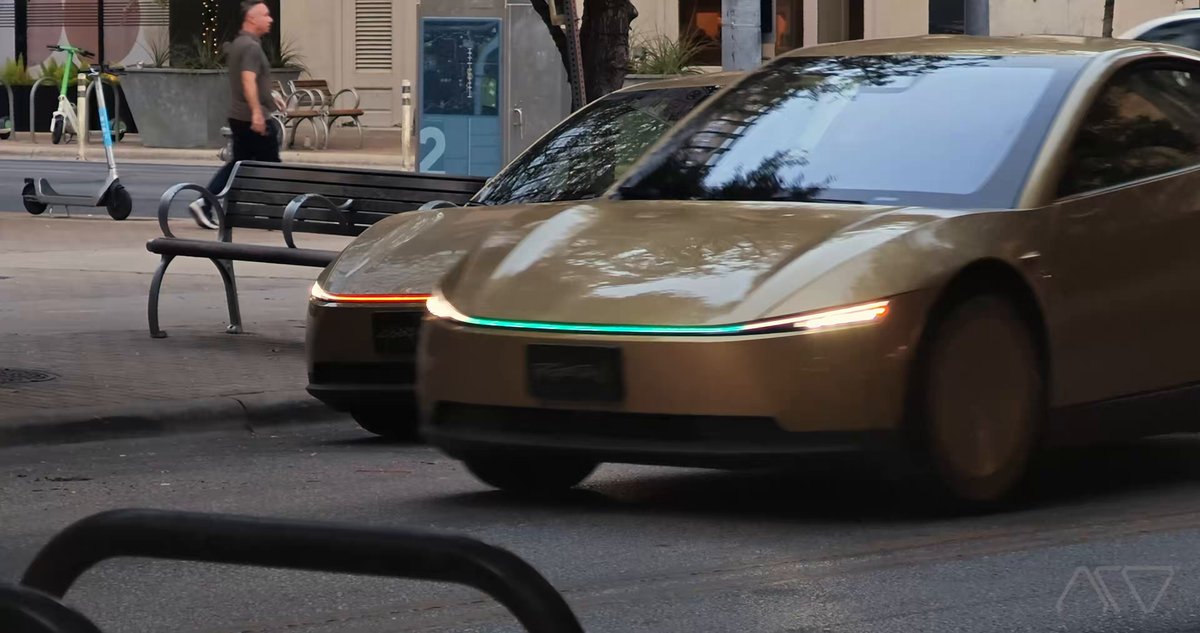
Tesla's Cybercab has a clever answer to one of the most mundane problems in autonomous ride-hailing: how do you know which robotaxi is yours? A color-changing RGB light bar on the front of the vehicle is designed to solve exactly that — and new footage shows it cycling through at least three distinct colors ahead of the September 3rd Austin launch event.

What exactly is the RGB light bar on the Cybercab?
It's a full-width strip of LEDs running across the front of the vehicle, capable of displaying multiple colors. In normal operation, according to background research, the bar appears as a continuous white strip with the headlights integrated into it. But the same hardware can switch to solid colors — purple, green, and orange have all been observed so far, per reporter Sawyer Merritt. The presence of individually addressable RGB LEDs means the bar can be programmed to display virtually any color on demand.
Why does a driverless car need a color-changing light?
Think about hailing a ride in a busy area — an airport pickup lane, a stadium exit, a downtown corner. With a human driver, you look for a face or a license plate. With a fleet of identical autonomous Cybercabs, that doesn't work. Assigning each incoming vehicle a unique color signal gives the rider something immediately visible from a distance, cutting down on confusion and time spent scanning the curb. It's a practical UX solution baked into the hardware.
Has Tesla officially confirmed this is the purpose?
Not in a formal statement. Sawyer Merritt, who has closely tracked Cybercab development, reported the rider-identification function based on observed behavior. Tesla has not issued a public explanation for the multi-color capability. More detail is expected around the September 3rd launch event in Austin, Texas, where Tesla is expected to formally introduce the Cybercab to the public.
Are there any regulatory concerns about colored front lights?
Potentially, yes. U.S. regulations generally restrict front auxiliary lighting to white and amber — red, blue, and green are typically reserved for emergency vehicles or prohibited outright on public roads. According to background research, it's widely suggested that the colorful light effects may be limited to parked vehicles, private property, or the moment a car is stationary at a pickup point rather than while driving. How Tesla navigates this in different states will be worth watching as commercial operations scale.
Does the Cybercab have any other lighting features worth knowing about?
Yes — interior ambient lighting is also part of the package. Pilot production Cybercabs feature RGB cabin lighting that riders can adjust in color through the center touchscreen, according to background research. So the color customization isn't just an exterior identification tool; it extends to the passenger experience inside the vehicle as well.
When does the Cybercab launch, and what else do we know about it?
Tesla is holding a dedicated Cybercab launch event in Austin, Texas on September 3, 2026. The vehicle is a two-passenger, fully autonomous design — no steering wheel, no pedals. It starts at $25,000, making it Tesla's most affordable vehicle to date. EPA filings show a 47.6 kWh battery, a 163 kW front-wheel-drive motor, and an estimated range of approximately 293 miles. Mass production began at Giga Texas in April 2026, and hundreds of units have already been spotted near the plant.
The RGB light bar is a small detail with outsized practical importance — it's the kind of thoughtful design that separates a functional robotaxi from a confusing one. Whether Tesla fully explains the system on September 3rd or rolls it out quietly through software behavior, the mechanism is already visible in the wild. Riders in Austin won't have to guess which Cybercab is pulling up for them.
🚕 Following the Robotaxi rollout? See every operating city, launch date and announced market in our Tesla Robotaxi Tracker.
Related Gear
Gear up your Tesla with tested, custom-fit BASENOR accessories — shop Tesla accessories →
Sources & reporting notes
The links below identify the material source records used for this report.
- @SawyerMerritt on X (2026-08-27T03:04:54.000Z) — Direct source
Source links are preserved as published or accessed. See our editorial standards and corrections policy.
The BASENOR Editorial Desk covers Tesla, SpaceX, and related technology, curating reporting from primary sources — official accounts, regulatory filings, and software release data. Every article passes source-record and fact-checking review before publication. About the newsroom.
This report was curated by the BASENOR Editorial Desk from the sources listed above. Read our editorial standards or email editorial@basenor.com to report an error.