📌 UPDATE — July 11, 2026
Tesla has moved beyond pure track validation — Cybercab is now running as a continuous autonomous service for employees at Giga Texas, ferrying workers across the campus on demand. This marks a significant operational milestone, transitioning the Cybercab from closed-loop NVH and validation testing into real-world, repeated-use deployment with actual passengers. Observers note this internal rollout is a strong leading indicator that a broader Robotaxi expansion to paying customers in Austin and other regions is imminent.


📌 UPDATE — July 10, 2026
Tesla has officially announced that Cybercab employee rides at Giga Texas are starting soon — marking a major milestone beyond track validation. The vehicles used will have no steering wheel or pedals, confirming fully autonomous operation for these internal rides. This moves the Cybercab program from pure NVH and engineering testing into real-world passenger service, albeit limited to Tesla employees on-site. It's the clearest signal yet that Tesla considers the Cybercab ready for human occupants in a controlled environment.

📌 UPDATE — July 9, 2026
Tesla is now removing the fence covers at its dedicated Robotaxi hub in Austin, Texas, leaving the Cybercabs fully visible to the public for the first time. The move comes on top of the NVH track upgrades at Giga Texas and is being widely interpreted as a strong signal that the commercial Robotaxi service launch is imminent. Uncovering the hub suggests Tesla is no longer concerned about concealing operational readiness — a deliberate shift in posture that typically precedes a public rollout.
@TeslaNewswire · July 9, 2026
"Tesla is removing the fence covers at its Robotaxi hub in Austin, Texas, making the Cybercabs fully visible. A sign that the launch is imminent?"
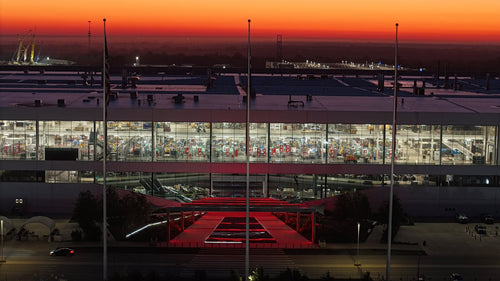
Aerial footage from Giga Texas on July 8 reveals Tesla is simultaneously scaling up Cybercab testing and upgrading the infrastructure needed to validate the vehicle. Drone observer Joe Tegtmeyer spotted multiple Cybercabs staged for testing runs while construction crews were actively laying a rough cobblestone surface on the test track — a specialized road type used specifically for Noise, Vibration, and Harshness (NVH) evaluation.

What's Being Built — and Why It Matters
NVH testing is one of the most demanding phases of vehicle validation. Cobblestone sections are a standard tool in automotive engineering — the irregular surface amplifies vibrations and acoustic resonances that would otherwise go undetected on smooth asphalt. For a vehicle like the Cybercab, which has no steering wheel, no pedals, and is designed to carry paying passengers in a fully autonomous environment, cabin comfort and noise isolation are critical commercial requirements, not just engineering checkboxes.
Tegtmeyer also noted that the track upgrades include infrastructure for active noise cancellation testing — suggesting Tesla is developing ANC tuning specifically for the Cybercab's interior, likely to compensate for road noise given the vehicle's unique architecture.

Where the Cybercab Program Stands
The activity at the test track fits into a broader acceleration of the Cybercab program. The first production unit rolled off the Giga Texas line on February 17, 2026, and by early July, more than 100 Cybercabs had accumulated in the factory's outbound lots, according to previous reports. Engineering tests on public Austin roads began June 30, with a safety monitor in the passenger seat — a standard regulatory step before fully driverless commercial deployment.
On the Giga Texas test track itself, Cybercabs have already been observed running full autonomy without a safety monitor, including simulated passenger drop-off and pick-up sequences. The addition of the cobblestone section suggests Tesla is now moving deeper into ride-quality refinement — the kind of work that typically precedes a commercial launch timeline rather than early prototype evaluation.
The Cybercab launches with an AI4+ hardware configuration — an enhanced version of the AI4 chip with more than 32GB of RAM, potentially up to 64GB — because the next-generation AI5 chip isn't expected to reach sufficient production volume until mid-2027, according to previous reports.
The Bigger Picture at Giga Texas
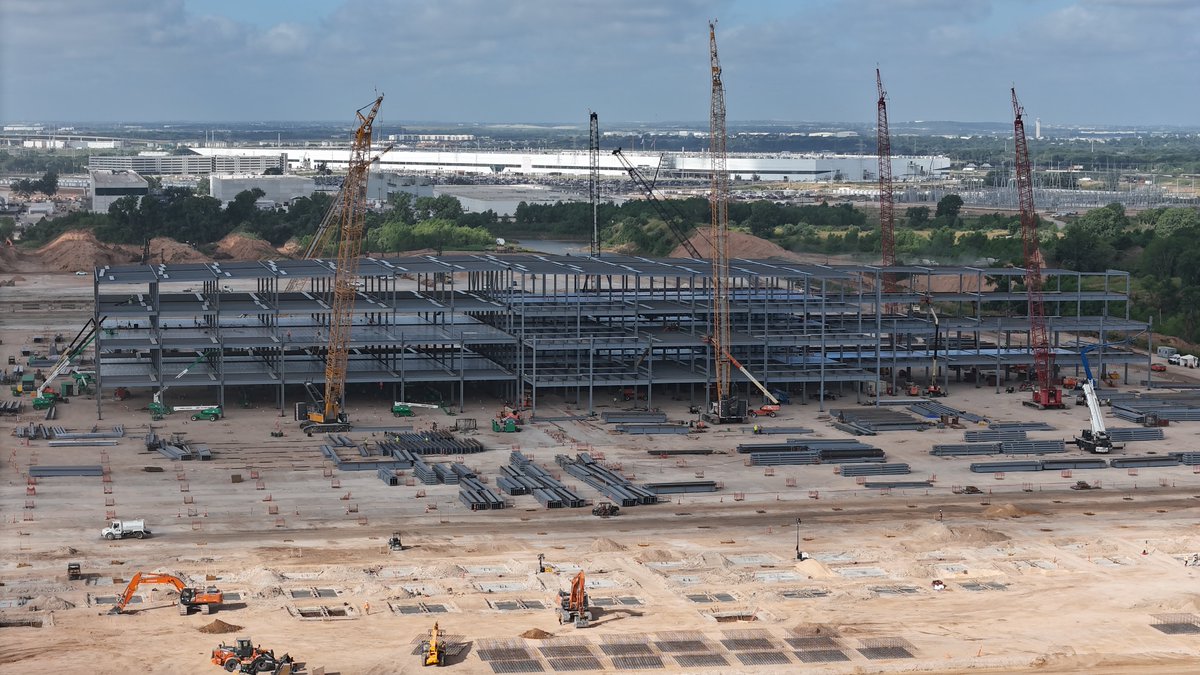
The test track upgrades are one piece of a larger construction push visible in today's aerial footage. Tegtmeyer also documented foundation preparation for an advanced chip fabrication facility, continued steel assembly growth on the Optimus factory, and extension of River Road infrastructure reaching what he described as the "Lone Tree" field. The scale of simultaneous construction activity points to a campus that is expanding its manufacturing and R&D footprint well beyond just the Cybercab program.
The cobblestone section is a small detail in that larger picture — but it's a meaningful one. It signals that Cybercab validation is progressing through the unglamorous middle phases of automotive development, where engineers chase down squeaks, rattles, and resonance frequencies that passengers would notice on day one of a commercial service. Getting this right before launch, rather than patching it after, is exactly the kind of disciplined engineering process that will determine whether the Cybercab's ride quality matches its autonomous ambitions.
Related Gear
Gear up your Tesla with tested, custom-fit BASENOR accessories — shop Tesla accessories →
🚕 Following the Robotaxi rollout? See every operating city, launch date and announced market in our Tesla Robotaxi Tracker.
Sources & reporting notes
The links below identify the material source records used for this report.
- @JoeTegtmeyer on X (2026-07-08T15:07:18.000Z) — Direct source
- @JoeTegtmeyer on X (2026-07-08T15:05:49.000Z) — Direct source
- @TeslaNewswire on X (2026-07-09T04:54:28.000Z) — Direct source
- @Tesla on X (2026-07-10T23:52:27.000Z) — Direct source
- @SawyerMerritt on X (2026-07-10T23:54:57.000Z) — Direct source
- @teslascope on X (2026-07-11T00:01:51.000Z) — Direct source
- @wholemars on X (2026-07-11T00:09:03.000Z) — Direct source
Source links are preserved as published or accessed. See our editorial standards and corrections policy.
The BASENOR Editorial Desk covers Tesla, SpaceX, and related technology, curating reporting from primary sources — official accounts, regulatory filings, and software release data. Every article passes source-record and fact-checking review before publication. About the newsroom.
This report was curated by the BASENOR Editorial Desk from the sources listed above. Read our editorial standards or email editorial@basenor.com to report an error.