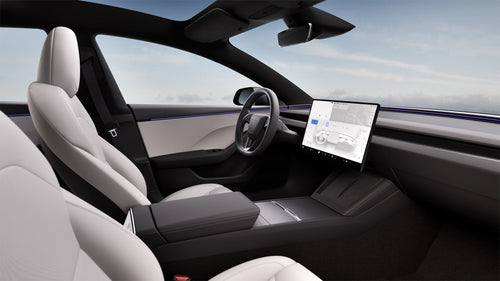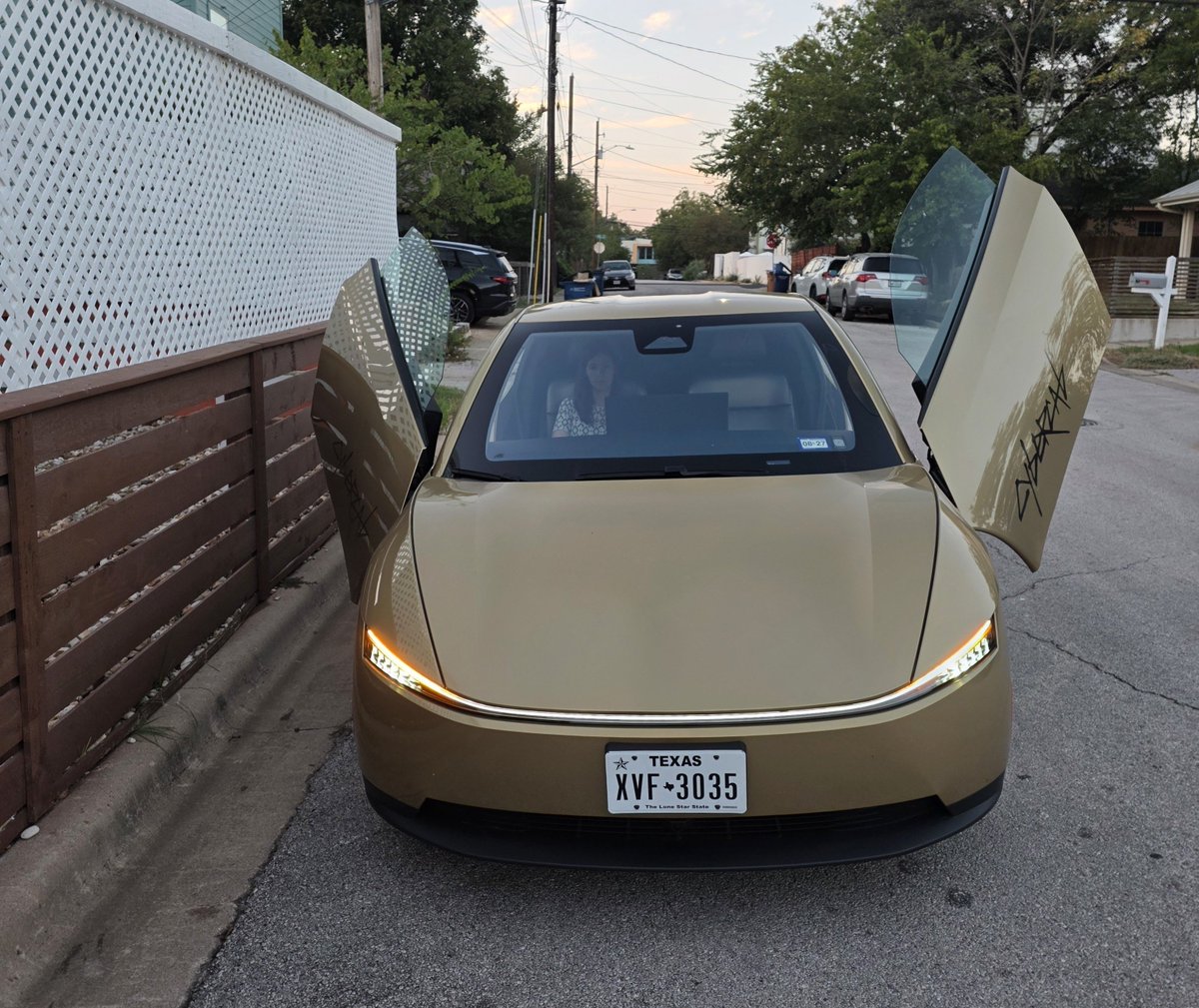
A short video clip shared by Dirty Tesla on Thursday night captures something easy to miss at first glance: a Cybercab quietly adjusting how far it opens its butterfly door to avoid clipping a nearby fence. It's a small moment, but it points to a layer of environmental intelligence that goes well beyond what most people expect from an autonomous vehicle's door system.

More Than a Simple Stop
Most obstacle-detection systems on conventional vehicles are binary: the door either opens fully or it doesn't open at all. What the Cybercab appears to be doing here is different — it's modulating the opening arc in real time, stopping at the widest angle that still clears the obstruction. That distinction matters. A door that refuses to open entirely would strand a passenger in a tight parking spot or a curbside drop-off zone with a planter or bollard nearby. A door that opens just enough to let someone exit is genuinely useful.
According to Tesla's documentation, the Cybercab's butterfly doors are governed by a vision system that actively scans the door's full swing path both before and during the opening sequence. The system accounts for the complete arc of travel — lateral clearance, overhead obstructions, and moving objects like cyclists or pedestrians passing through the zone. UWB (Ultra-Wideband) technology handles precision positioning as a confirmed rider approaches, triggering the automatic open sequence only when the geometry is clear enough to proceed.
What Happens When the Path Is Blocked
If the system detects a hard obstruction that leaves no safe opening angle at all, the door halts and will not open. For situations where a rider needs to override that judgment — say, a tight but technically passable gap — Tesla has built in a hold-to-override function that allows the door to be forced open slowly, giving nearby road users time to react. That's a deliberate safety tradeoff: preserve the autonomous default while giving humans a last-resort option.
Door control isn't limited to the automatic system either. Riders can operate the doors via an exterior button on the B-pillar, a door icon on the central touchscreen inside the cabin, or a physical lever on the door panel itself. That lever uses a two-detent design: a light pull triggers the electronic release, while a full lift engages a mechanical cable release for emergencies or power-loss scenarios — a detail that matters when the vehicle is fully autonomous and there's no driver to intervene.
Why This Matters for Robotaxi Operations
The Cybercab has been running paid robotaxi service in Austin since September 4, 2026, which means the door system is being stress-tested across a wide variety of real-world drop-off environments — curbside, parking lots, residential driveways, commercial zones. Each of those settings presents different obstacle profiles. A door system that can only do full-open or full-stop would generate friction in a meaningful percentage of those scenarios, either blocking exits or requiring manual intervention that defeats the purpose of a driverless service.
The fence clip in Dirty Tesla's video is a low-drama illustration of exactly the kind of edge case that accumulates into fleet reliability data. The system handled it without passenger input, without a full refusal, and without contact. For a robotaxi operation trying to scale, that's the outcome the engineering needs to produce consistently — not just once on camera.
Tesla has also engineered a post-collision egress sequence into the Cybercab: in the event of an impact, doors automatically unlock, hazard lights activate, the cabin illuminates, the high-voltage battery disables, and windows vent. That sequence is separate from the adaptive opening logic, but it reflects the same underlying principle — door behavior in an autonomous vehicle has to cover scenarios a human driver would normally handle by judgment, and the system has to get it right without anyone in the front seat.
🚕 Following the Robotaxi rollout? See every operating city, launch date and announced market in our Tesla Robotaxi Tracker.
Related Gear
Gear up your Tesla with tested, custom-fit BASENOR accessories — shop Tesla accessories →
Sources & reporting notes
The links below identify the material source records used for this report.
- @DirtyTesLa on X (2026-10-09T03:09:51.000Z) — Direct source
Source links are preserved as published or accessed. See our editorial standards and corrections policy.
The BASENOR Editorial Desk covers Tesla, SpaceX, and related technology, curating reporting from primary sources — official accounts, regulatory filings, and software release data. Every article passes source-record and fact-checking review before publication. About the newsroom.
This report was curated by the BASENOR Editorial Desk from the sources listed above. Read our editorial standards or email editorial@basenor.com to report an error.