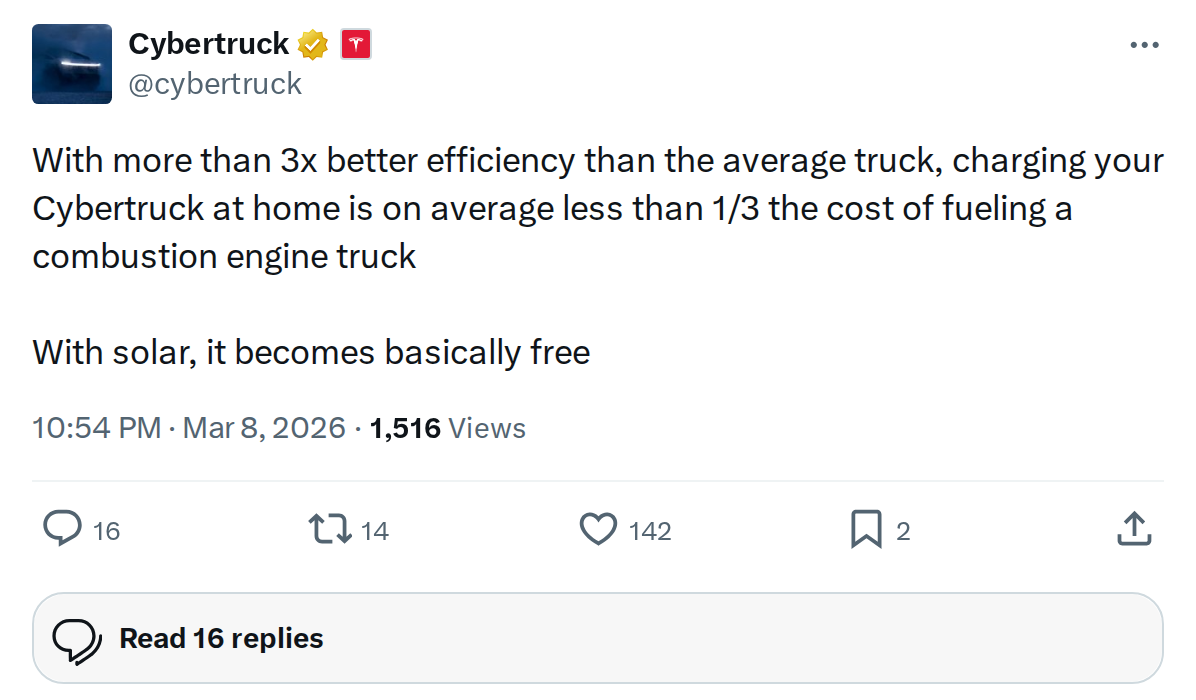
The News: The official Cybertruck account confirms the truck is over 3x more efficient than the average combustion engine truck — translating to home charging costs less than one-third of what gas truck owners pay at the pump.
Why It Matters: For Cybertruck owners, this is a concrete, dollar-figure argument for their purchase. Pair it with Tesla Solar and those energy costs drop to near zero.
Source: @cybertruck on X

📊 What the Numbers Actually Mean
The Cybertruck's official account isn't just throwing around a marketing claim — the efficiency gap between electric trucks and their gas counterparts is real and significant. The 2026 Cybertruck AWD carries an EPA rating of 79 MPGe. The average full-size gas truck sits in the mid-20s MPG range. That's where the "3x" figure comes from, and it holds up under scrutiny.
Here's how it translates to actual dollars at the household level:
| Metric | Cybertruck (AWD) | Avg Gas Truck |
|---|---|---|
| EPA Efficiency | 79 MPGe | ~24 MPG |
| Est. Annual Energy Cost (15k mi) | ~$1,045 | ~$3,200+ |
| Cost per Mile (home charging) | ~$0.07 | ~$0.21+ |
| Cost per Mile (Tesla Solar) | ~$0.05 or less | N/A |
Estimates based on $0.17/kWh average U.S. electricity rate, ~$3.50/gal gas, and 15,000 miles/year. Individual results vary by region and driving conditions.
⚡ The Solar Equation
The most compelling part of the official claim is the solar angle. When paired with a Tesla Solar system, the Cybertruck account states charging becomes "basically free." This isn't pure marketing spin — Tesla's own figures put the cost at as little as 5¢ per mile when solar generation covers your driving energy. At 15,000 miles annually, that's roughly $750 per year, compared to over $3,200 for a comparable gas truck. The delta is over $2,400 saved every single year.
The caveat worth noting: the solar scenario depends on system size, your local sun hours, and how much of your charging happens during daylight generation. Owners in sun-rich states like Arizona, Texas, or California will see the strongest benefit. But even in less sunny regions, the home-charging cost advantage alone is substantial.
🚦 Owner's Action Plan
Verdict: RECOMMENDED — Run your own numbers before your next gas fill-up
Step 1 — Calculate your current gas spend. Take your average monthly miles, divide by your truck's MPG, multiply by your local gas price. That's your monthly fuel cost baseline.
Step 2 — Estimate your Cybertruck home charging cost. Multiply your monthly miles by 0.43 kWh/mile (EPA-based figure for AWD), then multiply by your local electricity rate. For most U.S. owners at the national average of ~$0.17/kWh, the number will be significantly lower than gas.
Step 3 — Check your home charging setup. If you're still charging on a standard 120V outlet, you're leaving time (and potentially money) on the table. A dedicated 240V circuit or a Wall Connector maximizes overnight charging efficiency and minimizes any charging losses that affect your real-world cost per mile.
Step 4 — If you own or are considering Tesla Solar, model the solar offset. Log into your Tesla app and use the Energy tab to see how much solar generation you currently have (if applicable). Tesla's energy advisors can model a system sized to cover your annual Cybertruck mileage — the payback math has gotten considerably more compelling with the truck's efficiency profile.
Step 5 — Factor in off-peak rates. Many utilities offer time-of-use (TOU) rates that drop electricity prices significantly overnight. Scheduling your Cybertruck to charge between midnight and 6 AM can push your cost per mile even lower than the averages cited above — in some regions, well below $0.05/mile without any solar at all.
📰 Deep Dive
The efficiency story for the Cybertruck has always been a complicated one to tell. The truck's size and weight work against it in raw kWh-per-mile terms — real-world highway testing puts consumption around 500 Wh/mile for the dual-motor AWD, and some owners report averages closer to 342 Wh/mile on mixed commute routes. Neither figure is "efficient" in the way a Model 3 is efficient. But that's the wrong comparison entirely.
The correct benchmark is the segment it competes in: full-size trucks. And against a Ram 1500, F-150, or Silverado averaging 20-24 MPG combined, the Cybertruck's 79 MPGe rating represents a genuine, measurable advantage — not a rounding error. The "3x" claim holds up when you run the math against segment averages, and the cost-per-mile gap is real money over a 5-year ownership period.
The solar integration angle is where the value proposition becomes genuinely unique in the truck segment. No gas-powered truck can offer a credible path to near-zero fuel costs. The Cybertruck, paired with Tesla's energy ecosystem, can. For owners who already have Powerwall or Solar installed — or who are evaluating the full Tesla Energy stack — the Cybertruck's efficiency makes it the most logical vehicle to anchor that system around. Every kWh your roof generates goes further in a Cybertruck than it would in a less efficient vehicle.
The practical takeaway for current owners: if you haven't already optimized your home charging setup and electricity rate, now is a good time to do it. The hardware advantage is already in your driveway — making sure your energy setup is dialed in is the last step to realizing the full cost benefit Tesla is advertising.

Sarah focuses on Tesla Energy, SpaceX missions, and the broader Musk AI portfolio. Former data analyst in clean energy. Based in San Francisco.
Sources verified at publish time. Spotted an inaccuracy? Email editorial@basenor.com.