Owners who unlocked Full Self-Driving through unauthorized CAN bus hardware modifications are now finding themselves locked out of FSD software updates entirely — a consequence that's drawing sympathy even from Tesla community insiders who understand why the crackdown had to happen.

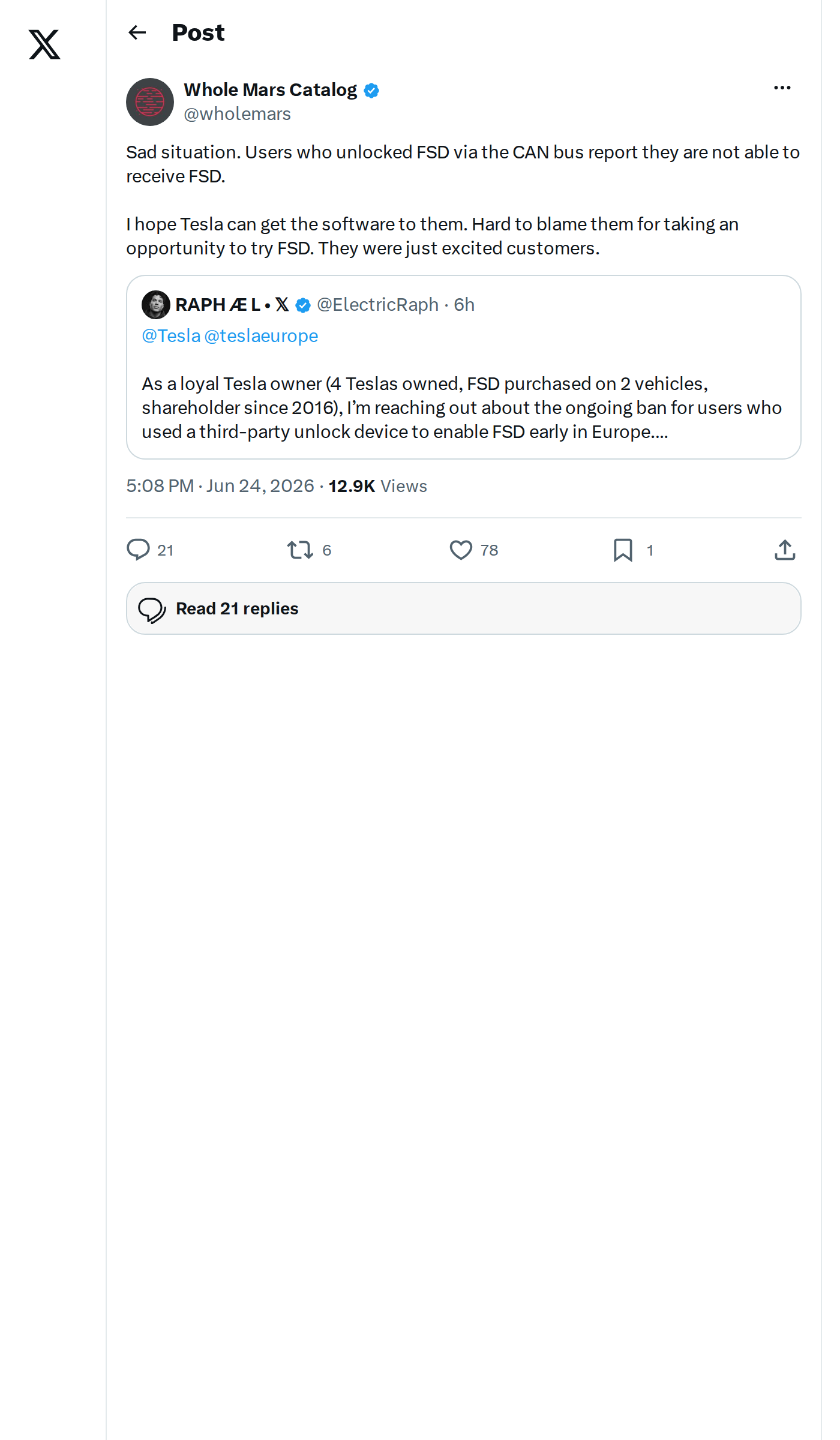
The sentiment from Whole Mars Catalog captures the tension well: these weren't malicious actors. They were enthusiastic Tesla owners in regions where FSD simply wasn't officially available, willing to spend €500 to $2,000 on a small USB-like CAN bus device to experience technology their hardware was already capable of running. Now, they're paying a steep price.
What These Devices Actually Did
The unauthorized hardware modules plug directly into a vehicle's Controller Area Network (CAN) bus — the internal communication backbone that connects a car's electronic systems. By intercepting and spoofing signals, these devices bypassed Tesla's regional software locks and geofencing restrictions, enabling FSD (Supervised) in countries where it hasn't received regulatory approval. At their peak, over 100,000 owners in China alone reportedly installed such modifications, according to reports from multiple outlets covering the crackdown.
The appeal was straightforward: the underlying hardware — in many cases Hardware 3 or Hardware 4 — was identical to vehicles in North America running FSD. The software capability existed. The regulatory approval did not. A $540 workaround felt like a reasonable bridge to some owners.
Tesla's Response Has Been Systematic
Since approximately April 2026, Tesla has moved aggressively to close this gap. The company began remotely disabling FSD on identified vehicles, reverting them to basic Autopilot. Affected owners across Europe, South Korea, China, and Turkey have reported receiving in-car notifications and emails citing terms of service violations, safety system integrity concerns, and cybersecurity risks.
The consequences go beyond simply losing FSD access. Tesla has explicitly stated it reserves the right to refuse warranty repairs on affected vehicles — regardless of whether the unauthorized device had any connection to the issue requiring repair. Some owners who had legitimately purchased FSD before relocating to an unsupported country report permanent bans from the feature, with no refund pathway.
In South Korea, the stakes are even higher. The Ministry of Land, Infrastructure and Transport has classified use of these hack devices as criminal activity under the Automobile Management Act, carrying penalties of up to two years in prison or fines of approximately $13,200 to $14,800 USD.
The Software Update Problem
The latest wrinkle — flagged by Whole Mars Catalog — is that affected owners aren't just stuck on an older FSD version. They're reportedly unable to receive FSD software updates at all. This matters because Tesla's FSD development is moving fast: FSD v14.3.4 (firmware 2026.14.6.12) began rolling out to Hardware 4 vehicles in North America around June 23, featuring a rewritten AI compiler with MLIR2, a 20% faster reaction time, and an upgraded neural network vision encoder. Being frozen out of that pipeline isn't a minor inconvenience — it's a growing capability gap that widens with every release.
Whether Tesla can or will find a path to deliver software to these owners — even after disabling the unauthorized hardware — remains an open question. Whole Mars expressed hope that Tesla might find a way, framing these owners as excited customers who took an opportunity rather than bad-faith actors. That framing is sympathetic, but it runs into a hard reality: Tesla's terms of service violations and the legal complexity in multiple jurisdictions make any blanket amnesty unlikely.
The Broader Context
This situation sits at the intersection of several ongoing Tesla storylines. FSD's one-time purchase option was discontinued as of February 14, 2026, making monthly subscriptions the only path forward for new customers. Tesla has also retroactively modified FSD purchase agreements signed between 2016 and early 2024 to explicitly include the word "Supervised" — a change that's expected to be a central issue in a certified class action lawsuit over FSD advertising claims. Original contracts have reportedly become inaccessible to some owners.
For owners in unsupported regions, the message is unambiguous: the only legitimate path to FSD is waiting for Tesla to secure regulatory approval in your country. The shortcut cost some owners their warranty protections, their FSD access, and in certain jurisdictions, their legal standing. The excitement that drove the original purchase doesn't change the outcome.
📋 Tracking Tesla software? See every firmware, FSD and app version in one place in our Tesla Software Update Tracker.
Related Gear
Gear up your Tesla with tested, custom-fit BASENOR accessories — shop Tesla accessories →
Sources & reporting notes
The links below identify the material source records used for this report.
- @wholemars on X (2026-06-24T17:08:43.000Z) — Direct source
Source links are preserved as published or accessed. See our editorial standards and corrections policy.
The BASENOR Editorial Desk covers Tesla, SpaceX, and related technology, curating reporting from primary sources — official accounts, regulatory filings, and software release data. Every article passes source-record and fact-checking review before publication. About the newsroom.
This report was curated by the BASENOR Editorial Desk from the sources listed above. Read our editorial standards or email editorial@basenor.com to report an error.