📌 UPDATE — June 24, 2026
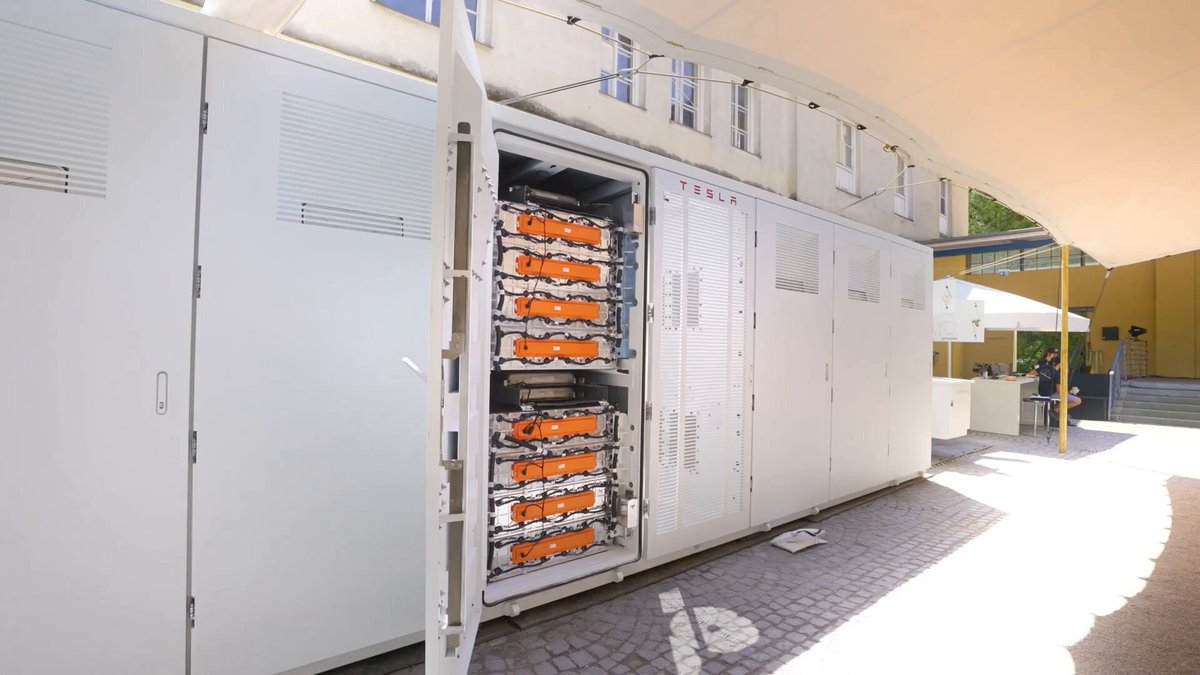
Tesla has officially confirmed the Megablock launch at the Mega Munich event, revealing new details about the system's integrated architecture. The pre-engineered block bundles Megapack 3 units, a busbar assembly, and switchgear — but the standout disclosure is that the transformer is now manufactured by Tesla itself, marking a significant step toward vertical integration in its energy storage supply chain. This in-house transformer production reduces third-party dependencies and could accelerate deployment timelines for large-scale grid projects across Europe.
@TeslaNewswire · June 24, 2026
⚡️🇩🇪 Tesla launched Megablock in Germany during its Mega Munich event! Megablock is a pre-engineered energy storage block that combines: ✅ Megapack 3 units ✅ Busbar assembly ✅ Transformer (now produced by Tesla) ✅ Switchgear
View on X →
Tesla's Megablock — the company's most advanced factory-assembled energy storage system — has arrived in Germany, marking a meaningful step in Tesla Energy's push across the European market. The arrival coincided with a series of 'Mega Munich' events where the Tesla Megapack team hosted customers for technical deep dives covering fire safety protocols, grid compliance requirements, and control system architecture.

What Megablock Actually Is
Megablock isn't just a larger Megapack — it's a fundamentally different deployment model. Unveiled in September 2025 alongside Megapack 3, the Megablock integrates four Megapack 3 units together with transformers and switchgear into a single, factory-assembled system. The result is 20 MWh of energy storage capacity delivered as one pre-integrated unit, reducing on-site installation time by 23% and construction costs by 40% compared to deploying individual units, according to Tesla's product announcements.
Each Megapack 3 inside the block uses new lithium iron phosphate (LFP) cell chemistry, pushing individual unit capacity from 3.9 MWh to 5 MWh. The platform also reduces interconnection points by 78%, which matters enormously for grid operators who need to minimize failure points in large-scale installations. Deliveries for the Megapack 3 platform are scheduled to begin in the second half of 2026.
Germany's Grid Storage Context
Germany isn't a new market for Tesla Energy, but the Megablock's arrival signals a step up in ambition. The country's first Tesla Megapack began test operation in January 2025 at Forschungszentrum Jülich — a 24-ton unit offering 595 kW of peak power and 2,616 kWh of usable capacity, integrated into the medium-voltage network to optimize grid operations, according to Forschungszentrum Jülich's published data. That pilot laid groundwork for exactly the kind of commercial conversations the Mega Munich events were designed to advance.
The timing of the Mega Munich events is deliberate. Europe's largest battery and energy storage exhibition, ees Europe, ran in Munich from June 23-25, 2026 — putting Tesla's customer engagement directly alongside the industry's biggest annual gathering. Hosting technical deep dives on fire safety, grid compliance, and controls at that moment positions Tesla Energy not just as a hardware vendor but as a grid-integration partner.
The Bigger European Picture
Germany's Megablock arrival doesn't exist in isolation. Just one day earlier, on June 23, Tesla signed a multi-year agreement with independent energy firm NatPower to supply over 25 GWh of Megapack storage systems across Italy and the United Kingdom — a deal valued at up to $5 billion for the initial phase, with a broader program targeting more than 100 GWh of capacity, according to published reports.
That deal, combined with the German deployment, suggests Tesla Energy is executing a coordinated European expansion rather than opportunistic one-off sales. The manufacturing capacity to back it up is in place: Tesla's Shanghai Megapack factory is running at an annualized 40 GWh production rate with cumulative shipments exceeding 2,000 units, and a new Megafactory near Houston targeting 50 GWh annually is slated to begin production in late 2026.
Tesla deployed a record 46.7 GWh of energy storage globally in 2025 — 48% year-over-year growth. With Megablock now physically on German soil and a pipeline of European deals taking shape, 2026 is shaping up to be the year Tesla Energy stops being a footnote in the company's financials and starts being a headline.
Related Gear
Gear up your Tesla with tested, custom-fit BASENOR accessories — shop Tesla accessories →
Sources & reporting notes
The links below identify the material source records used for this report.
- @Tesla_Megapack on X (2026-06-24T16:27:23.000Z) — Direct source
- @TeslaNewswire on X (2026-06-24T19:36:58.000Z) — Direct source
Source links are preserved as published or accessed. See our editorial standards and corrections policy.
The BASENOR Editorial Desk covers Tesla, SpaceX, and related technology, curating reporting from primary sources — official accounts, regulatory filings, and software release data. Every article passes source-record and fact-checking review before publication. About the newsroom.
This report was curated by the BASENOR Editorial Desk from the sources listed above. Read our editorial standards or email editorial@basenor.com to report an error.