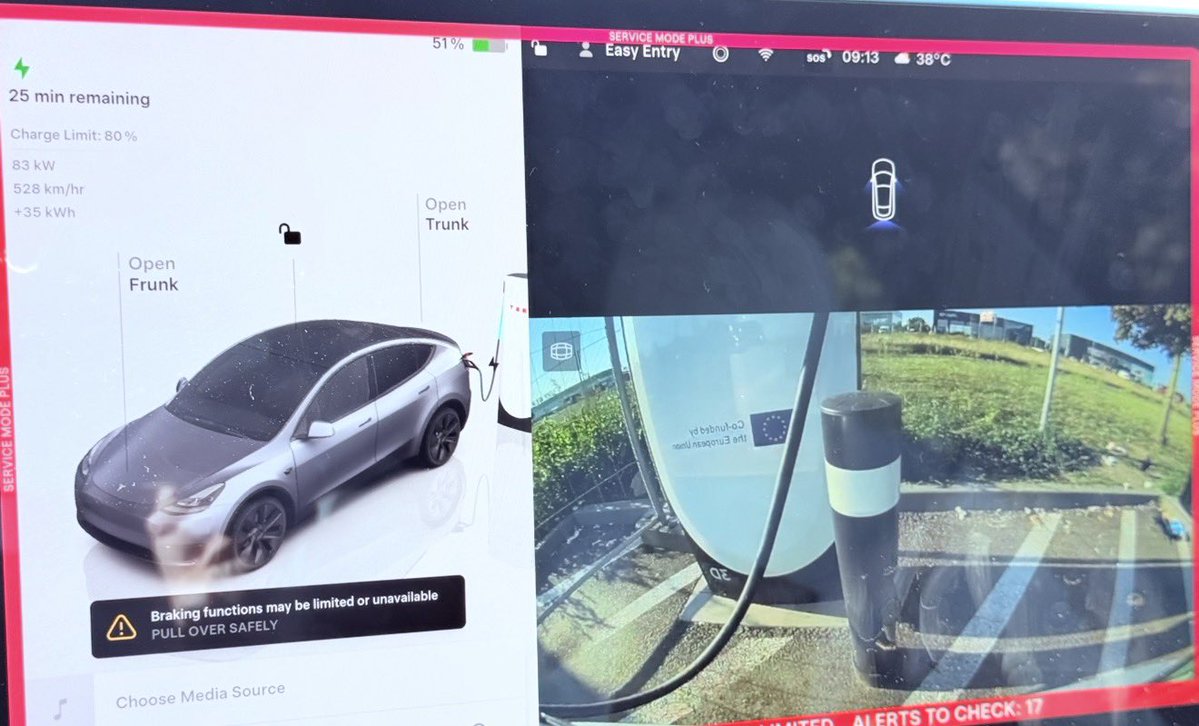
A milestone many long-time Tesla owners have been waiting on since the HW3 era just quietly cleared its first real hurdle. Independent tinkerers have reportedly completed the first working Hardware 4 (HW4) computer retrofit on a 2022 Tesla Model 3, with the swapped-in HW4 board powered up and the first camera confirmed operational. It's an unofficial, community-driven upgrade — not a Tesla service program — but it proves the physical and electrical path from HW3-generation cars to HW4 is possible without wholesale camera replacement.
For owners of pre-HW4 Model 3 and Model Y vehicles who have been watching newer HW4 cars pull ahead on Full Self-Driving capability, this is the most concrete progress in years.
What was actually done
The retrofit was documented by @TeslaNewswire and separately observed by well-known Tesla reverse-engineer @greentheonly, who has tracked Tesla hardware internals for nearly a decade. According to the reports posted on August 15, 2026, the upgrade on a 2022 Model 3 required three main steps:
- HW4 computer replacement — the original HW3 Autopilot computer was swapped out for a genuine HW4 unit.
- Some ECU modifications — additional electronic control unit changes were needed to make the HW4 board talk to the rest of the 2022 Model 3's architecture.
- Camera adapters — instead of pulling and replacing every camera in the car, adapters were used to bridge the existing HW3-generation cameras to the HW4 computer's connectors.
That last point is the one that matters most for cost and feasibility. Camera replacement on a Tesla is invasive — headliner removal, pillar disassembly, recalibration — and doing it on all eight surround cameras plus the forward array would make the project uneconomic for most owners. Keeping the original cameras and adapting the signal path sidesteps the biggest labor block.

Why this is harder than the HW2-to-HW3 swap
Back in 2019, Tesla itself offered a paid HW2.5-to-HW3 upgrade to owners who had bought the FSD package on older cars. That swap was relatively clean: same connectors, same camera generation, mostly a computer change. The community mirrored it shortly after and it became a well-documented DIY.
HW4 is a different animal. As @greentheonly put it, the "tinkering spirit is strong with this one" — but it is "much more work than HW2→HW3." The HW4 computer has a different form factor from the HW3 module it's replacing, uses different camera interfaces, and expects a newer ECU environment around it. Green flagged the mechanical fit itself as an open question, noting he wonders "how the different form-factor MCU was pushed in."

In other words: the retrofit is not just a plug-and-play board swap. It's a physical fitment problem, a wiring problem, and an ECU compatibility problem stacked together. That the first car has booted with a working camera means all three problems have plausible answers — but it does not yet mean a repeatable kit exists.
What this means for pre-HW4 owners
Tesla has never offered an official HW3-to-HW4 upgrade program. When customers who paid for FSD on HW3 cars have asked, the company's public position has been that HW3 remains capable of the FSD feature set they purchased. But as FSD builds have advanced through v13 and v14, community testing has repeatedly suggested HW4 cars get earlier access, larger models, and smoother behavior on the newest releases. Owners of 2020–2023 Model 3 and Model Y cars in particular have watched that gap widen.
This first successful third-party retrofit changes the conversation in a few concrete ways:
- It proves feasibility. Until now, HW3-to-HW4 was theoretical. One working car is not a product, but it is proof the electrical and mechanical path exists.
- It preserves the cameras. Any eventual retrofit service — official or aftermarket — is dramatically more affordable if the existing cameras stay in the car.
- It puts pressure on Tesla. If independents can do it, questions about an official upgrade path (particularly for FSD-purchased HW3 cars) become harder to sidestep.
What it does not mean — yet
A few important caveats before anyone books a shop appointment:
- One camera working is not a validated system. The full FSD stack requires all cameras, radar/ultrasonic where applicable, IMU data, and vehicle CAN bus communication to be correctly interpreted by the new computer. First-camera-online is milestone one, not milestone ten.
- Software authentication is unknown. Tesla's software binds to specific hardware identifiers. Whether a retrofitted HW4 board will pull the same FSD builds a factory HW4 car receives — over the long term, through OTA updates — has not been demonstrated publicly.
- Warranty and safety implications are real. Any third-party swap of the Autopilot computer voids relevant warranty coverage and carries safety-critical implications the owner assumes.
- This is not a kit. There is no purchasable HW4 retrofit product today. This is a one-off engineering effort by advanced hobbyists.
Key details at a glance
| Item | Status |
|---|---|
| Donor vehicle | 2022 Tesla Model 3 |
| HW4 computer install | Complete |
| First camera online | Confirmed |
| Camera replacement needed | No — adapters used |
| ECU modifications | Required |
| Tesla-official program | None |
What to watch next
The near-term signals worth tracking are whether the retrofit vehicle can (a) bring all remaining cameras online without artifacts, (b) complete a factory-style camera calibration drive, (c) authenticate against Tesla's servers to pull the current FSD build for HW4, and (d) survive an OTA update cycle without being flagged. Each of those is a distinct technical checkpoint. Clearing all four would elevate this from a proof of concept to something a small number of specialist shops could realistically replicate.
For owners of pre-HW4 Model 3 and Model Y vehicles who have been quietly wondering whether their car will ever run the newest FSD stack, today is the first day the answer stopped being "probably never" and started being "maybe, eventually." That's not a service appointment yet — but it is a meaningfully different future than the one that existed 24 hours ago.
Related Gear
Gear up your Model 3 with tested, custom-fit BASENOR accessories — shop Model 3 accessories →
Sources & reporting notes
The links below identify the material source records used for this report.
- @greentheonly on X (2026-08-15T17:37:52.000Z) — Direct source
- @TeslaNewswire on X (2026-08-15T17:46:55.000Z) — Direct source
Source links are preserved as published or accessed. See our editorial standards and corrections policy.
The BASENOR Editorial Desk covers Tesla, SpaceX, and related technology, curating reporting from primary sources — official accounts, regulatory filings, and software release data. Every article passes source-record and fact-checking review before publication. About the newsroom.
This report was curated by the BASENOR Editorial Desk from the sources listed above. Read our editorial standards or email editorial@basenor.com to report an error.