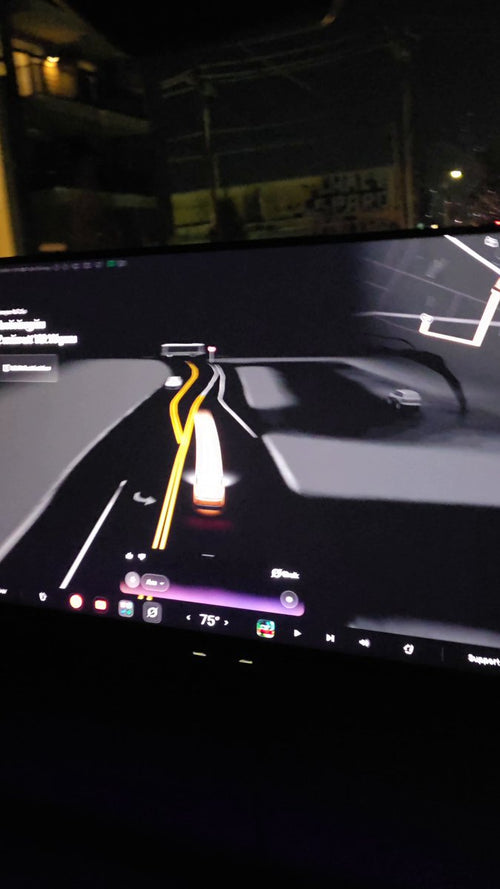
The News: Tesla's FSD Supervised now actively reduces hydroplaning risk by using Tesla Vision to estimate road wetness and automatically adjust vehicle speed in rainy conditions.
Why It Matters: Wet-road safety has historically been one of the trickier challenges for autonomous systems. This feature adds a real-time, sensor-driven layer of protection for every FSD Supervised user driving in rain.
Source: @Tesla on X
FSD Supervised Now Reduces Hydroplaning Risk — Here's How It Works
Tesla has quietly rolled out one of the most practical wet-weather safety upgrades FSD Supervised has ever received. Using Tesla Vision — the camera-based perception system that replaced radar across the fleet — FSD Supervised can now detect how wet the road surface is and automatically slow your car down to reduce the risk of hydroplaning. No driver input required.

📊 How the System Works
This isn't a simple rain sensor triggering a blanket speed reduction. Tesla has built a multi-input system that combines three real-time data streams to make intelligent speed decisions:
| Input | What It Measures | Role in the System |
|---|---|---|
| Tesla Vision | Road surface wetness | Primary environmental input — detects rain accumulation on road |
| Vehicle Input & Response | Real-time handling behavior | Detects any early signs of traction loss or abnormal vehicle response |
| Estimated Tire Tread Depth | Traction capacity of your tires | Adjusts the safety margin based on how much grip your tires can realistically provide |
When these inputs indicate elevated hydroplaning risk, FSD Supervised automatically reduces speed — proactively, before a loss of control can occur. Tesla AI demonstrated this capability handling heavy rain conditions as far back as February 17, 2026, when official footage showed FSD navigating through severe wet-road scenarios with controlled speed adjustments.
The tire tread depth estimation is particularly notable. It means the system isn't applying a one-size-fits-all speed reduction — it's accounting for the actual grip potential of your specific tires at that moment. A car running on nearly worn tires will receive a more conservative speed adjustment than one with fresh rubber. This is a meaningful step toward truly personalized safety management in autonomous driving. For more on how Tesla's self-driving stack is evolving, see our FSD coverage.
🚦 Owner's Action Plan
Verdict: RECOMMENDED — Confirm your FSD Supervised is active and up to date
- Verify FSD Supervised is enabled. Go to Controls → Autopilot and confirm Full Self-Driving (Supervised) is active on your vehicle. This feature is part of FSD Supervised — it is not available in standard Autopilot or Traffic-Aware Cruise Control.
- Check your software version. Navigate to Controls → Software and ensure you're on the latest available release. If an update is pending, install it. Tesla has not assigned a specific version number to this feature announcement, but keeping your software current ensures you receive all active safety improvements.
- Engage FSD Supervised in wet conditions as normal. You do not need to activate a separate setting. When FSD Supervised is active and Tesla Vision detects wet road conditions, the speed adjustment happens automatically in the background.
- Monitor the instrument cluster. When the system adjusts speed for wet conditions, watch for any on-screen indicators. Being aware of when the system is actively managing your speed helps you stay engaged as the supervised driver.
- Maintain your tires. Since the system factors in estimated tire tread depth, keeping your tires in good condition directly affects how the safety margins are calculated. Worn tires won't just reduce your grip — they'll trigger more conservative speed reductions from FSD Supervised.
- Stay attentive. This is FSD Supervised. The system can reduce hydroplaning risk, but you remain responsible for the vehicle at all times. In heavy rain, be prepared to intervene if road conditions deteriorate beyond what the system anticipates.
📰 Deep Dive
Hydroplaning is one of those risks that's easy to underestimate until it happens. At highway speeds on a wet surface, even a brief loss of tire contact with the road can send a vehicle into an uncontrolled slide before a human driver has time to react. The fact that Tesla is now addressing this proactively — rather than reactively — within FSD Supervised is a meaningful shift in how the system handles adverse weather.
What makes this approach technically interesting is the use of Tesla Vision for road wetness estimation. Tesla's camera-only perception stack has to infer surface conditions from visual data — reflections, water accumulation patterns, spray from other vehicles — rather than a dedicated sensor. The fact that this is reliable enough to feed into active speed control decisions reflects how far the vision-based system has matured since radar was phased out.
The tire tread depth estimation layer adds another dimension. Tesla vehicles already collect a significant amount of data about how the car responds to driver inputs over time. Estimating tread wear from vehicle dynamics data — braking distances, traction control interventions, handling response — is a logical extension of that capability. It means the hydroplaning risk model is not static; it degrades appropriately as your tires age, pushing the system toward more conservative speed choices before you might even notice your tires need replacing.
Taken together, this feature is a strong example of what differentiates Tesla's approach to autonomous safety: using the full sensor and data stack to build a richer model of the driving environment, then acting on it automatically. Rain has always been a challenging edge case for camera-based systems. This update suggests Tesla is treating it less like an edge case and more like a solved problem.
Related Gear
Gear up your Tesla with tested, custom-fit BASENOR accessories — shop Tesla accessories →
Sources & reporting notes
The links below identify the material source records used for this report.
- @Tesla on X (2026-04-02T23:27:12.000Z) — Direct source
Source links are preserved as published or accessed. See our editorial standards and corrections policy.
The BASENOR Editorial Desk covers Tesla, SpaceX, and related technology, curating reporting from primary sources — official accounts, regulatory filings, and software release data. Every article passes source-record and fact-checking review before publication. About the newsroom.
This report was curated by the BASENOR Editorial Desk from the sources listed above. Read our editorial standards or email editorial@basenor.com to report an error.