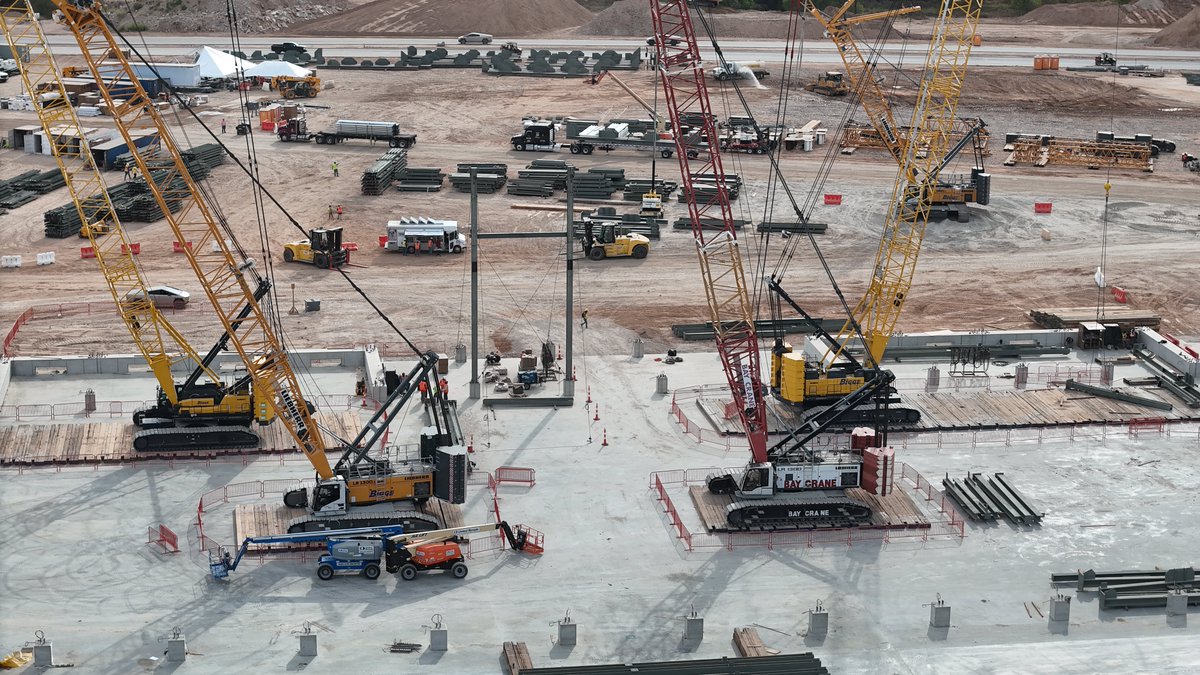
The Advanced Technology Chip Fabrication facility at Giga Texas — known as Terafab — has officially entered its vertical assembly phase. Aerial footage captured October 1st shows the first steel columns now standing, seven large cranes positioned across the site, and large sections of the thick, pier-reinforced foundation already poured. The pace signals Tesla intends to move fast from slab to structure.

From Groundbreaking to Steel in Five Months
Tesla broke ground on the ATCF prototype research fab on April 22, 2026 — just five months ago — at the North Campus of Giga Texas in Austin. Elon Musk had officially unveiled the Terafab project a month earlier, on March 21, 2026, framing it as a joint effort involving Tesla, SpaceX, and xAI, with Intel participating as a foundry partner. The initial capital commitment for the North Campus research facility stands at $3 billion, according to public filings.
Five months from groundbreaking to first structural steel is a brisk pace for a chip fabrication facility — a building category that typically demands extraordinarily precise foundations due to the vibration sensitivity of semiconductor manufacturing equipment. The thick, pier-reinforced slab visible in the footage is consistent with that requirement: chip fabs need foundations engineered to sub-micron stability standards, which is why the foundation pour itself represents a substantial portion of early-phase construction time.
Seven Cranes Is Not a Subtle Signal
The presence of seven large cranes simultaneously on site is worth noting beyond the visual spectacle. Crane count is a rough but reliable proxy for how many parallel work fronts a construction team is running. A single large industrial building might use one or two cranes sequentially. Seven suggests Tesla's construction team is erecting steel across multiple sections of the structure at the same time — a deliberate compression of the schedule rather than a sequential build-out.
That approach mirrors how Tesla has built Gigafactories: aggressive parallelization, accepting some coordination complexity in exchange for a faster path to operational status. If the ATCF follows a similar construction rhythm, the steel frame could be substantially complete well before mid-2027.
Why This Facility Matters Beyond Austin
The North Campus research fab is explicitly a prototype and development facility — the permanent, full-scale production fab is planned for Grimes County, Texas. What gets proven at the Austin site informs the design and process flows for the larger plant. That makes the pace of the research fab's construction directly relevant to the timeline of the production facility: the sooner the research fab is operational, the sooner Tesla, SpaceX, and xAI can begin qualifying processes for the Grimes County build.
The strategic logic behind Terafab has been consistent since the March announcement: the three companies collectively consume enormous quantities of advanced AI and power semiconductors, and domestic chip fabrication reduces dependence on overseas supply chains that proved fragile during the 2021–2023 chip shortage. Intel's involvement as a foundry partner adds process expertise to what would otherwise be a first-time fab operator.
What to Watch Next
Vertical steel assembly on a building this technically demanding typically proceeds in phases: structural frame first, then the building envelope (roof and walls), then the extraordinarily complex mechanical, electrical, and plumbing systems that chip fabs require — cleanroom HVAC alone can represent 40% of a fab's construction cost. The steel going up now is the visible, photogenic part. The harder, less telegenic work follows.
Joe Tegtmeyer, who has tracked Giga Texas construction from the earliest site prep, characterized the expected vertical assembly speed as rapid — and the crane deployment on site backs that read. The next meaningful visual milestone will be the steel frame reaching roof height, at which point the building's footprint and scale will become fully apparent from aerial observation. Given the pace so far, that moment may arrive sooner than most industry watchers anticipated when Tesla first announced the project six months ago.
Related Gear
Gear up your Tesla with tested, custom-fit BASENOR accessories — shop Tesla accessories →
Sources & reporting notes
The links below identify the material source records used for this report.
- @JoeTegtmeyer on X (2026-10-01T11:58:57.000Z) — Direct source
Source links are preserved as published or accessed. See our editorial standards and corrections policy.
The BASENOR Editorial Desk covers Tesla, SpaceX, and related technology, curating reporting from primary sources — official accounts, regulatory filings, and software release data. Every article passes source-record and fact-checking review before publication. About the newsroom.
This report was curated by the BASENOR Editorial Desk from the sources listed above. Read our editorial standards or email editorial@basenor.com to report an error.