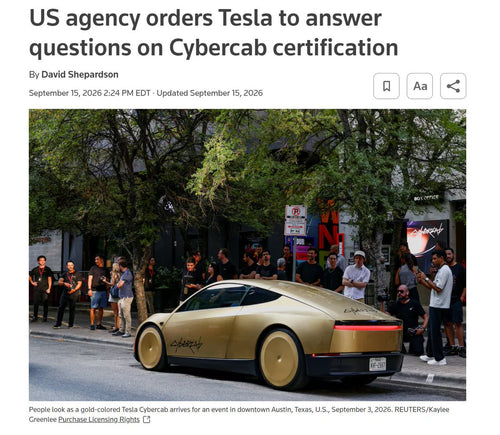
The Giga Texas test track rarely sits idle these days, but September 30 brought a particularly telling snapshot: a Model YL working the rough road section while a fleet of Cybercabs split time between those same punishing lanes and the large oval. Aerial observer Joe Tegtmeyer captured the action on video, and the details are worth unpacking.

1. The Cybercab fleet at Giga Texas has grown fast
What started as a handful of test units has become a genuine fleet operation. According to previous reporting, 26 Cybercabs were observed on the track as recently as September 16 — and by September 22, Tesla's Austin robotaxi fleet had officially reached 67 vehicles. Today's session adds to a pattern of near-daily validation runs, suggesting the program is well past early-stage prototype testing and into systematic durability and performance verification.
2. Rough road testing is deliberate — and significant
It would be easy to dismiss "rough road laps" as routine, but for an autonomous vehicle that will carry paying passengers, suspension tuning and sensor calibration over broken surfaces are critical safety gates. The fact that Cybercabs are sharing the rough road section with the Model YL — a vehicle specifically noted for its comfort-tuned suspension — suggests Tesla is running parallel validation programs on the same surface simultaneously, an efficient use of track time that points to a compressed timeline.
3. The oval is being used for high-speed characterization
While some Cybercabs ground through the rough road lanes, others were observed "speeding around the large oval," per Tegtmeyer's account. High-speed oval work typically covers stability at highway speeds, emergency braking distances, and FSD behavior under sustained velocity — the kind of testing that doesn't make headlines but directly determines whether a robotaxi can safely handle Austin's freeways. Seeing both test profiles running concurrently indicates the program is covering a broad envelope in a single session.
4. The Model YL's presence signals production ramp confidence
The Model YL is no longer a pre-production curiosity. According to previous reports, Tesla began assigning VINs to U.S. customers on September 12, with first deliveries confirmed by September 17. The long-wheelbase six-seater — 150mm longer wheelbase, 2-2-2 seating, 16-inch central screen, and an EPA-rated range of approximately 327 miles — is now a shipping product. Continued track work at this stage typically focuses on quality verification of production-spec builds rather than development validation, which is a meaningful distinction.
5. Infrastructure is being built to match the testing pace
The activity on track doesn't exist in isolation. Superchargers are being installed at the Test Track Operations Center specifically to support the growing number of Cybercabs cycling through validation. That kind of permanent infrastructure investment isn't made for a short-term test program — it reflects Tesla treating the Austin facility as an ongoing operational hub for both robotaxi preparation and vehicle production sign-off. The charging buildout is arguably the quietest but most telling signal of how serious this program has become.
Taken together, today's session at Giga Texas reads less like a development milestone and more like a maturing operation running on a production schedule. The Cybercab fleet is growing, the infrastructure is catching up, and the Model YL is transitioning from test track to customer driveways. The pace of activity at the oval suggests the next significant update won't be long in coming.
🚕 Following the Robotaxi rollout? See every operating city, launch date and announced market in our Tesla Robotaxi Tracker.
Related Gear
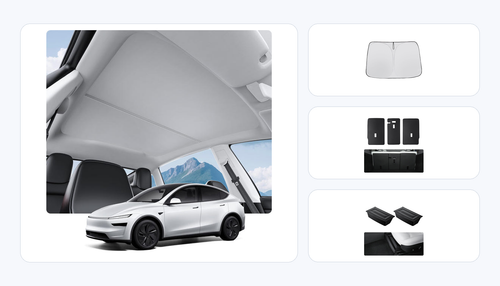
Gear up your Model Y with tested, custom-fit BASENOR accessories — shop Model Y accessories →
Sources & reporting notes
The links below identify the material source records used for this report.
- @JoeTegtmeyer on X (2026-09-30T16:48:14.000Z) — Direct source
Source links are preserved as published or accessed. See our editorial standards and corrections policy.
The BASENOR Editorial Desk covers Tesla, SpaceX, and related technology, curating reporting from primary sources — official accounts, regulatory filings, and software release data. Every article passes source-record and fact-checking review before publication. About the newsroom.
This report was curated by the BASENOR Editorial Desk from the sources listed above. Read our editorial standards or email editorial@basenor.com to report an error.